The ECB-Fed Rate Differential: the Driver of EUR/USD

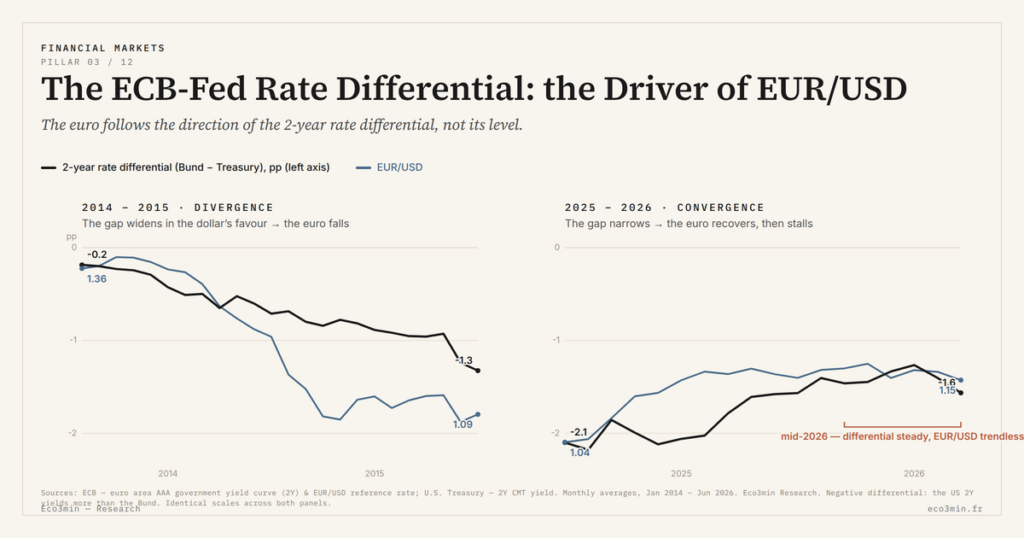
The rate differential between the ECB and the Fed is the first-order driver of EUR/USD. But it is its expected direction, read on the two-year segment, that imprints the move, not the level of the observed gap.
This satellite isolates that driver and details its mechanics: the two levels of reading, the role of surprise, transmission through the risk premium, and the June 2026 illustration, without treating the dollar as a subject, only as a leg of the gap.
1. Two readings of the differential: policy rates and the two-year segment
The differential is read first at the level of policy rates. In June 2026, the ECB deposit rate stands at 2.25% after the 11 June hike, while the Federal Reserve holds its federal funds range at 3.50%–3.75%. The policy gap is roughly 1.4 percentage points in the dollar’s favour. This snapshot is accurate but uninformative about direction: the same gap is compatible with a rising euro and with a falling one. This satellite extends the general decomposition set out in the framework explaining why the euro moves against the dollar, focusing on this first order alone.
The useful reading sits at the level of two-year market rates: the German Bund yield against the US Treasury. This segment aggregates monetary-policy expectations over the horizon where most of the divergence plays out. It moves ahead of decisions, as soon as the market re-prices each central bank’s likely path. When the German two-year rises faster than its US equivalent, the euro tends to appreciate; in the opposite case, it gives way. The policy rate sets the starting point, the two-year tells its expected dynamics. On the practical follow-up, see the upcoming ECB rate-decision dates.
The difference between the two readings is not incidental. A policy gap unfavourable to the euro, but narrowing in expectations because the Fed is approaching the end of its cycle, is in fact supportive for the single currency. Conversely, a favourable gap eroding in expectations withdraws its support. Reading the policy level alone, without the two-year segment, leads to confusing the state of the driver with its direction.
2. Why direction beats level
The central principle is that EUR/USD reacts to the expected change in the differential, not to its level. This follows from how markets incorporate information. At any moment, the level of the rate gap is already known and embedded in the price; it therefore no longer holds explanatory power for the move to come. What shifts the exchange rate is the arrival of information that alters the expected path of one or other of the short rates.
Concretely, the driver activates when the market revises its expectations: a surprising inflation print, a central banker’s message harsher or softer than anticipated, an unexpected activity reading. These revisions move the two-year, and with it the pair. The level of the gap, meanwhile, can stay identical while the expected direction flips. That is why two periods showing the same policy differential can experience opposite currency moves: the driver is not in the number, it is in its derivative.
Central-bank communication plays a decisive role here, sometimes more than the decisions themselves. Guidance given in advance shifts the expected differential without any rate changing immediately: it is enough for the market to adjust its expected path. That is why a meeting can move the pair while the rate is left unchanged, and why, conversely, a perfectly telegraphed hike passes almost unnoticed. The exchange rate reacts to the shift in the curve of expectations, which forms as much in words as in deeds. Each of those shifts is pinned to a dated decision, hold or move, in the ECB’s full run of rate decisions since 1999.
The differential acts on the currency through two joint channels. The first is portfolio flows: at comparable risk, global savings move toward the highest-yielding assets, supporting demand for the corresponding currency. The second runs through expectations, already described: it is these, not the instantaneous yield, that steer allocation decisions.
A third element modulates the whole: the currency risk premium. The theory of uncovered interest parity predicts that in equilibrium the yield gap should be offset by an expected depreciation of the high-yield currency, with no systematic gain. In practice, this relationship is regularly violated in the short run, because investors demand compensation for bearing a currency’s risk. This premium fluctuates with global risk appetite and explains why the differential does not transmit mechanically: the same rate gap does not have the same effect depending on whether risk appetite is high or fading. The differential also feeds entire strategies, and broad dollar swings sit on the other side of the same gap, a dynamic visible through broad dollar strength as the other leg of the relationship.
The choice of the two-year segment is not arbitrary. The ten-year yield, often cited, is a poorer indicator of the differential relevant to the exchange rate: it embeds term premia and growth prospects that dilute the monetary-policy signal. The two-year, by contrast, is almost entirely governed by the expected path of policy rates over the horizon where divergence plays out. It is the maturity that maximises monetary information content while minimising the noise of other factors, which makes it the reference proxy for reading the EUR/USD driver.
4. The June 2026 configuration: a differential without divergence
The mid-2026 context illustrates the distinction between level and direction almost pedagogically. The policy gap is clearly in the dollar’s favour, at around 1.4 points. Yet the pair trades in a narrow range around 1.14, with no marked trend. The reason lies in direction: both central banks lean the same way. The ECB raised rates in June and the market prices a high probability of a hold at its next meeting, while leaving open a hike before year-end. The Fed held its range and lifted the median projection of its members for end-2026 to 3.8%, signalling a hawkish bias. The euro-area policy benchmark can be tracked through the ECB deposit rate series.
The result is near-parallelism: both expected paths move in the same direction, so the expected gap neither widens nor narrows materially. Without a directional change in the differential, the first-order driver imprints no trend, and the pair drifts on second-order forces and positioning. It is the exact opposite of the great divergence of 2014–2015, when the ECB was easing while the Fed prepared to tighten, and the euro fell by about a quarter under the sole effect of the direction gap.
One often believes that a rate hike mechanically supports the currency. This is false when the hike was anticipated: already embedded in the price, it does not move it. Worse, a hike paired with cautious guidance on what follows can weaken the currency, because the market revises down the path of future rates. Only the surprise relative to what was expected matters.
5. Reading the differential in practice
The operational reading rests on two accessible instruments. The first is the two-year Bund-Treasury yield gap, to be followed in its change rather than its level: it is what condenses the expected direction of the driver. The second is the money market, which allows an implied probability to be extracted for each central-bank meeting. At the end of June 2026, these instruments assigned roughly 89% probability to the ECB holding its deposit rate at its July meeting, while the Fed’s median projection placed its rate above the prevailing level. This dual reading gives, at a point in time, the state of the expected direction on both sides.
These implied probabilities deserve careful interpretation. They are not forecasts but a snapshot of market expectations, and they shift continuously as new data arrive, sometimes sharply within a single intermeeting period. Their value is comparative: a probability that drifts from one reading to the next signals that the expected path, and therefore the differential, is being re-priced, which is precisely the variable that moves the pair. Read as a level, they say little; read as a change, they track the derivative of the driver in close to real time.
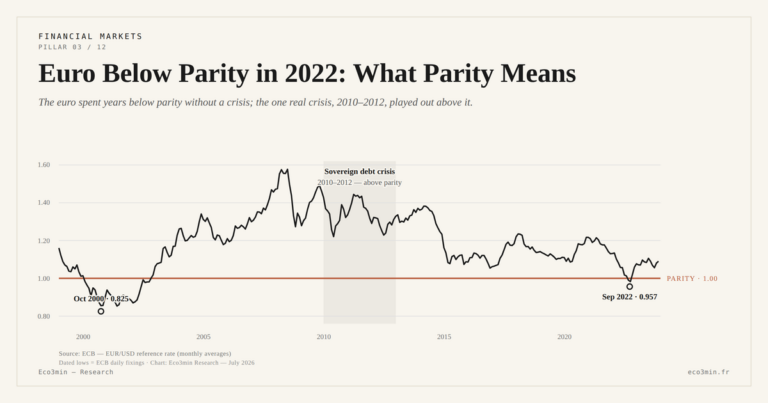
This reading has limits worth keeping in mind. The differential does not explain everything: a residual remains, attributable to the euro’s own forces and to the risk premium, which grows over short horizons. The driver’s weight also varies by regime: it dominates in periods of clear divergence, it fades when policies converge, as in mid-2026. To place this driver among the others and understand, for instance, how it combined with an energy shock during the euro slipping under parity in 2022, the general framework remains the reference. The regimes of the foreign exchange market, and the place of the differential among the determinants of the exchange rate, are also presented in the sub-pillar devoted to the foreign exchange market and its regimes.
Conclusion
The ECB-Fed differential is the first order of EUR/USD, but it is not read in the level of the gap: it is read in its expected direction, on the two-year segment, modulated by a variable risk premium. The June 2026 configuration, where a gap favourable to the dollar produces no trend for want of directional divergence, is its clearest illustration. Understanding this driver means following the derivative of the differential rather than its amount, and recognising the moments when converging policies strip it of its directional power. On the American side, following that derivative starts from the raw series of decisions, and every FOMC rate decision since 1990, vote by vote is that series.
Last updated — 19 September 2026
Disclaimer – Financial Information: The analyses, commentary, and content published on eco3min.fr are provided for informational and educational purposes only. They do not constitute investment advice or a solicitation to buy or sell financial instruments. Past performance is not indicative of future results. All investment decisions involve risk and are the sole responsibility of the reader.
Read next
Full pillar →Euro Below Parity in 2022: What Parity Means
In September 2022, the euro fell below parity with the dollar, to around 0.95, a low not seen…
Eurozone Fragmentation: Sovereign Spreads and the Euro
The euro is issued by a monetary union without a complete fiscal union: twenty-one sovereign debts coexist under…
The Euro’s Energy Import Bill: the Gas Shock and the Currency
In 2022, the surge in gas prices turned the euro area's historic current-account surplus into a deficit and…