Financial Discipline: Why Regularity Outweighs Optimisation
Compound interest depends on the continuity of the compounding base. Financial discipline acts as a structural form of inertia, far more decisive over long horizons than the one-off optimisation of returns.

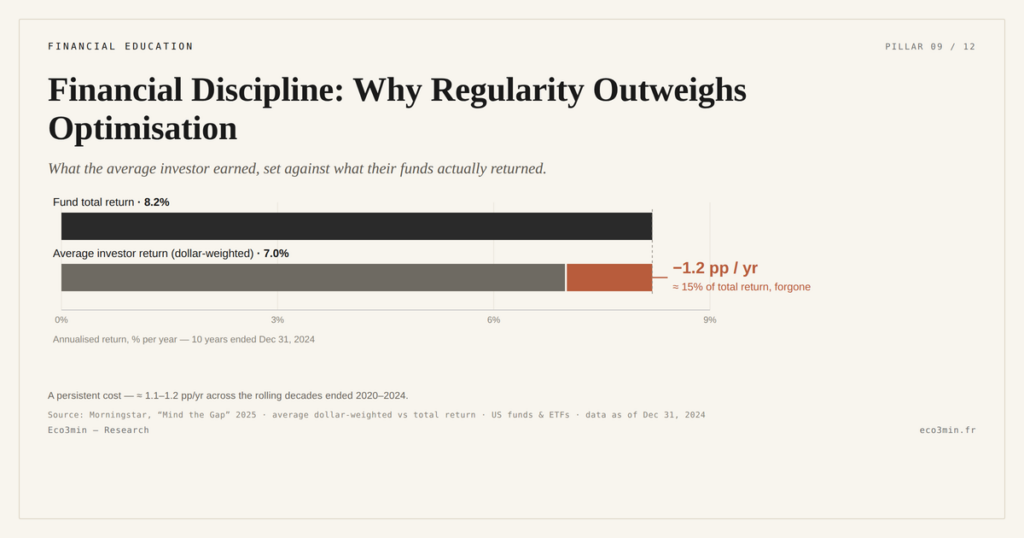
Analysis of the role of regularity and discipline in cumulative effects, independent of the search for maximum return.
TL;DR
In compound systems, the regularity of contributions shapes the cumulative trajectory more than one-off return optimisation, because every interruption shrinks the base on which future compounding operates.
- Discipline works as a form of inertia: it smooths entry points and keeps the compounding base continuous, reducing dependence on discretionary timing decisions.
- A prolonged interruption, even temporary, durably alters the trajectory, because compound interest amplifies behavioural discontinuities.
- The dispersion of contributions and the interruption rate act as readable signals; past a certain threshold of interrupted flows, the cumulative effect weakens rapidly.
The compound interest mechanism rests on a simple but demanding rule: each period builds entirely on the previous one. Within this framework, the regularity of contributions and the consistency of behaviour become structural variables, well beyond the one-off optimisation of returns. This point is often underestimated, because it cannot be read in aggregate figures, but in the continuity of the process. A related perspective: our note on everyday financial trade-offs across economic regimes.
Unlike a reading focused on annual performance, discipline acts as a positive form of inertia. It does not create an immediate advantage, but stabilises the trajectory over time by reducing exposure to behavioural disruptions that mechanically degrade compounding.
Discipline as a discreet economic mechanism
Financial regularity is not an abstract virtue. It constitutes a precise micro-economic mechanism: smoothing of entry points, continuity of the compounding base, reduced dependence on discretionary decisions. Each regular contribution integrates into the compounding chain without depending on a short-term arbitrage.
In a volatile environment, this inertia becomes decisive. A prolonged interruption, even temporary, durably alters the cumulative trajectory. Conversely, the mechanical repetition of the same financial gesture produces a silent stacking effect, rarely visible in return comparisons. That stacking has a closed form: each payment compounds over its own remaining horizon, summed by the annuity term added to the compounded opening balance.
What dominant readings underestimate
Part of the consensus continues to favour return optimisation as the central variable, assuming that behaviours adjust naturally around this parameter. The implicit scenario is one of agents capable of entering and exiting with discipline, depending on perceived opportunities.
This reading misses a key point: compound interest amplifies behavioural discontinuities. Each break in regularity reduces the surface on which future compounding can operate. The analysis diverges here by treating discipline not as a psychological constraint, but as a structural condition for economic continuity.
Disciplined projection and trajectory visibility
Detailed projection tools make this mechanism more legible. By visualising a complete trajectory rather than a final result, they highlight the gap between a regular approach and an opportunistic one. This is precisely what a compound interest calculator shows: the trajectory depends less on isolated peaks than on the consistency of the process.
This trajectory-based reading helps explain why strategies perceived as unambitious produce robust cumulative results, while approaches that look more optimised on paper remain fragile in the face of behavioural variations.
Why this dimension is becoming more visible now
Since the normalisation of interest rates and the return of more persistent volatility, gaps in trajectory materialise more rapidly. This acceleration of trajectory gaps connects to our analysis of the sequence of decisions in financial education. Periods of inaction or interrupted flows leave durable marks on compounding, where a smoother environment would have masked them.
This context makes financial discipline more economically observable: it does not protect against volatility, but it prevents volatility from fragmenting the cumulative process.
What readers are really trying to understand
Behind the notion of discipline lies a more pragmatic question: why do apparently modest trajectories remain coherent over time, while more sophisticated approaches degrade. The issue is not to maximise a one-off return, but to preserve the continuity of the mechanism over a long horizon. When continuity breaks, it usually breaks at the point where an immediate arbitrage outweighs a distant one — the asymmetry at the centre of the present bias in saving decisions.
Variables that could invalidate this reading
This analysis assumes an operational capacity to maintain regularity over time. Liquidity shocks, income constraints or prolonged macroeconomic disruptions can interrupt the process. Likewise, unstable inflation or tax changes can alter the real efficiency of this positive inertia.
Equating financial discipline with low ambition. This confusion is misleading, because discipline does not act on the level of return, but on the continuity of the compounding base that conditions the cumulative effect.
Useful indicators to read discipline within the trajectory
A simple indicator is to observe the dispersion of contributions over time. The more regular the flows, the less the trajectory depends on specific entry points. The interruption rate of contributions is also a key signal: beyond a certain threshold, the cumulative effect rapidly weakens.
In a broader reading of educational mechanisms linked to personal finance, this approach fits within the behavioural biases analysed on the Financial Education pillar page.
This is not the most commented scenario, but financial discipline remains a silent factor of robustness. This is unpacked carefully in this dedicated note on rebalancing discipline returns. As long as trajectories remain subject to shocks and irregular cycles, this discreet inertia warrants particular attention in any long-term reading.
Last updated — 13 August 2026
Disclaimer – Financial Information: The analyses, commentary, and content published on eco3min.fr are provided for informational and educational purposes only. They do not constitute investment advice or a solicitation to buy or sell financial instruments. Past performance is not indicative of future results. All investment decisions involve risk and are the sole responsibility of the reader.
Read next
Full pillar →Series I and EE Savings Bonds: Locked Formulas in a Moving Rate World
US savings bonds lock a rate formula at the moment you buy them, for the life of the…
Where the Livret A’s Money Goes: The Caisse des Dépôts Circuit and Social-Housing Finance
The savings held on Livret A accounts do not sit idle. A regulation-set share is centralised at the…
France’s LEP vs the Livret A: A Means-Tested Higher Rate, Explained
France’s Livret d’épargne populaire is often described as "the Livret A, only better". The description misleads: the LEP…