Financial Literacy 2026: What Has Actually Changed
Bitcoin in institutional portfolios, ETFs as the dominant retail wrapper, durably positive rates and AI in asset management: in 2026, financial literacy has become a vital skill. The fault line now separates those who decode systemic dynamics from those who content themselves with simplified interfaces.

Markets are no longer reserved for “insiders.” In 2026, with Bitcoin now fully integrated into institutional portfolios, ETFs continuing to attract massive flows, interest rates anchored in positive territory, and AI permeating asset management, financial literacy has become a vital skill — on a par with using a computer. Those who understand current mechanisms build a durable lead; the rest are taken along for the ride.
TL;DR
In 2026 the divide in finance separates those who grasp systemic mechanisms from those who mistake easy access for mastery, as ETFs and Bitcoin draw the 20–45 cohort into markets.
- Spot Bitcoin ETFs have anchored crypto as a tactical building block inside some institutional allocations, yet structural volatility stays elevated — an institutionalized asset is not a stabilized one.
- Broad ETFs now capture much of global equity flows but concentrate them on the same large-cap names, raising cross-asset correlation and flow dependence that can amplify herding during corrections.
- Interest rates now sit structurally above their 2010s range, restoring a clear risk/return hierarchy, while green and ESG products enter a maturity phase under tighter transparency rules.
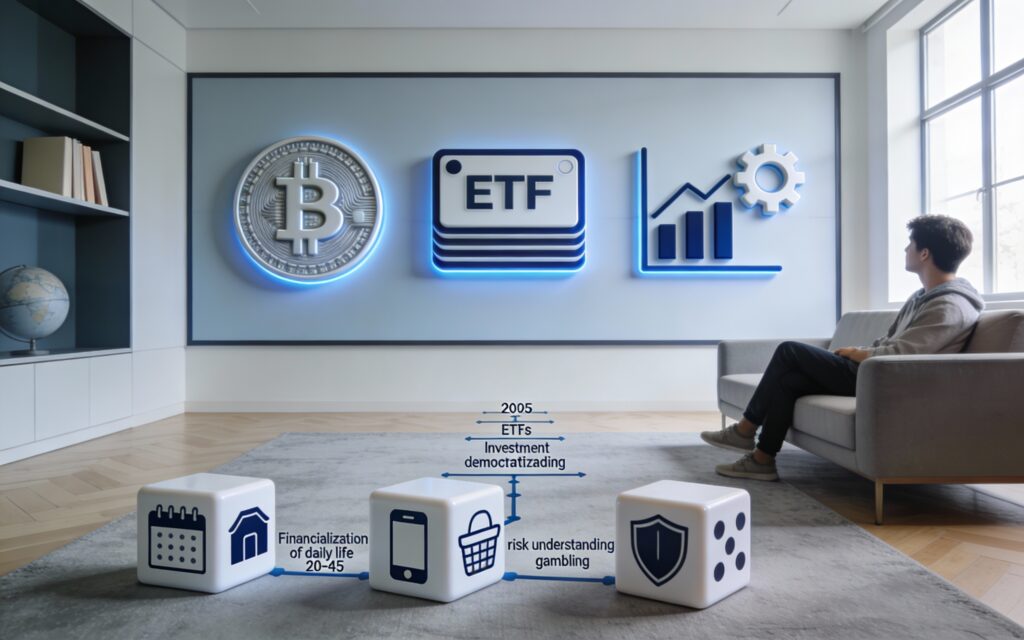
Behind the noise of rising and falling prices, three structural shifts stand out: the durable financialization of daily life for the 20–45 cohort, the structural normalization of investing (via apps, ETFs and recurring contributions), and a new fault line between those who grasp systemic risks and those who confuse accessibility with mastery. The point is no longer simply to “place one’s money,” but to decode a system that has changed regime — and one that will not be forgiving toward the inattentive. Related analysis: our reference page on how households weigh financial decisions through the cycle.
In this now-established financialization, understanding fundamental mechanisms is essential to avoid mistaking ease of access for rigorous risk management: that is precisely the purpose of financial education, which structures the reading of markets, identifies behavioral biases, and supports informed decisions in a financial-product universe of growing complexity.
Key Trends This Week
1. Bitcoin and crypto: from alternative asset to tactical building block
In 2026, Bitcoin is no longer purely a speculative bet: for parts of the institutional landscape, it has become a tactical building block within diversified allocations. Spot Bitcoin ETFs have anchored this normalization in traditional portfolios.
Direct consequence: many retail investors feel legitimized in their exposure, without always factoring in that structural volatility remains elevated. An institutionalized asset is not a stabilized asset. The actual trend behind the normalization is gradual integration — with risks that have not vanished.
2. ETFs: passive management as the dominant norm
The ETF wrapper continues to capture a meaningful share of global flows. For the 20–45 cohort, ETFs have become the standard tool for accessing public equity markets. Lower fees, automatic diversification, automated investing: market entry has never been simpler.
In 2026, the issue is no longer the rise of ETFs but their systemic effects: concentration on the same large-cap names, heightened cross-asset correlation, dependence on flows. This evolving question connects to our framework on the temporal ordering of financial decisions, which examines how the sequencing of choices shapes the trajectory. For the disciplined saver, the ETF is a powerful tool; for the investor without a framework, it can amplify herding moves during corrections.
3. Interest rates: a new durable equilibrium
After the rate-hike shock of recent years, interest rates now move within a more stable regime — but one structurally above the 2010s. Bond products, savings accounts and euro-denominated funds offer more attractive nominal yields, even if inflation still constrains real returns.
The real shift in 2026 is the return of a clear hierarchy between risk and return. Investment trade-offs are again strategic: duration, rate sensitivity, credit quality. Capital has a cost again, and that disciplines the entire system.
4. Green finance and energy transition: from rhetoric to execution
“Green” products and responsible investing (SRI, ESG) are entering a maturity phase. Regulators have tightened transparency requirements, investors are demanding measurable indicators, and companies must demonstrate concrete impact in their energy-transition projects.
For the individual investor, the issue is more analytical than emotional: distinguishing strategies genuinely aligned with the transition from simple marketing repositioning. The transition continues to redirect capital, but within a more structured and selective framework.
In-Depth Analysis: What the Newsflow Reveals
Behind these trends, one observation stands out: finance has durably embedded itself in everyday life, but understanding of the mechanisms remains unevenly distributed. Interfaces are simple; the underlying dynamics — monetary, macroeconomic, regulatory — are not. That is where the central stake of financial literacy in 2026 actually plays out.
Macroeconomically, the dominance of passive management and the relative stabilization of rates are reshaping price formation. Central banks remain decisive: their trade-offs simultaneously influence the valuation of risk assets, credit, real estate and overall risk perception.
Sectorally, the energy transition and AI direct capital flows. Energy infrastructure, grids, storage and AI-driven optimization attract massive investment. By contrast, models heavily exposed to regulatory constraints or carbon costs face rising financing costs.
Immediate Implications for Companies, Investors and Individuals
For individuals (ages 20–45)
- Distinguishing automation from strategy: an automated investment plan operates within a coherent allocation and a clear horizon — without that anchor, it has historically amplified rather than mitigated mistakes.
- Structuring household balance sheets: separating liquid emergency savings, long-horizon allocation (diversified ETFs, bonds), and more volatile pockets (crypto, thematic positions).
- Treating volatility as a permanent feature: apparent stability can mislead; corrections remain inherent to risk assets.
For companies
- Strengthening financial readability: retail investors represent a growing share of indirect flows via ETFs and platforms.
- Aligning strategy with energy constraints: access to capital depends increasingly on the credibility of transition trajectories.
For more advanced investors
- Reassessing allocations in an environment of durably positive rates.
- Monitoring implicit concentration in indices: many broad ETFs remain heavily weighted on a small number of large-cap names.
Weak Signals That Will Matter
Several quieter dynamics could shape the coming months.
- The normalization of AI in asset management: automated allocation tools, portfolio analysis, tax optimization. Accessibility is improving, but understanding remains the differentiator.
- The return of simplified structured products: in a positive-rate environment, “protected” products are proliferating, with mechanisms that are sometimes complex.
- Crypto and ESG regulatory evolution: tighter frameworks, reinforced transparency requirements, standardization of practices.
Outlook: How the Next 3 to 12 Months Could Evolve
Several plausible scenarios are taking shape in 2026.
- Scenario 1: prolonged stability — Moderate growth, relatively stable rates, steady ETF flows. Diversified, disciplined strategies benefit from a predictable environment.
- Scenario 2: renewed volatility — Macroeconomic surprise, geopolitical tension or monetary inflection. Markets correct rapidly; emotional discipline becomes decisive.
- Scenario 3: targeted regulatory tightening — Crypto, financial AI or sustainable finance face new norms. The market becomes more structured at the cost of greater complexity.
Indicators to track: policy-rate trajectories, implied volatility (VIX), net ETF flows, and the evolution of financial and climate regulatory frameworks. The underlying series is published in our VIX index history.
Conclusion
The 2026 fault line no longer separates novices from self-proclaimed experts, but those who grasp systemic dynamics — monetary, financial, regulatory — from those who content themselves with simplified interfaces. Bitcoin, ETFs, rates, sustainable finance, AI: together they form a coherent, demanding and interdependent ecosystem.
The stake remains the same: clarifying objectives, structuring allocations, accepting that return and risk are inseparable, and continuously deepening understanding. The newsflow moves fast; analytical discipline builds a durable advantage.
Sources reviewed: recent economic analyses, 2026 market data, and specialized publications on finance, investing and the energy transition.
Last updated — 12 July 2026
Disclaimer – Financial Information: The analyses, commentary, and content published on eco3min.fr are provided for informational and educational purposes only. They do not constitute investment advice or a solicitation to buy or sell financial instruments. Past performance is not indicative of future results. All investment decisions involve risk and are the sole responsibility of the reader.
Read next
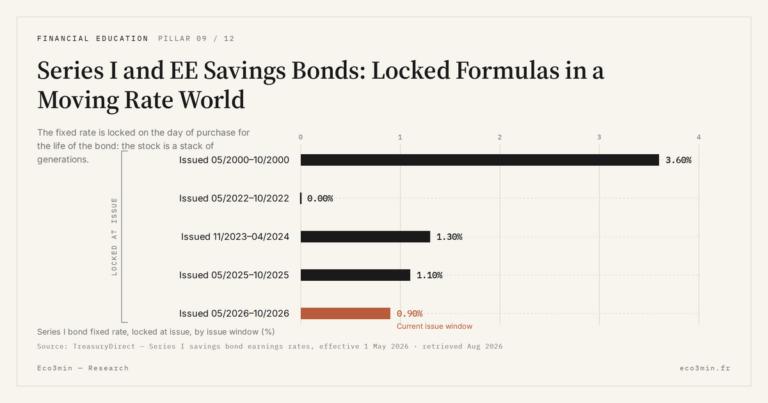
Full pillar →Series I and EE Savings Bonds: Locked Formulas in a Moving Rate World
US savings bonds lock a rate formula at the moment you buy them, for the life of the…
Where the Livret A’s Money Goes: The Caisse des Dépôts Circuit and Social-Housing Finance
The savings held on Livret A accounts do not sit idle. A regulation-set share is centralised at the…
France’s LEP vs the Livret A: A Means-Tested Higher Rate, Explained
France’s Livret d’épargne populaire is often described as "the Livret A, only better". The description misleads: the LEP…