Why Investment Horizon Changes the Meaning of Decisions
Investment horizon acts as a filter that transforms how financial decisions are read. The same choice can appear inconsistent in the short term while remaining coherent over a longer time frame.

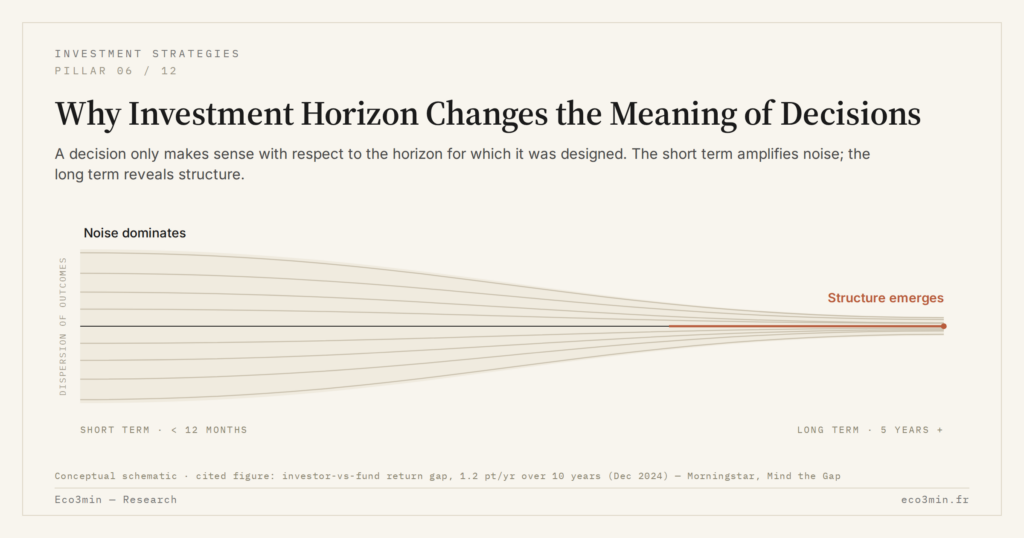
Understanding how the investment horizon modifies the meaning and interpretation of financial decisions over time.
TL;DR
A financial decision carries no absolute meaning; the same choice can look unstable over months yet coherent over years, because the horizon it was built for governs its reading. On the same theme: our breakdown of reading the economic cycle for portfolio positioning.
- Over 2010–2019, annualised volatility explained much of the performance gap below twelve months; beyond five years, macro regimes (inflation, cost of capital, nominal growth) dominate trajectories instead.
- Since 2022, rates held higher for longer have lengthened adjustment lags, so decisions can look inconsistent in the short term while staying compatible with a long-horizon framework.
- Shortening a horizon after disappointing interim results raised cumulative frictions by roughly 0.4 to 1 point per year over 2015–2024, between rotation costs and interpretation errors.
- The common error confuses observation horizon with design horizon, attributing to the choice itself effects that are tied to time rather than to the decision.
The same financial decision can produce opposite effects depending on the duration over which it is evaluated. Time acts as a filter that transforms the reading of economic mechanisms. As the horizon lengthens, certain fluctuations become secondary while other dynamics take precedence. Many continue, however, to judge long-term choices using short-term benchmarks. This truncated reading leads to mistaken interpretations of past decisions. Understanding the role of time allows each decision to be placed back within its strategic logic.
Time as a Variable That Requalifies a Decision
An allocation exposed to volatile assets can appear unstable over a few months while remaining coherent over several years. The mechanism is simple: the short term amplifies noise, while the long term lets structural forces emerge. Part of the consensus continues, however, to evaluate the relevance of a decision based on immediate results, as if the horizon were merely a secondary parameter. This tension between short-term reading and long-term discipline lies at the heart of our study on investment consistency and full-cycle performance.
This reading diverges on a key point: a decision has no absolute economic meaning; it has meaning only with respect to the horizon for which it was designed. This gap explains why ex ante rational choices are often called into question too early.
When the Short Term Distorts the Reading of Mechanisms
Aggregate market data show that, over the 2010–2019 period, annualised volatility explained a significant share of performance differences observed at less than twelve months. Conversely, over horizons longer than five years, macroeconomic regimes — inflation, cost of capital, nominal growth — structure trajectories more strongly.
Judged over too short a horizon, a decision designed to absorb cycles can appear ineffective. Judged over a longer horizon, the same decision regains its coherence. The problem is not the decision but the time frame used to evaluate it.
It is precisely over these long horizons that cumulative mechanisms become readable. The dispersion of results observed in the short term gradually fades in favour of an overall trajectory, where cumulative effects over time play a decisive role in the interpretation of decisions.
Why This Gap Is Becoming More Visible Now
Since 2022, the maintenance of policy rates higher for longer than expected has lengthened economic adjustment lags. Mainstream projections still assume that the effects of decisions diffuse rapidly. Yet, in an environment where the cost of capital remains durably higher than during the previous decade, lagged effects carry more weight.
This time lag explains why some decisions appear inconsistent in the short term while remaining compatible with a long-term strategic framework, as developed in the strategic framework set before performance.
What Many Are Really Trying to Understand
The real question is not so much whether a decision was “good” or “bad,” but whether it is evaluated over the horizon for which it was designed. Behind this inquiry often lies a simpler concern: that of confusing a delay in effect with a judgment error.
A Largely Underestimated Reading Risk
A frequent error consists of shortening the horizon after the fact, in response to disappointing intermediate results. This practice mechanically increases the frequency of adjustments. Over the 2015–2024 period, aggregate estimates suggest that this implicit reduction of the horizon increased cumulative frictions by around 0.4 to 1 point per year depending on the segments observed, between rotation costs and interpretation errors.
This mechanism is close to the one observed when reassuring indicators mask a more fragile dynamic, as in the case of a misleading economic indicator.
Judging a long-term decision based on short-term results. This reading is misleading because it confuses the observation horizon with the design horizon, and attributes to the choice itself effects that are tied to time.
What Horizon Changes in the Macro Reading
In the short term, decisions are dominated by liquidity, flows, and monetary policy expectations. Over the longer term, structural constraints — productivity, demographics, cost of capital — regain the upper hand. A decision can therefore appear contradictory depending on which of these regimes is privileged.
This is not a flaw in the reasoning but a property of time as an economic variable.
Observable Economic Implications
For markets, this confusion fuels excessive rotations and an unstable reading of performance. For companies, it translates into strategic revisions justified by short-term signals. For households, it complicates the understanding of past decisions and accentuates the sense of incoherence.
Within the architecture of investment strategies, the horizon is not a secondary parameter: it conditions the very meaning of decisions.
- A decision only makes sense with respect to the horizon for which it is designed.
- The short term amplifies noise; the long term reveals structural mechanisms.
- Shortening the horizon after the fact increases reading errors and cumulative frictions.
Last updated — 12 July 2026
Disclaimer – Financial Information: The analyses, commentary, and content published on eco3min.fr are provided for informational and educational purposes only. They do not constitute investment advice or a solicitation to buy or sell financial instruments. Past performance is not indicative of future results. All investment decisions involve risk and are the sole responsibility of the reader.
Read next
Full pillar →Beneficiary Designations, the Step-Up in Basis, and the 10-Year Rule: How US Accounts Transfer at Death
At death, most US financial accounts pass outside the will, straight to a named beneficiary, under tax rules…
The Fee Stack in Variable Annuities: M&E Charges, Riders, and Subaccount Costs
A variable annuity does not carry one fee, but a stack of them. Mortality and expense charges, subaccount…
The Conventional 401(k)-Match-First Funding Order: Where It Comes From, How It Works
The question of what order to fund accounts in usually draws a fixed list, presented as a rule…