Signal-Less Markets: When Stable Indices Hide Rising Dispersion Risk
Stable indices, fading conviction: late-cycle markets enter signal-less phases when contradictory macro forces neutralise at the aggregate level. Risk does not vanish — it migrates from indices to firm-level dispersion. A framework for reading the regime, not predicting the move.

A signal-less phase is a regime in which the standard market indicators — indices, implied volatility, credit spreads, term premia, macro surprise indices — stop functioning as reliable proxies for the underlying level of risk. The reason is not a data outage but informational saturation: several macro forces operate at once (slowing growth, restrictive monetary stance, conditional liquidity, late-cycle dispersion) and partially neutralise each other at the aggregate level. The result is a paradox that defines late-cycle markets: stable indices on top, widening fractures below. Reading that quiet as normalisation is the classic error; the regime is closer to a filter that selects rather than to a market that rests.
TL;DR
Indices can stay calm while balance sheets fracture beneath them, the defining paradox of a signal-less regime where aggregate indicators stop tracking firm-level risk.
- The BIS Annual Economic Report 2025 and the IMF's October 2025 Global Financial Stability Report both document a widening gap between calm aggregate volatility and rising firm-level risk.
- Rising real policy rates act as a selective filter, widening the distance between robust and vulnerable business models instead of producing a uniform correction.
- Index stability rests on concentration: a handful of large-cap names with predictable cash flows hold the level up while market-cap weighting masks the weakening beneath.
- The regime is not transitory; in past cycles the equivalent state ran 12 to 24 months before a macro resolution or a microeconomic stress event redirected it.
This kind of regime emerges from a market dynamic in which expectations neutralise rather than align: contradictory macro signals coexist long enough that no directional thesis dominates the index level.
The institutional groundwork for this reading is found in the Bank for International Settlements’ recurring work on late-cycle dispersion (BIS Annual Economic Report 2025, chapter on financial vulnerabilities) and in the IMF Global Financial Stability Report of October 2025, both of which document a widening gap between aggregate index volatility and idiosyncratic firm-level risk.
When markets look readable, even though they no longer are
Some market sequences create the impression of clarity. Indices trade in tight ranges, the VIX drifts below its long-run average, dominant narratives appear anchored, and the major asset classes seem to point in compatible directions. Our VIX implied-volatility series compiles the full historical series. Below that surface, something else is happening. Not a single indicator breaks; the market’s capacity to produce usable signals erodes.
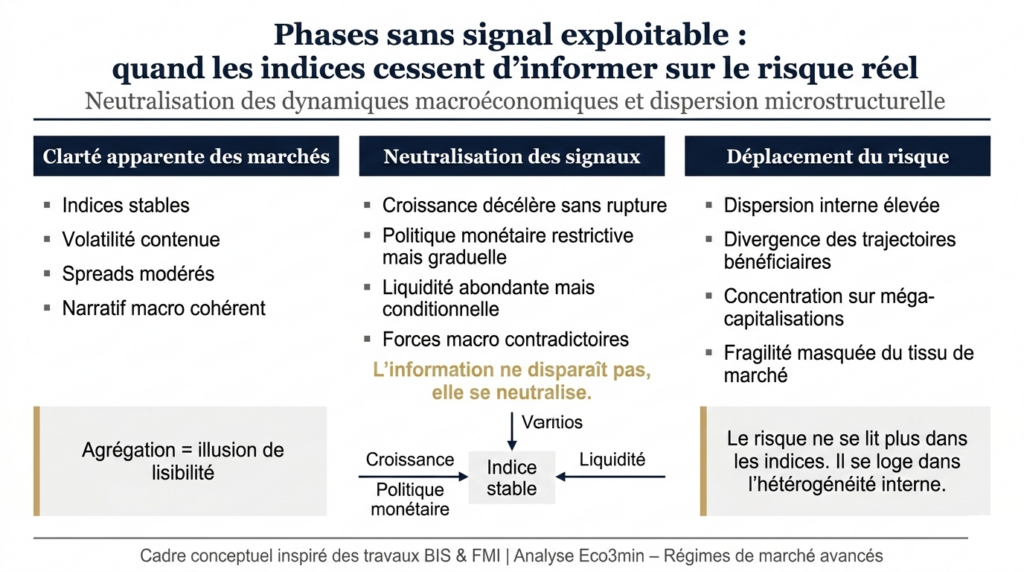
These sequences belong neither to panic nor to euphoria. They sit in a quieter regime, often misread, in which aggregate indicators progressively lose informational content about the real level of risk. The market does not become unreadable because volatility rises; it becomes unreadable because the signal is saturated. The data are still produced, but they cancel out.
This phenomenon, rarely named as such, is a structural indicator in its own right. It does not announce a reversal, but it tells the analyst a great deal about the regime in which capital is being allocated. Naming it makes internal dispersion, cycle shifts, and the boundaries of conventional indicator-based approaches easier to handle.
This framework extends the approach developed on the Financial Markets pillar, which is built around the idea that index observation alone misses the underlying mechanics.
Stable indices do not signal a healthy market; they signal that risk has migrated below the aggregate.
The aggregation problem
Modern markets lean heavily on synthetic indicators. Equity indices, implied volatility, credit spreads, long-term rates, and macro surprise indices compress a vast amount of information into readable signals. That aggregation works well in early and mid-cycle phases, when dynamics remain comparatively homogeneous and a dominant macro force pushes most assets in the same direction.
As the cycle matures, the same aggregation becomes a source of illusion. Averages mask a widening internal fracture. Assets stop responding uniformly to common impulses. Some firms absorb a higher cost of capital without trouble; others do not. Some earnings paths remain legible; others turn erratic. The index keeps printing a stable number.
The problem is not that the indicators are wrong; it is that they are incomplete. They keep measuring what they were designed to measure, even though the object of observation has shifted. The market is no longer governed by a dominant factor but by a combination of partially antagonistic forces that cancel out at the aggregate level.
Signal disappearance versus statistical noise
A signal-less phase is not the absence of information. It is information saturation. Signals still exist; their coherence fades. Indicators stop converging and start sending ambiguous, sometimes contradictory messages depending on the angle of analysis.
The distinction with statistical noise matters. Noise is short-term agitation: erratic oscillations around a mean. The disappearance of signal unfolds over months and quarters. Historical relationships between variables distort without fully breaking down. Correlations do not collapse; they become unstable. That instability is itself the signal.
What this phenomenon actually measures is a shift in the decision-making architecture of markets. That regime shift in how expectations form is the subject of our sub-pillar on market expectations and sentiment. Trade-offs become more complex, the established hierarchy among factors loses sharpness, and risk analysis requires more granularity.
The loss of readability at the aggregate level does not mean risk has vanished. It has moved. When indices stop emitting a clear signal, information recomposes at a finer scale: the dispersion of performance across firms. In late-cycle phases, the market as a whole says less than the widening gaps between individual trajectories — a mechanism analysed in our piece on equity performance dispersion and the increasingly selective nature of the market.
- It does not provide a buy or sell signal.
- It does not predict a crash or reversal.
- It does not replace valuation analysis.
What the aggregate can no longer reflect
In these phases, the aggregate market no longer captures the dispersion of risk. It does not reflect the heterogeneity of balance sheets, the divergence of profitability paths, or the differential sensitivity to the cost of capital. It projects a stabilised image of a fragmenting whole.
Why this regime emerges late in the cycle
Signal-less phases typically arrive when the macro cycle matures. Growth slows without collapsing, monetary policy tightens without immediately triggering a sharp contraction, and the cost of capital stops being neutral.
In that setting, real policy rates become central. Their gradual rise acts as a selective filter. It does not produce a uniform correction; it widens the gap between robust business models and vulnerable ones. The mechanism is documented in detail in the pillar article on real policy rates and the hidden tightening they impose on weaker borrowers.
Liquidity changes character at the same time. It remains abundant at the global level but becomes more conditional. This shift connects to our sub-pillar on systemic risk indicators, where conditional liquidity functions as an early stress marker. Liquidity concentrates in certain market segments and gradually retreats from those perceived as riskier or less transparent. The movement amplifies dispersion without immediately producing systemic stress.
From beta regime to selective regime
Early in a cycle, beta rules. Broad index exposure is usually enough to capture the bulk of available returns. Late in the cycle, that regime fades. Performance becomes idiosyncratic. The market stops rewarding general exposure and starts rewarding the ability to navigate a fragmented environment.
Earnings, dispersion, and microstructure
Corporate earnings are among the clearest readouts of this signal disappearance. Earnings paths stop moving in tandem. Positive and negative surprises offset at the aggregate level even as they reveal growing dispersion at the firm level.
This dynamic is at the heart of the analysis developed in our piece on earnings surprises and what they reveal about the equity cycle. When the dispersion of surprises widens without translating into a directional move in indices, the market has shifted into a regime in which the aggregate signal has been neutralised.
Sector dynamics offer no shelter from this. Even traditionally defensive sectors become heterogeneous. Some firms keep strong earnings visibility; others face mounting competitive, regulatory, or financial pressure. Market-cap weighting reinforces the illusion of stability by overrepresenting dominant names at the expense of the rest of the market.
Why indices can stay stable while the underlying fractures
The apparent stability of indices in these phases rests heavily on concentration effects. A handful of large-cap names with strong balance sheets and predictable cash flows are enough to hold the index up. That stability disguises the gradual weakening of the underlying market fabric.
Reading the regime, not predicting the market
A signal-disappearance regime is neither a market-timing tool nor a crash indicator. It does not allow one to date a turning point or anticipate a sharp correction. Its value sits elsewhere. It provides a framework for understanding the regime in which decisions are taken.
In such an environment, naïve strategies lose effectiveness. Passive exposure remains tied to a growing concentration risk. Systematic approaches built on stable historical relationships become more fragile. Balance-sheet quality, earnings visibility, and financial discipline take on disproportionate weight, both in terms of return dispersion and drawdown behaviour, in the firm-level data documented by the BIS and the IMF for late-2025.
This regime can last. It is not transitory by nature. As long as macro forces continue to neutralise one another without resolving, and as long as the cost of capital keeps filtering without triggering a systemic shock, the market can remain in this intermediate state for several quarters — in past cycles, the equivalent state has spanned 12 to 24 months before either a macro resolution or a microeconomic stress event redirected the regime.
The neutralisation of aggregate signals reflects a regime of high internal dispersion in which risk shifts from indices to microeconomic trajectories.
The takeaway is not directional. It is methodological. When markets stop producing usable signals at the aggregate level, that is not a malfunction. It is information in itself. It indicates that risk can no longer be read in the indices — only in their growing inability to reflect the market’s internal reality.
- Stable indices do not imply a healthy market.
- Aggregate signal neutralised by internal dispersion.
- Risk displaced, not erased.
- Micro-level reading beats aggregate macro reading.
This reading framework fits within a structural approach to financial markets, grounded in observation of dispersion regimes and late-cycle dynamics documented in the institutional literature. Among the structural drivers of dispersion, the inflation regime is one of the most consequential — see the complete guide to inflation regimes and their macro-financial implications.
In these phases, the work is not to predict but to recognise. Not to anticipate the event but to identify the regime. The difference between a surface reading of the market and a structural one often hinges on that ability to spot the absence of signal as a signal of its own.
Last updated — 22 June 2026
Disclaimer – Financial Information: The analyses, commentary, and content published on eco3min.fr are provided for informational and educational purposes only. They do not constitute investment advice or a solicitation to buy or sell financial instruments. Past performance is not indicative of future results. All investment decisions involve risk and are the sole responsibility of the reader.
Read next
Full pillar →Eurozone Fragmentation: Sovereign Spreads and the Euro
The euro is issued by a monetary union without a complete fiscal union: nineteen sovereign debts coexist under…
The Euro’s Energy Import Bill: the Gas Shock and the Currency
In 2022, the surge in gas prices turned the euro area's historic current-account surplus into a deficit and…
The ECB-Fed Rate Differential: the Driver of EUR/USD
The rate differential between the ECB and the Fed is the first-order driver of EUR/USD. But it is…