
Equity Performance Dispersion: Why Markets Turn Selective Late in the Cycle
Headline indices project calm, but underneath, equity performance dispersion is widening sharply. This silent fragmentation has historically signaled cycle maturity, when discrimination supplants the broad lift of accommodative liquidity.

Headline equity indices project a misleading sense of calm. Beneath that smooth surface, the market is undergoing a quiet but profound fragmentation. The performance gap between individual stocks is widening sharply, sketching the contours of an environment where discrimination has come to supplant the collective lift of earlier phases. This rising dispersion ranks among the most revealing indicators of a cycle reaching maturity. Adjacent reading: our breakdown of the drivers of equity market valuation.
TL;DR
Equity performance dispersion, the widening return gap between individual stocks, ranks among the clearest microstructural markers of a maturing cycle, even as headline indices drift sideways.
- In a structurally higher-rate environment, the cost of capital becomes the discriminating criterion, penalizing valuations built on distant cash flows while companies generating solid free cash flow stand apart.
- Cap-weighted indices can stay supported by a handful of mega-caps while equal-weighted indices, small-caps and mid-caps disengage, masking erosion across the broader market.
- Earnings revisions act as the operative barometer: once they tip negative, sectorally or idiosyncratically, dispersion accelerates, historically anticipating index turning points by several months.
Behind the index facade, a market quietly coming apart
Appearances flatter. Headline indices oscillate within tight ranges, a handful of mega-caps trade close to all-time highs, and standard volatility gauges remain remarkably contained. That snapshot, however, conceals a far more uneven reality.
Examining individual trajectories paints a different picture: a small set of stocks captures most of the upside while a growing share of the market drifts lower, sometimes abruptly. This widening divergence (equity performance dispersion) is a characteristic signature of late-cycle phases.
The blind spot of headline indices
The stability projected by the indices conceals a widening gulf between individual names. A handful of leaders carry overall performance while a majority of stocks falls behind. This rising heterogeneity reflects a market that has become deeply discriminating, well before aggregate gauges record any sign of it.
This dispersion is no statistical accident. It reflects a structural shift in how markets function: the move from a regime where the rising tide lifted all boats toward an environment where balance-sheet quality, pricing discipline and the ability to navigate more demanding waters are what matter.
When this dispersion settles in for the long run, it does not necessarily produce a clear directional signal. The coexistence of radically opposed trajectories tends to scramble information at the aggregate level, leaving traditional indicators progressively less useful. This regime shift is examined in depth in our analysis of market phases without an exploitable signal, which decodes how an abundance of microeconomic information can paradoxically neutralize the broader macro signal.
Performance dispersion: what exactly are we measuring?
Dispersion measures the spread of returns across the components of a given investment universe over a defined period. The wider those spreads, the more the market is described as « dispersed ».
During phases of broad-based expansion, dispersion remains contained: most companies benefit from a supportive macro backdrop and capital flows redistribute without much discrimination. As the cycle matures, individual destinies diverge.
In practice, this shift implies that:
- performance increasingly hinges on each company’s specific characteristics;
- vulnerable business models are quickly penalized by the market;
- aggregate indices obscure a growing heterogeneity of underlying situations.
Dispersion thus operates more as a window into market structure than as a directional indicator.
The phenomenon is a recurring theme of the Bank for International Settlements (Quarterly Review) and the IMF (Global Financial Stability Report) in their work on performance concentration and index investing.
The drivers of late-cycle dispersion
The fading of universal macro support
Early and mid-cycle, economic growth, accommodative monetary policy and abundant liquidity combine into an environment that lifts most companies along a relatively homogeneous trajectory. Performance gaps stay marginal.
Once those favorable conditions dissipate (rising real rates, monetary normalization, softening demand) the market stops behaving as a unified whole. Financial robustness, pricing power and the visibility of future earnings become decisive.
The cost of capital reasserts itself as the arbiter
In an environment of structurally higher rates, the cost of capital reasserts itself as the discriminating criterion. Companies whose valuations rest on distant cash-flow projections or on easy access to financing are penalized, while those able to generate solid free cash flow stand out.
This mechanism explains why dispersion widens even as headline indices appear to drift sideways: the market is conducting a methodical, silent sorting.
Earnings revisions, the new barometer
Performance dispersion maintains a close link with corporate earnings dynamics. What matters is no longer the absolute level of profits but their trajectory and the successive adjustments to expectations. This signal has historically anticipated index turning points by several months, as detailed in our analysis of earnings revisions and equity market reactions.
The mechanisms detailed in our analysis of earnings surprises as a leading indicator of the equity cycle fit fully into this logic: once revisions tip into negative territory, whether sectorally or idiosyncratically, dispersion accelerates.
Stable indices, fragile market: the illusion trap
Rising dispersion produces a paradoxical situation: market-cap-weighted indices can remain supported by a handful of mega-caps while the bulk of the listed market quietly erodes.
This phenomenon becomes particularly visible when:
- a few stocks capture a disproportionate share of total performance;
- equal-weighted indices lag noticeably behind their cap-weighted peers;
- small and mid-caps clearly disengage from the broader trend.
For the investor, this configuration raises the risk of misreading the cycle. Relying solely on headline index levels means ignoring the internal fissures that quietly accumulate. This logic is explored in our reading of earnings surprises as a window into market selectivity.
The sectoral dimension of dispersion
Dispersion is not reducible to a simple split between isolated winners and losers. It also reflects deep sectoral fault lines.
In late-cycle phases:
- cyclical sectors see their performance become sharply contrasted;
- defensive sectors lose their uniformly protective character;
- structural growth themes face a far more discriminating reassessment.
These mechanisms sit at the core of the sectoral dynamics analyzed on our dedicated pillar page, which decodes how the economic cycle progressively reshuffles the cards between companies and industries.
A leading indicator of cycle maturity
Market history shows that phases of high dispersion frequently precede equity market turns, though without offering precise temporal anchoring. They signal that the market has entered a maturing phase in which risk tolerance is gradually thinning. This dynamic fits within the anticipation cycles of equity markets, which structure how turning phases can be read.
Unlike standard macroeconomic indicators, dispersion acts as a microstructural signal. It allows observers to identify:
- the gradual erosion of participation in the upward move;
- the weakening of entire segments of the market well before it surfaces in the indices;
- a build-up of endogenous risk that is often underestimated.
Passive investing: the limits exposed by dispersion
In a high-dispersion environment, several implicit advantages of index investing erode. Broad exposure can mask pockets of vulnerability and mechanically concentrate risk on a small number of dominant names.
This does not imply that passive management becomes unsuitable, but rather that it deserves a more nuanced reading. Dispersion is a reminder that aggregate performance no longer necessarily reflects the real experience of the majority of investors exposed to the market.
Reading dispersion without falling for market timing
It deserves to be emphasized that performance dispersion does not allow anyone to anticipate a market top or bottom. It is neither an automatic sell signal nor a short-term management tool.
What it does offer is a valuable analytical lens for:
- gauging the quality of participation in the market move;
- understanding why certain strategies stop delivering their expected effects;
- gradually calibrating risk exposure.
Overlooking dispersion often amounts to confusing surface stability with genuine resilience.
What dispersion reveals about the current market regime
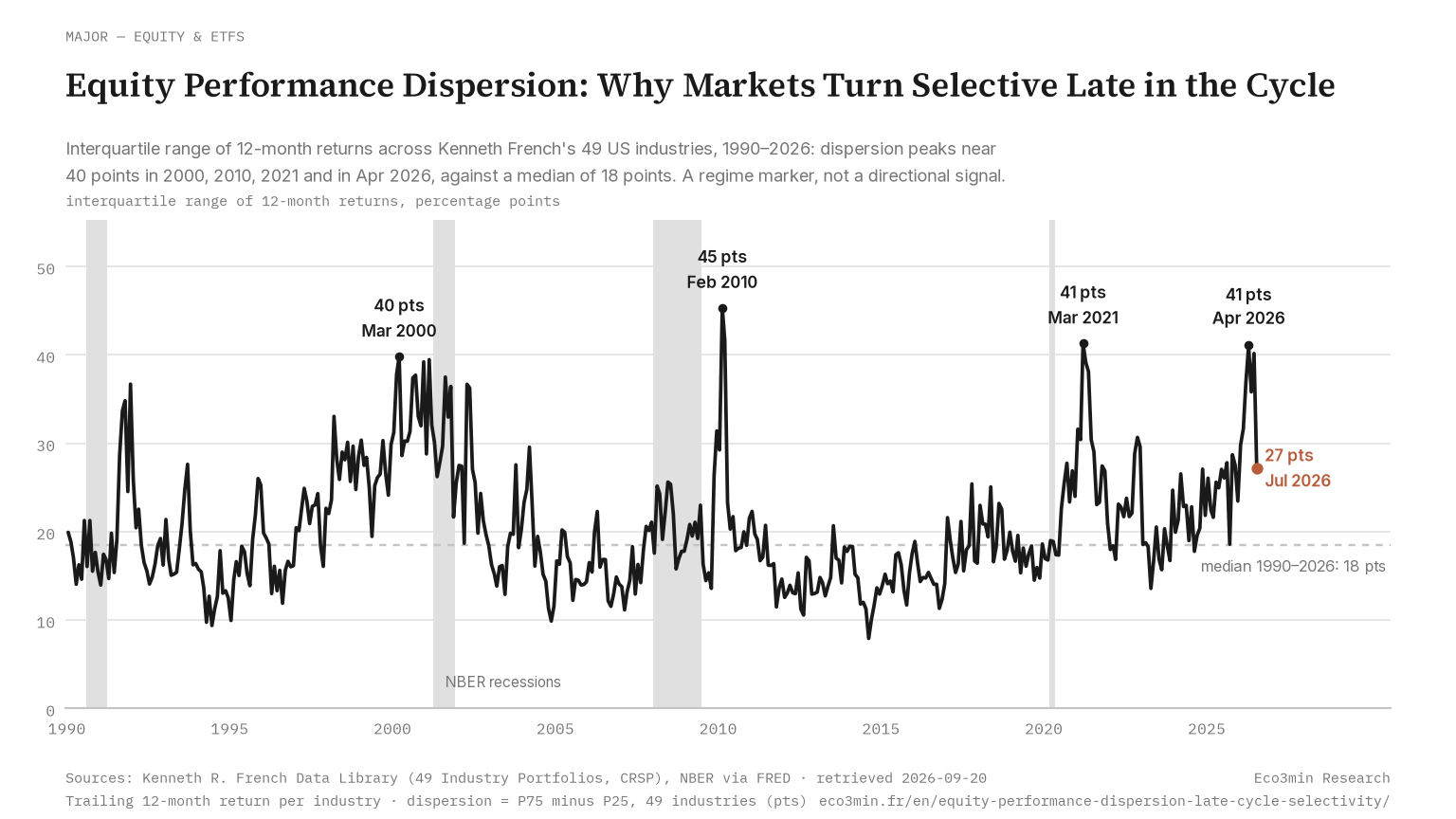
What the data shows, as of 20 September 2026. Measured across Kenneth French‘s 49 US industry portfolios (interquartile range of trailing 12-month returns, CRSP data), dispersion has a median of 18 points since 1990. It peaked at 40 points in March 2000, a year before the 2001 recession, but also at 45 points in February 2010 and 41 points in March 2021, in the middle of a post-recession recovery. It reached 41 points again in April 2026, its highest since 2021, before easing to 27 points in July 2026. The signal is a regime marker: its peaks bracket turning points in both directions and date neither a top nor a bottom.
In the present context (structurally higher interest rates, fragmented economic growth and corporate margins under pressure) the amplification of dispersion is hardly surprising. It is, in fact, one of the distinctive signatures of the new market regime.
Companies able to defend their margins, finance their development without excessive reliance on debt and offer a credible earnings trajectory continue to stand out. Others sink relentlessly behind.
Performance dispersion reflects a market regime in which selectivity supplants broad macroeconomic support and where risk lodges in internal heterogeneity rather than in the trajectory of the index itself.
This analytical lens fits a structural approach to financial markets, grounded in the observation of dispersion and concentration regimes documented across institutional research.
The takeaway
Equity performance dispersion is neither an incidental phenomenon nor a mere statistical artifact. It ranks among the most reliable signals of cycle maturity, marking the shift from a market driven by abundant liquidity to one defined by a quality requirement. Liquidity-driven, then quality-driven: that sequence is the equity cycle in miniature, the object of the pillar devoted to equity markets and ETFs.
Grasping this dynamic moves the analysis beyond a superficial reading of the indices and surfaces the micro-fractures that announce broader market reconfigurations. In a more demanding environment, knowing how to decode dispersion becomes an indispensable skill for anyone seeking to understand equity cycles.
The Eco3min briefing
Last updated — 6 October 2026
Disclaimer – Financial and Legal Information: The analyses, commentary, and content published on eco3min.fr are provided for informational and educational purposes only. They do not constitute investment advice or a solicitation to buy or sell financial instruments. Past performance is not indicative of future results. All investment decisions involve risk and are the sole responsibility of the reader. Data, charts and calculated series are provided as is and may contain errors or lag behind their source: check any figure against the primary source cited before relying on it. Content describing laws, regulations or contracts reflects the law as of its publication date and does not constitute legal or tax advice; applying it to a specific situation requires a qualified legal or tax professional.
Read next
Full pillar →Global Equity ETFs: When the US Weight Outruns the US Economy
US issuers made up 61.4% of a fund tracking the MSCI ACWI in July 2026, against 48.8% of…
Equal-Weight ETFs: The Quiet Signal Behind Rising Indices
Equal-weight ETFs reveal the true health of the equity market behind mega-cap-driven indices. Their gap with cap-weighted ETFs…
Smart Beta ETFs: The Risk Lies in the Gap Between Factors
Over the eighteen months to August 2026, value gained 8.2% and profitability lost 17.7%: stacking factor ETFs adds…