New-generation guaranteed funds: how their rate sensitivity differs

The classic guaranteed fund, protected at every instant, is no longer the only format on offer. Dynamic guaranteed funds and term-guarantee vehicles modulate the guarantee commitment — by blending in a share of riskier assets, or by guaranteeing capital only at maturity. In doing so, they shift the trade-off between protection and sensitivity to the rate cycle.
TL;DR
A term-guarantee vehicle is two objects in one: market-sensitive before maturity, guaranteed at the term, so an interim loss may just be the path to a guarantee not yet due.
- The dynamic guaranteed fund stays near the guaranteed pole but takes valuation swings faster through its return-seeking pocket, while the term-guarantee vehicle moves toward the exposed pole until maturity.
- Both trade part of the guarantee for added return potential and added volatility, offering intermediate doses between permanent guarantee and full exposure rather than an upgrade on the classic fund.
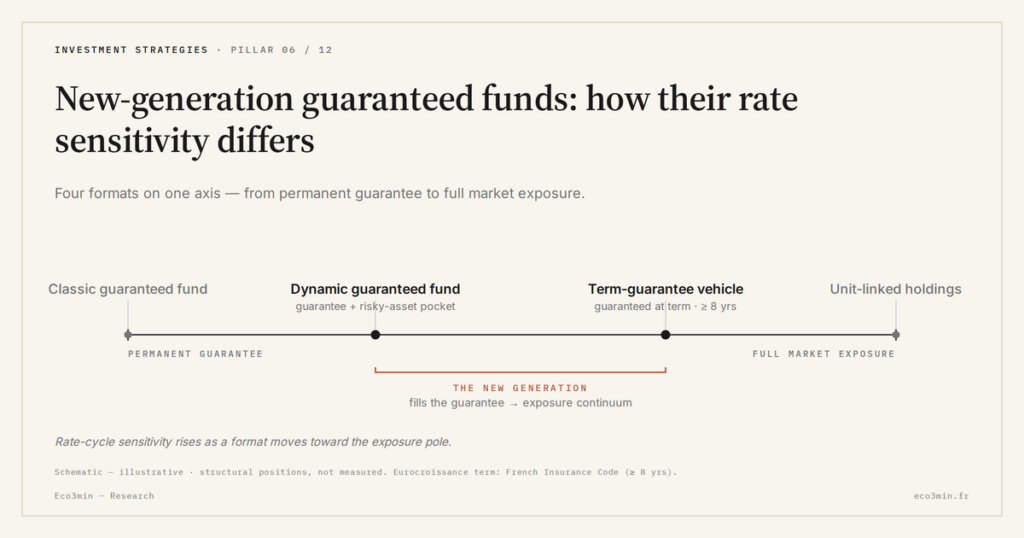
Setting the guaranteed fund against unit-linked holdings sets two extremes against each other: a permanent guarantee on one side, full market exposure on the other. Between them, a generation of hybrid vehicles has grown up that blurs the boundary. Dynamic guaranteed funds keep a guarantee but add a share of riskier assets. Term-guarantee vehicles — sometimes labelled eurocroissance — move the guarantee through time: capital is protected only at the end of a holding period, not at every instant. Neither format is better or worse than the classic guaranteed fund; each occupies a different point on the axis running from guarantee to exposure, and each reacts differently to the rate cycle. This article describes what the new generation changes structurally — on the guarantee and on sensitivity to the regime — without designating a preferable format.
The dynamic guaranteed fund starts from the classic guaranteed fund and adds a dose of return-seeking assets — equities, property, corporate debt — beyond the bond base that secures the guarantee. The logic is that of a safe core completed by a riskier satellite: most of the assets stay invested cautiously to preserve the guarantee commitment, while a fraction is exposed to assets that may pay the contract better in favourable phases.
This structure changes the return profile. In recent years, dynamic guaranteed funds have generally credited higher yields than the classic guaranteed fund, at the price of greater year-to-year volatility in performance. The risky pocket pulls the return up when markets carry it, and weighs on it when they fall back; the guarantee itself stays secured by the bond base. The contract gains in potential what it loses in regularity, without tipping into the full exposure of a unit-linked holding.
The guarantee itself also carries a nuance here. Depending on the contract, protection may cover only part of the capital, or be assessed net of fees and of the risky pocket’s performance over the year. A dynamic guaranteed fund’s guarantee is therefore not always as unconditional as the classic fund’s: it can be capped, conditioned or recomputed under rules specific to each vehicle. Reading the contract documentation becomes essential, because two dynamic guaranteed funds bearing the same label can rest on appreciably different guarantee mechanisms. This heterogeneity is one reason these vehicles compare poorly on credited yield alone.
Above all, this risky share makes the dynamic guaranteed fund more sensitive to the market environment, and so indirectly to the rate regime that governs it. Where the classic guaranteed fund reacts to the cycle only with the lag of its bond portfolio, the dynamic fund takes in faster, through its return-seeking pocket, the valuation swings the regime imposes. The guarantee remains, but the path to it becomes bumpier. It is precisely this tension between a guaranteed base and an exposed share that places these formats between guarantee and exposure.
Term-guarantee vehicles: guaranteed at maturity, not at every instant
The term-guarantee vehicle follows a different, more radical logic. Instead of adding risk to a permanent guarantee, it moves the guarantee itself through time: capital is no longer protected at every instant, but only at the end of a holding period set at subscription, often of the order of eight years or more. Before that term, the vehicle’s value can fluctuate; at the term, the insurer commits to a guaranteed amount.
Pushing the guarantee out in time changes everything for management. Freed from the obligation to guarantee capital at every instant, the insurer can invest a larger share in performance assets over the life of the contract, since it has the time needed to absorb fluctuations before maturity. The term-guarantee vehicle thus trades short-term protection for higher return potential over the period — a trade-off that only makes sense for a sufficiently long holding horizon, and that exposes the saver to interim volatility.
This mechanism makes the term-guarantee vehicle markedly more sensitive to the cycle than the classic guaranteed fund. During the interim phase, the vehicle’s value reacts to the rate-and-market regime like a diversified portfolio, without the cushion of a permanent guarantee. Protection materialises only at arrival. The very nature of the guarantee — deferred rather than immediate — therefore shifts the vehicle towards the exposed pole of the spectrum, while keeping a safety net at maturity. This reading extends directly the limits of the classic guarantee: here the guarantee is not only limited to the nominal, it is also moved through time. Related analysis: the panorama of vehicles by economic regime.
What the new generation changes for cycle sensitivity
Placed back on the axis running from permanent guarantee to full exposure, these two formats occupy distinct intermediate positions. The dynamic guaranteed fund stays close to the guaranteed pole, with added responsiveness from its risky pocket. The term-guarantee vehicle moves towards the exposed pole during the interim phase, before regaining an anchor at maturity. Both are more sensitive to the rate-and-market cycle than the classic guaranteed fund, and less than a pure unit-linked holding. They do not abolish the trade-off between protection and return; they offer intermediate doses of it.
This intermediate position has a major practical implication: the holding period. The dynamic guaranteed fund, close to the guaranteed pole, tolerates varied horizons since its guarantee applies continuously. The term-guarantee vehicle, by contrast, only makes sense over the span that leads to its maturity: withdrawn before the term, capital is no longer protected, and the saver bears the market value of the moment. The horizon ceases to be a secondary parameter and becomes intrinsic to the vehicle: it is duration that switches the guarantee on, or not. For a term-guarantee vehicle, choosing the vehicle and choosing the holding horizon are not two separate decisions but one.
This duration-dependence also reshapes how risk should be read. The classic guaranteed fund presents the same face whatever the holding period, because its protection never lapses. A term-guarantee vehicle, by contrast, is two different objects depending on when it is observed: a fluctuating, market-sensitive holding mid-course, and a guaranteed one at maturity. Judging it on a single interim statement, as one would a classic fund, misreads it entirely — the relevant horizon is the term, not the day of the snapshot. What looks like a loss before maturity may simply be the interim path towards a guarantee that has not yet come due.
This added sensitivity has a direct consequence for the reading by regime. In a high-rate regime, both formats’ bond base benefits from more generous coupons, like the classic guaranteed fund, but their performance-asset pocket adds variability that depends on the state of equity and property markets. In a falling-rate regime, that same pocket can amplify the return if valuations rise, or hold it back otherwise. The behaviour of these vehicles cannot be read off the level of rates alone: it depends on the composition of their risky share and on the phase of the cycle, which makes them objects to analyse as hybrid formats against the cycle.
“New-generation” does not mean “better”. Dynamic guaranteed funds and term-guarantee vehicles do not dominate the classic guaranteed fund: they move the cursor between protection and exposure, trading part of the guarantee for added return potential and added volatility. The maturity guarantee of a term-guarantee vehicle, in particular, is not equivalent to the permanent guarantee of the classic fund: between subscription and maturity, the value can fluctuate. These formats are not an upgrade of the guaranteed fund, but a different point on the same spectrum.
A boundary become continuous
The contribution of the new generation is not to offer an “enhanced” guaranteed fund, but to fill the gap between permanent guarantee and full exposure. Where the classic contract set two sharply separated pockets against each other — the guaranteed fund on one side, unit-linked holdings on the other — these hybrid formats install a continuum, with intermediate doses of guarantee and risk. The boundary between the guaranteed pocket and the exposed one, once sharp, becomes gradual.
This reading does not dispense with understanding the two poles between which these formats sit: the classic guarantee and its limits on one side, market exposure on the other. On the contrary, it requires mastering them to place each hybrid vehicle correctly. The dynamic guaranteed fund and the term-guarantee vehicle are intelligible only when referred back to the fundamental trade-off of the contract, between the safety of a guarantee and the potential of an exposure. They are variations on that trade-off, not its transcendence — and on that basis they complete, without replacing, the central choice between guaranteed funds and unit-linked holdings. Understanding this continuum, rather than seeking in it a universally superior format, is the right way to approach the new generation.
Last updated — 12 July 2026
Disclaimer – Financial Information: The analyses, commentary, and content published on eco3min.fr are provided for informational and educational purposes only. They do not constitute investment advice or a solicitation to buy or sell financial instruments. Past performance is not indicative of future results. All investment decisions involve risk and are the sole responsibility of the reader.
Read next
Full pillar →Beneficiary Designations, the Step-Up in Basis, and the 10-Year Rule: How US Accounts Transfer at Death
At death, most US financial accounts pass outside the will, straight to a named beneficiary, under tax rules…
The Fee Stack in Variable Annuities: M&E Charges, Riders, and Subaccount Costs
A variable annuity does not carry one fee, but a stack of them. Mortality and expense charges, subaccount…
The Conventional 401(k)-Match-First Funding Order: Where It Comes From, How It Works
The question of what order to fund accounts in usually draws a fixed list, presented as a rule…