The capital guarantee: what it protects, what it costs by regime

A guaranteed fund’s capital guarantee protects the nominal, not purchasing power. That protection has a price — a yield capped by cautious management — and a limit: in an inflationary regime, guaranteed capital can erode in real terms year after year.
TL;DR
A guaranteed fund's cost is an opportunity cost: the return forgone for a capped yield, a gap whose size and sign depend on what markets did over the period.
- The guarantee covers the nominal euro value, fixed by the ratchet effect, and rests on the insurer's commitment under prudential rules rather than a state guarantee; it says nothing about purchasing power.
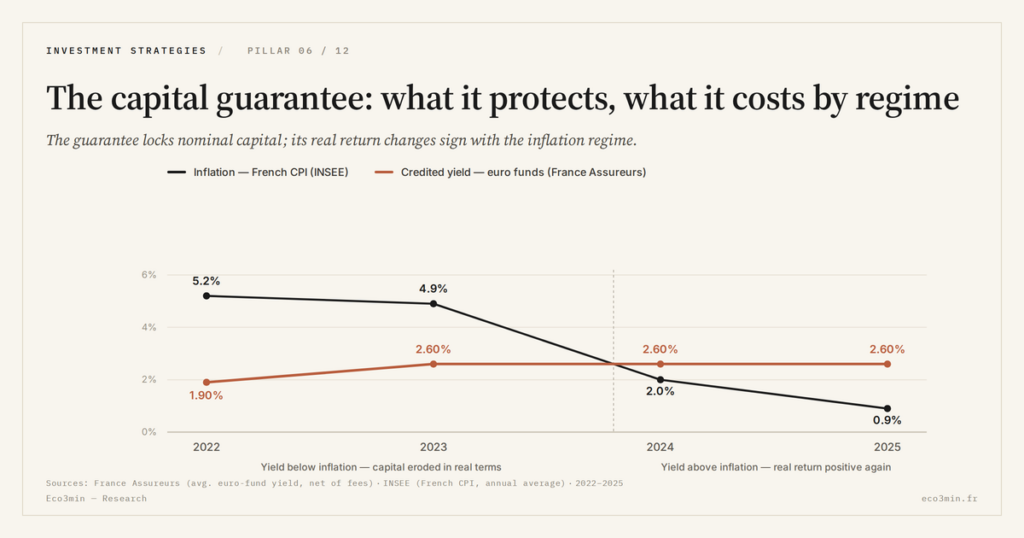
- In 2022-2023, credited yields (about 1.9% then 2.6%) ran far below euro-area inflation (roughly 8.4% then 5.4%, Eurostat), so guaranteed capital fell in real terms despite the nominal guarantee.
- As euro-area inflation fell back towards 2% in 2024-2025 with yields near 2.6%, the fund turned clearly positive in real terms again: the guarantee's value tracks the rate-and-inflation pairing, not the headline rate.
The capital guarantee is the guaranteed fund’s central selling point: capital paid in cannot, in principle, fall in nominal terms. That protection is real, but it carries a cost and a limit that commercial comparisons rarely spell out. The cost: to guarantee the nominal, the insurer invests cautiously, which caps the yield. The limit: the guarantee covers the nominal, not purchasing power. In an inflationary regime, capital preserved in nominal terms can lose ground in real terms year after year. During high-inflation episodes, credited yields on guaranteed funds have run below the rise in prices, eroding real capital — the opposite of the protection sought. This article describes what the guarantee actually protects, what it costs, and how the rate-and-inflation regime shifts its value.
What the guarantee protects — and what it does not
A guaranteed fund’s capital guarantee covers a precise quantity: the nominal value of the capital paid in, in euros. Combined with the ratchet effect — which makes interest definitively acquired once credited — it ensures that, at any moment, the euro amount shown on the contract cannot, in principle, fall back. It is a protection against the accounting decline of capital, and it is real: unlike a unit-linked holding, the guaranteed pocket never shows a nominal loss from one statement to the next.
But this protection is defined in current euros, not in purchasing power. What a saver ultimately measures is what their capital lets them buy. Between these two quantities sits inflation: capital steady in euros can represent, over the years, a shrinking quantity of goods and services if prices rise faster than the credited yield. The guarantee says nothing about this second dimension. It locks the nominal and leaves the real at the mercy of the inflation regime.
This distinction is no technicality: it governs the whole reading of the guaranteed fund. Confusing nominal protection with real protection leads savers to overrate the safety of the guaranteed pocket in high-inflation phases, and to underrate it in disinflationary phases where the real return turns positive again. The guarantee is a stable accounting fact; its economic value, however, varies with the regime. Placing this back in the contract’s frame means comparing the guaranteed pocket against the exposed one not on displayed safety alone, but on the risk each actually carries.
A final point sets the scope of this guarantee: it rests on the insurer’s commitment, framed by prudential regulation, not on a state guarantee. In practice, the solvency framework imposes capital requirements and policyholder-protection arrangements designed to make that commitment robust. But “guaranteed by the insurer” and “guaranteed by the state” are not synonyms: the capital guarantee is a contractual promise backed by the company’s soundness and its regulatory frame, not a certainty detached from any issuer. This nuance, often left unsaid in comparisons, completes the reading: the guarantee protects the nominal, at a cost, within a real limit, and subject to the soundness of the one who carries it.
The price: a yield capped by caution
Guaranteeing the nominal at all times imposes a management constraint. To be able to return each policyholder’s capital whatever happens, and to meet its prudential capital requirements, the insurer invests most of the guaranteed fund in high-quality bonds, weighted towards sovereign and investment-grade securities. This caution is not a discretionary choice that could be lifted: it follows directly from the guarantee commitment. And cautious management means a bounded return potential.
The capped yield is therefore the structural counterpart of the guarantee, not a management failure or a lack of ambition. One cannot simultaneously guarantee capital each year and capture the full risk premium of volatile assets — equities, property, high-yield debt — which can fall sharply in a given year. The guaranteed fund buys its stability at the price of a cap; the unit-linked holding buys its potential at the price of no guarantee. Both pockets pay, in different currencies, the same trade-off between safety and return.
This cap is not fixed once and for all: it depends on the level of rates. In a low-rate regime, as in the 2010s, mandatory caution condemned the guaranteed fund to very low yields, sometimes below 1.5%. In a higher-rate regime, as since 2022, the same caution now allows more to be credited, because quality bonds again offer substantial coupons. Our analysis of US savings bonds examines this ground in detail. The cap therefore rises with rates — but with the lag specific to portfolio renewal. The cost of the guarantee is not constant; it weighs more when rates are low and less when they are high. Related discussion: the hierarchy of investments across the macro phase.
Seen this way, the real cost of the guarantee is an opportunity cost rather than a fee. The saver pays nothing visible for it; what they forgo is the additional return a less constrained, more exposed allocation might have produced over the same period — alongside the additional risk that allocation would have carried. In calm or supportive markets the forgone return can look large; in falling markets it can vanish or reverse, the cap turning into a shelter. The cost of the guarantee is therefore not a number on a statement but a conditional gap, whose size and even sign depend on what markets did over the holding period.
The limit: real erosion in an inflationary regime
The most counter-intuitive consequence of all this appears in an inflationary regime. When inflation exceeds the credited yield, nominally guaranteed capital loses purchasing power in real terms — exactly the situation the guarantee was meant to rule out. The protection then works in reverse: capital does not fall in euros, but it buys less each year.
Recent figures date this dynamic without ambiguity. In 2022 and 2023, at the inflation peak, the average yield credited by euro guaranteed funds — about 1.9% in 2022 and 2.6% in 2023 — ran far below inflation, with euro-area HICP averaging roughly 8.4% in 2022 and 5.4% in 2023 on Eurostat data. The gap, several points a year, means that capital held in guaranteed funds fell in real terms over those two years, despite the nominal guarantee. The protection sought played out against itself.
The disinflationary regime then flipped the picture. As euro-area inflation fell back towards the 2% area in 2024 and 2025, while credited yields held near 2.6%, the guaranteed fund turned clearly positive in real terms again for the first time in several years. The value of the guarantee is therefore nothing absolute: it is strong when inflation is low and the yield higher, weak or even negative when inflation exceeds the yield. It is the rate-and-inflation pairing, not the guarantee itself, that decides whether nominal protection is matched by real protection. This dependence on the regime is precisely what the body of content on protection across the regime documents.
This regime-dependence has a practical reading. A guaranteed pocket viewed at the bottom of a high-inflation episode and a guaranteed pocket viewed in a disinflationary stretch are, in real terms, two very different objects, even at an identical nominal rate. The nominal figure on the statement is stable; the real value it protects is not. Judging the guarantee therefore means pairing the credited rate with the inflation of the same period — a step the headline number never performs on its own.
Reading “guaranteed” as “no possible loss” is a misleading shortcut. A guaranteed fund’s guarantee covers nominal capital, not purchasing power: in an inflationary regime, capital guaranteed in euros can lose real value, as in 2022-2023, when credited yields (about 1.9% then 2.6%) ran far below euro-area inflation (roughly 8.4% then 5.4%, Eurostat). The guarantee rules out an accounting loss, not the erosion of purchasing power.
A guarantee whose value depends on the regime
One should be careful not to turn this observation into a condemnation. The guaranteed fund is not “bad” because its guarantee has a cost and a limit; it is, like the unit-linked holding, an instrument whose properties prove favourable or unfavourable depending on context. In a regime of positive real rates — nominal rates above inflation — the nominal guarantee is matched by real protection, and the pocket becomes an effective savings base again. The allocation role the guaranteed fund can then play is treated separately, in the content devoted to the guaranteed fund’s role as an allocation base; the present article keeps to the reverse side, the cost and the limit of the guarantee. On this point: how savings fare regime by regime.
Finally, the classic guarantee — the one that applies at every instant — is no longer the only format on offer. Variants have emerged that modulate the guarantee commitment, either by blending in a share of riskier assets, or by guaranteeing capital only at the end of a holding period, which shifts the trade-off between protection and return. What these formats change, on the guarantee and on behaviour across the regime, belongs to the analysis of next-generation guarantees. The point to keep here is that a capital guarantee is never unconditional protection: it protects a precise quantity, the nominal, at a cost that varies with rates, and with a real effectiveness that depends entirely on the inflation regime.
Last updated — 12 July 2026
Disclaimer – Financial Information: The analyses, commentary, and content published on eco3min.fr are provided for informational and educational purposes only. They do not constitute investment advice or a solicitation to buy or sell financial instruments. Past performance is not indicative of future results. All investment decisions involve risk and are the sole responsibility of the reader.
Read next
Full pillar →Beneficiary Designations, the Step-Up in Basis, and the 10-Year Rule: How US Accounts Transfer at Death
At death, most US financial accounts pass outside the will, straight to a named beneficiary, under tax rules…
The Fee Stack in Variable Annuities: M&E Charges, Riders, and Subaccount Costs
A variable annuity does not carry one fee, but a stack of them. Mortality and expense charges, subaccount…
The Conventional 401(k)-Match-First Funding Order: Where It Comes From, How It Works
The question of what order to fund accounts in usually draws a fixed list, presented as a rule…