Rate Hikes and Inflation: How the New Monetary Regime Is Reshaping the Economy
The end of the low-rate era forces a structural reset in debt refinancing, capital allocation and risk management, with positive real rates redefining the cycle for corporates, investors and households.

[Editorial note: Article updated in April 2026 to reflect the stabilisation of monetary policies on a restrictive plateau and the evolving risks tied to debt.]
TL;DR
The era of free money is over: real rates held in restrictive territory, the 2026-2027 debt wall and a confirmed real-estate correction now define the economic baseline. This specific point is developed further in how cross-asset correlations move with regimes.
- Real rates sit on a restrictive plateau ('higher for longer'), making the cost of liquidity a genuine selection filter for companies as the leverage premium disappears.
- The 2026-2027 'debt wall' makes refinancing of near-zero-rate debt far costlier, shrinking emerging-market fiscal room and feeding the risk of sovereign-stress episodes.
- Real estate has moved from pressure to a confirmed 2026 correction, with prices adjusting down in major metros and commercial property a principal risk channel for shadow banking.
- Two stress points sit beneath resilient equity indices: private credit facing its first genuine default tests, and Asian local-government financing vehicles (LGFVs) threatening regional liquidity.
For more than twenty years, global monetary policy operated within a relatively stable framework. That era is now over.
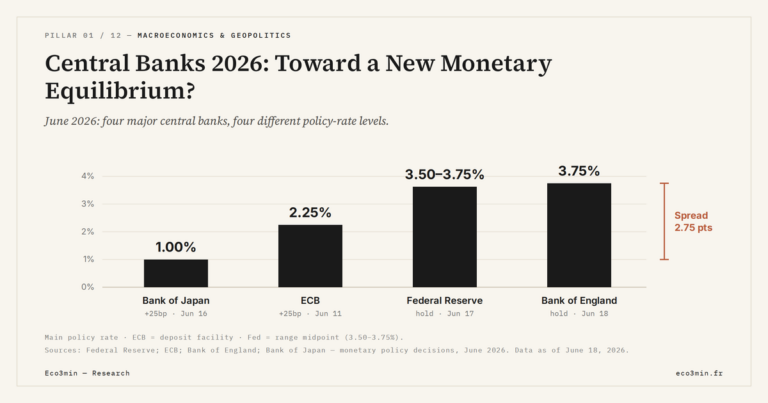
Faced with inflation that proved more persistent than anticipated, central banks have had to raise policy rates massively and now find themselves compelled to keep them at restrictive levels, at the risk of durably weakening growth.
This new equilibrium, marked by positive real rates, sets in motion an unprecedented cycle in which investment frameworks, financial stability, refinancing of the debt wall and the valuation of rate-sensitive sectors are being reshaped at a structural level. Read alongside: Our analysis of inflation explained.

Major trends to watch
1. Real rates have become structurally positive
Following the aggressive tightening phase, central banks now navigate a plateau: rates remain elevated (the well-known “higher for longer”) despite minor tactical cuts.
This cautious posture aims to prevent any rebound in an inflation whose final mile remains complex to traverse. The global economy is adjusting to a cycle in which the cost of liquidity once again becomes a genuine selection filter for companies.
2. The debt wall in a high-rate world
For heavily indebted states and corporates, the new rate era makes refinancing (the 2026-2027 “debt wall”) considerably more costly.
Emerging markets, still under pressure from US yields, see their fiscal room shrink.
Over time, this tension continues to feed the risk of sovereign-stress episodes and forces a wave of fiscal consolidation in developed economies.
This constraint extends beyond the trajectory of policy rates alone. It sits within a strong-dollar regime, which raises the cost of international financing, intensifies pressure on dollar-denominated debt and turns a local monetary adjustment into a global macroeconomic challenge.
3. Real estate: from pressure to structural adjustment
The rate shock has already weighed heavily on household demand and on developer activity over the past two years.
In 2026, the sector is going through a confirmed correction: prices are gradually adjusting downward in several major metropolitan areas, and transaction volumes struggle to rebound.
Commercial real estate, particularly exposed to refinancing, remains one of the principal risk channels for the shadow banking system.
4. Commodities: chronic volatility and fragmentation
Between mixed Asian growth and supply chains reconfigured by global geopolitical tensions, energy and industrial-metal markets remain hypersensitive.
This instability slows global disinflation, in turn limiting the ability of central banks to ease policy.
Decoding: a paradigm shift now confirmed
The world has definitively left the era of low rates and free money.
The current cycle is no longer a transition phase: it is the new economic baseline.
Central banks must engineer a soft landing while avoiding breaking investment (notably in the energy transition and AI) — a permanent balancing act.
This configuration reveals three deep dynamics:
- The end of the leverage premium: profitability must now exceed the real cost of capital.
- Massive capital reallocation: bonds and money-market instruments now seriously compete with equities on a risk-adjusted basis.
- Geopolitical reconfiguration: industrial reshoring and trade fragmentation impose inflationary friction costs.
The consequence: investors, governments and corporates operate in a more volatile framework, where leverage is no longer a viable default strategy.
Immediate impact: companies, investors, households
Companies
Refinancing of debt issued at near-zero rates is reaching maturity. This weighs on cash positions, particularly in capital-intensive sectors.
Companies that have optimised working capital, protected operating margins and demonstrated free-cash-flow generation have empirically navigated the cycle with greater resilience.
Investors
The return of yield on sovereign bonds and on high-quality credit (Investment Grade) is reshaping portfolio architecture.
In equities, “quality” segments (strong balance sheets, pricing power) have outperformed unprofitable growth names.
Intra-sector selectivity has historically replaced passive trend-following.
Households
While access to mortgage credit remains constrained in terms of debt-service ratios, precautionary savings have once again become remunerative.
The central issue shifts from simple inflation protection toward the optimisation of fixed-income holdings and capital-preservation arbitrage.
The weak signals that will matter
- Stress in private credit (Private Debt): a segment that ballooned during the low-rate era and now faces its first genuine default tests.
- Capital needs for AI and the energy transition: massive investments competing directly with sovereign deleveraging.
- Persistent vulnerability of LGFVs (local government financing vehicles) in Asia, threatening regional liquidity.
These elements, often masked by the apparent resilience of equity indices, are the potential catalysts of the next shocks.
3-12 month outlook
Several scenarios are emerging for the rest of 2026:
- Central scenario (Extended status quo): central banks maintain restrictive rates (“higher for longer”) in the face of sticky services inflation, accepting weak growth. The full framework is detailed in the Eco3min inflation framework.
- Risk scenario (Forced pivot): a sudden break in the labour market or a financial accident (commercial real estate) forces an emergency rate cut.
- Reflation scenario: a new geopolitical or supply shock reignites inflation, dismantling expectations of monetary easing.
Indicators to follow daily: US core inflation, credit spreads (High Yield), the slope of the yield curve and US consumer health.
Conclusion
The monetary policy revolution has produced a structurally more demanding economic cycle.
Durably positive real rates, constrained sovereign budgets and a tense geopolitical backdrop create an environment in which tactical allocation and risk management take precedence over leverage.
For corporates and investors alike, “Don’t fight the Fed” today means accepting that the cost of money will not return to zero. The advantage will accrue to those who have already adapted their balance sheets to this new reality.
Last updated — 12 July 2026
Disclaimer – Financial Information: The analyses, commentary, and content published on eco3min.fr are provided for informational and educational purposes only. They do not constitute investment advice or a solicitation to buy or sell financial instruments. Past performance is not indicative of future results. All investment decisions involve risk and are the sole responsibility of the reader.
Read next
Full pillar →Monetary Tightening: How Central Banks Are Reshaping Financial Markets
After more than a decade of ultra-accommodative policy, monetary tightening has reintroduced the real cost of capital as…
Hidden Unemployment: Reading the Real Labor Market in 2026
Headline unemployment is stabilizing while broad underemployment still runs above pre-2020 levels. Reading the gap between official rates…
2026 Economic Outlook: Key Trade-Offs After the End of Cheap Money
2026 ushers in a more constrained macro regime where real rates stay positive, fiscal space narrows and geoeconomic…