Why Real Rates Stay High After the Shock — and Why 2008 Was the Anomaly
Real rates do not always fall back after an economic shock. The persistence of positive real rates after 2021-2023 is not a glitch in the cycle — it points to a structural shift in capital supply and demand that the post-2008 decade obscured.

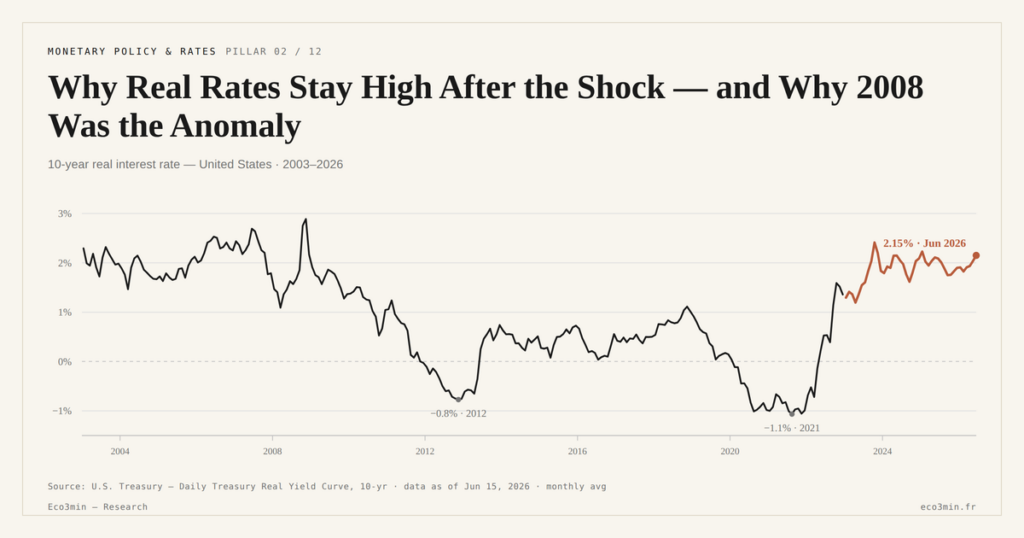
After every shock, the default expectation is that rates will fall. The eurozone’s mildly positive real rates in early 2026, despite slowing growth, point to something else — a balance between capital supply and demand that has structurally shifted.
TL;DR
The post-2008 decade of negative real rates was a one-off configuration: the 2021-2023 shock left eurozone real rates mildly positive into 2026, and the structural balance behind them has shifted.
- Eurozone growth slowed to ≈0.5% in 2023 (Eurostat), yet real rates never returned to negative territory — the reflex that slower activity drags rates down simply did not fire.
- Three forces hold capital demand high regardless of the cycle: energy-transition spending (the IEA's World Energy Outlook 2025 puts it near $4.5 trillion a year by 2030), demographics entering the dissaving phase, and geopolitical fragmentation.
- The Laubach-Williams model, updated by the Fed through Q4 2025, lifts the US equilibrium real rate (r*) about 0.5 point above its pre-Covid estimate — a level shift, not a cyclical detour.
The diagnostic mistake is not asking whether low rates will return. It is treating their return as a mechanical certainty, when the conditions that sustained the post-2008 regime no longer hold.
Real rates do not always fall after a shock. Demographic, productive and geopolitical factors keep them structurally elevated.
Forecasts of post-shock rate paths typically anchor on the 2008 precedent: a deep crisis, a central bank response, and real rates negative for more than a decade. The empirical side is documented in this dedicated note on 2023 regional bank crisis vs 2008. The 2021-2023 inflationary shock has not followed that script. Eurozone growth slowed to ≈0.5% in 2023 (Eurostat), and yet real rates did not return to negative territory. In early 2026, they remain mildly positive. The implication is that the post-2008 trajectory was a particular configuration, not a generic post-shock template, and that the central question becomes how the equilibrium real rate is set across cycles rather than within them.
What prevents the mechanical return to low rates
The cycle-level intuition — slower activity, weaker credit demand, lower rates — treats capital supply and demand as if they adjusted at quarterly frequency. They do not. Three structural forces have shifted the balance independently of the business cycle, and the historical sequence of inversion-then-rally episodes since 1980 already hinted at the divergence between cyclical and structural rate behavior.
The first is the investment bill attached to the ongoing transitions. The IEA’s World Energy Outlook 2025 puts annual investment in energy infrastructure required by 2030 at ≈$4.5 trillion. That spending creates persistent capital demand regardless of the cyclical setting. The second is demographic. The shift from the accumulation phase of the baby-boom cohort to the dissaving phase reduces the supply of available capital, while aging-related public spending increases sovereign financing needs on the demand side — two forces pulling in the same direction. In the same vein: our overview of the time lags between rate cycles and profit margins.
The third force is geopolitical fragmentation. Duplicated strategic infrastructure, partial reshoring of supply chains and rising military budgets all create investment needs without proportional productivity gains. The three forces converge on the same outcome: elevated capital demand independent of the cyclical environment. This is the configuration captured by the structural drivers that keep real rates above their post-2008 norm.
- The persistence of positive real rates after the 2021-2023 shock breaks with the post-2008 pattern because the underlying balance between capital supply and demand has structurally moved.
- Energy transition investment, demographics in the dissaving phase and geopolitical fragmentation all push capital demand higher, independent of where the business cycle stands.
- Reading the 2026 setting as cyclical when it is structural produces systematic errors in any projection of real-rate trajectories — for sovereign budgets, corporate capital plans and long-duration asset valuations alike.
What the post-Covid episode actually documented
The Covid shock of 2020 is the cleanest illustration. Real rates briefly plunged deep into negative territory under the combined effect of nominal cuts and rising inflation. The rebound that followed was faster and more durable than most forecasts allowed for. The Laubach-Williams model, updated by the Federal Reserve through Q4 2025, suggests the equilibrium real rate r* in the United States has risen by ≈0.5 percentage point relative to its pre-Covid estimates — a level shift, not a cyclical detour.
If that reassessment holds, “normal” real rates for the 2020-2030 decade will sit structurally above those of the 2010-2020 decade. The implication ripples through every long-horizon decision framework — institutional investors building duration exposure, sovereign borrowers projecting debt service, corporates evaluating multi-year capex. All of these decisions sit inside the post-shock financial conditions that reset the rate environment for the years ahead.
Last updated — 12 July 2026
Disclaimer – Financial Information: The analyses, commentary, and content published on eco3min.fr are provided for informational and educational purposes only. They do not constitute investment advice or a solicitation to buy or sell financial instruments. Past performance is not indicative of future results. All investment decisions involve risk and are the sole responsibility of the reader.
Read next
Full pillar →Real Rates: The True Cost of Capital Is Repricing
Why real rates are reasserting themselves as markets' anchor and how to recalibrate investment and financing decisions facing…
Real Interest Rates: The Quiet Signal Reshaping Markets
Real interest rates: why their persistence in positive territory in 2026 is reshaping the rules for bonds, equities,…
OAT-Bund Spread: A Quiet Gauge of French Sovereign Risk
OAT-Bund spread: how this yield gap has become a key signal on French sovereign risk, fiscal policy and…