Why Markets Can Rise Despite an Inverted Yield Curve
An inverted yield curve can coexist with rising markets without invalidating the signal. The lag reflects a structural disconnect between financial regime and economic regime, transmitted through credit before reaching asset prices.

A widely shared idea still dominates market commentary: an inverted yield curve would mechanically herald a downturn in financial assets. Yet observation of past cycles points to a more puzzling reality. It is not unusual to see markets continue to advance even after the signal is in place, sometimes for extended periods.
TL;DR
Equities can keep advancing for extended periods after a curve inverts because the signal works through the credit channel, reaching prices only once tighter financing weighs on investment.
- The real transmission runs through credit, not equities: when short rates sit durably above long rates, the profitability of financing operations erodes, intermediaries turn selective, and some investment projects stop being viable.
- Markets price the marginal change in available information, not the future state of the economy, so risk assets can hold while deterioration is neither visible nor binding for short-term cash flows.
- Modern market structure cushions the lag: existing liquidity, systematic arbitrage and the concentration of performance can sustain indices despite an already weakened macroeconomic backdrop.
- Inversion behaves as a process rather than a one-off event, and its duration, more than its onset, conditions the magnitude of the adjustments that follow.
This situation fuels a recurring confusion: either the curve has become inoperative, or markets have turned “irrational”. To untangle this confusion, the situation must be placed back within our framework on market regimes. In reality, the issue lies elsewhere. It stems from a misunderstanding of the nature of the signal and of how it transmits to the economy before becoming visible in asset prices.

A Financial Signal Not Aimed Directly at Markets
The yield curve is first and foremost a financial object. It reflects arbitrage between maturities, monetary expectations, and the perception of risk over time. This maturity-arbitrage mechanism fits within the framework on monetary policy transmission. Its inversion signals tension between restrictive monetary policy at the short end and more cautious expectations on future activity.
This signal does not target equity markets first. It acts upstream, by gradually altering financing conditions in the economy. As long as this transmission remains partial, indices can keep rising, supported by factors not immediately affected by monetary tightening. This finding is put in perspective by the transmission of rate cycles to earnings.
In this framework, inversion is not an instant trigger but a regime marker: it indicates that the system is entering a phase in which the cost of capital becomes structurally more constraining. The marker itself can be seen taking shape in the curve’s full deformation, replayed year by year.
Why Market Dynamics Can Remain Supportive
Financial markets do not react to the future state of the economy, but to the marginal change in available information. This logic of gradual integration sits at the centre of our sub-pillar on market expectation dynamics. As long as economic deterioration is neither visible nor binding for short-term cash flows, risk assets can continue to benefit from an environment perceived as stable.
This dynamic is reinforced by the very structure of modern markets: existing liquidity, systematic arbitrage, and concentration of performance can sustain indices despite an already weakened macroeconomic backdrop. The advance of markets does not invalidate the signal; it simply reflects a lag between financial regime and economic regime.
This phenomenon is consistent with the idea developed in the analysis of phases without an exploitable signal in markets, where the absence of immediate reaction does not mean the absence of constraint, but the temporary coexistence of contradictory forces.
Common Errors in Reading the Inverted Curve
The first error is to equate a macroeconomic signal with short-term equity performance. An inverted curve does not “forecast” an immediate market decline; it signals a growing incompatibility between monetary conditions and economic dynamics. In depth: the decoding of the maturity-sensitivity pair.
The second error is to mistake the absence of a visible crisis for regime normality. As long as credit flows and investment does not contract sharply, the system can keep functioning. This intermediate phase is precisely when the signal is most often called into question.
Finally, many interpret inversion as a one-off event, when it should be read as a process. Its duration, more than its onset, conditions the magnitude of the adjustments to come.
The Real Transmission Channel: Credit and Financing
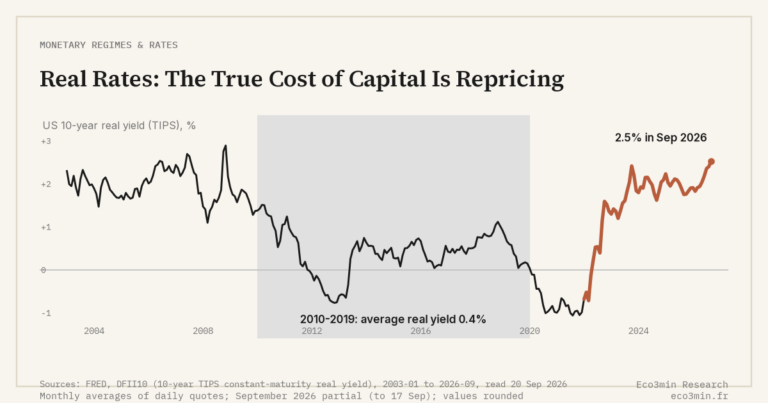
The economic impact of an inverted yield curve does not flow directly through equity markets, but through the credit channel. When short rates remain durably above long rates, the profitability of financing operations gradually deteriorates. The real-rate thread running through this analysis branches out in the pages below.
Going further
Reading real rates
Transmission to the economy
Each entry takes up one branch and reads independently.
Financial intermediaries become more selective, financing conditions tighten, and certain investment projects cease to be viable. These adjustments are slow, often invisible at first, but cumulative.
This is the logic behind the analysis of the credit cycle as the true market cycle, where imbalances emerge well before their explicit macroeconomic translation.
Why Inversion Can Coexist With Rising Markets
The 2022–2024 episode is the extreme case. The 10-year minus 2-year Treasury spread stayed below zero for 537 consecutive trading days, from 6 July 2022 to 26 August 2024, the longest inversion in the daily FRED series, with a trough of −1.08 pp on 3 July 2023, the deepest since 1981. Over that window the S&P 500 rose about 58%, from its October 2022 low of 3,577 to 5,648 at the end of August 2024 (daily closes). As of 20 September 2026, the NBER has dated no business-cycle peak since February 2020 and the index traded above 7,600, more than double its 2022 low.
As long as credit compression has not reached a critical threshold, markets can remain carried by the inertia of previous cycles. Companies financed before the tightening continue to operate, margins do not contract immediately, and short-term visibility remains sufficient.
This coexistence between a risk signal and positive performance fuels the idea that the curve has become obsolete. In reality, it simply highlights that markets react on different horizons from those of the real economy.
The signal becomes fully readable only when financing conditions start to weigh on investment, then on employment and consumption. At that stage, market dynamics generally shift quickly. The mechanisms behind this transmission are examined angle by angle in the series below.
In this series
Reading real rates
Valuation and the cost of capital
Transmission and lags
- Why rate hikes take time to bite
- Why investment reacts to policy with a lag
- Lagged reactions between inflation, growth and rates
- Who gets hit first when rates rise
- Why inflation resists monetary tightening
- When credit matters more than the rate level
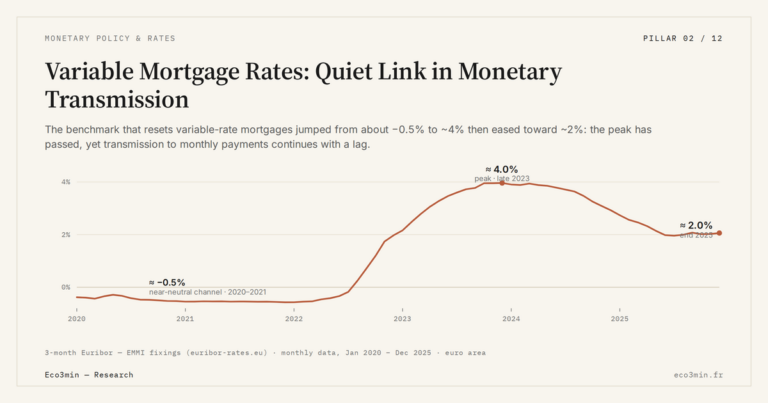
- Variable mortgages, a quiet transmission link
- One ECB rate, three monetary realities
- The threshold where rates start dragging on investment
Regimes, growth and saving
- High nominal rates without restrictive policy
- Money illusion in everyday rate decisions
- Why easing stalls once the slowdown is underway
- When low rates turn from stimulus to drag
- Low rates: the gap between intent and outcome
- Why real rates stay high after a shock
- How real rates shape long-term growth
- Why real rates may not revisit their pre-2020 lows
- Consumption, saving, investment: the real-rate trade-offs
- How real rates reshape saving — or fail to
Each entry isolates a single mechanism and can be read on its own.
A Necessary Deepening on the Impact of Rates
To understand more precisely why this dissociation between macroeconomic signal and market reaction is possible, it is useful to analyse the central role played by the level and trajectory of interest rates in asset price formation.
A detailed analysis of these transmission mechanisms is developed in this article: the impact of interest rates on financial markets, which places the yield curve within a broader framework of how the financial system operates.
Conclusion
The fact that markets can rise despite an inverted yield curve is neither an anomaly nor an invalidation of the signal. It reflects a structural lag between financial signal, economic transmission, and market price reaction.
The yield curve does not herald an immediate crisis; it signals entry into a regime where constraints accumulate silently. The decomposition of the bond term premium quantifies this dynamic over the long run. As long as this accumulation remains partial, market dynamics can persist. It is precisely this temporary coexistence that makes the signal hard to interpret — and yet essential to understand.
Last updated — 20 September 2026
Disclaimer – Financial Information: The analyses, commentary, and content published on eco3min.fr are provided for informational and educational purposes only. They do not constitute investment advice or a solicitation to buy or sell financial instruments. Past performance is not indicative of future results. All investment decisions involve risk and are the sole responsibility of the reader.
Read next
Full pillar →Real Interest Rates: The Quiet Signal Reshaping Markets
Real interest rates: why their persistence in positive territory in 2026 is reshaping the rules for bonds, equities,…
OAT-Bund Spread: A Quiet Gauge of French Sovereign Risk
OAT-Bund spread: how this yield gap has become a key signal on French sovereign risk, fiscal policy and…
Inverted Yield Curve: Reading a Regime Signal Without Immediate Effect
The inverted yield curve operates as a regime signal, not a timing tool. Its lagged effects are constitutive…