Why Real Rates May Not Return to Their Pre-2020 Lows
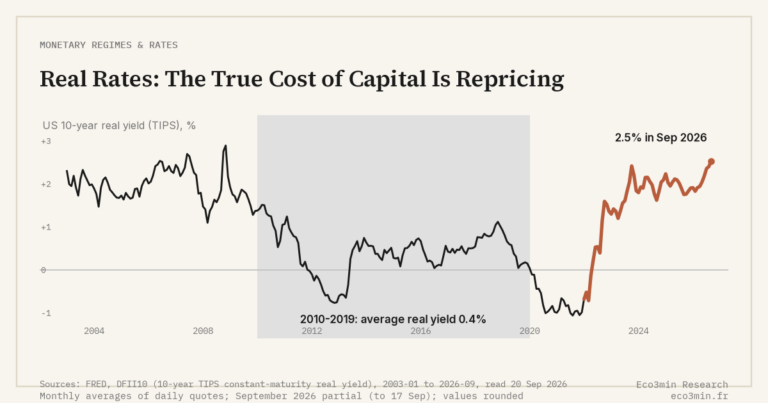
The 2010-2021 stretch of zero or negative real rates was not the destination of a long structural trend — it was the joint product of an Asian savings glut, abnormally low inflation and unconventional monetary policy. The forces invoked to forecast a return to those levels — aging, savings, low productivity — actually cut both ways once examined in detail.


The 2010-2021 stretch of zero or negative real rates is widely read as the destination of a long structural trend. Schmelzing’s BIS data on seven centuries of real rates suggest the opposite: it was the exception, not the norm.
TL;DR
Schmelzing's seven-century real-rate series frames the 2010–2021 lows as one episode among many, while aging, energy transition and reshoring now push capital demand structurally higher.
- Demographics work in two phases: Eurostat projects the euro-area old-age dependency ratio rising from ≈34% in 2025 to ≈50% in 2050, shifting cohorts from saving to dissaving and contracting capital supply at the margin.
- The IMF Fiscal Monitor (October 2025) estimates age-related spending could lift public borrowing needs by ≈3 to 5 points of GDP across advanced economies by 2040.
- The IEA puts energy-infrastructure investment needs at ≈$4.5 trillion a year by 2030, while reshoring and defence spending absorb capital without proportional productivity gains.
- Schmelzing's Bank of England data (2020), extended by BIS long-run series back to the 14th century, show elevated real-rate phases historically lasted as long as low-rate ones; the 2010–2021 lows rested on an Asian savings glut, abnormally low inflation around the 2% target, and zero-lower-bound policy.
The forces routinely invoked to forecast a return to those lows — aging populations, savings gluts, low productivity — cut both ways once examined in detail.
Real rates do not automatically return to low levels. Analysis of the demographic, productive and geopolitical factors that sustain them.
Each time real rates climb back toward positive territory, the same conviction resurfaces: structural forces — aging demographics, a global savings glut, declining productivity gains — will pull them back to the very low levels of the past decade. That reading dominated central-bank models and investor frameworks through the 2010s. Eco3min lays this out in this question on demographics structural inflation. It rests on a partial inventory. The same demographic shifts cited to justify low rates produce the opposite effect once one moves from the savings phase to the dissaving phase. Sizing the supply-demand balance for capital correctly is the first step in understanding why real rates govern the economy rather than merely reflecting it.
Demographics: A Two-Phase Variable, Not a One-Way Force
The conventional argument runs as follows: aging raises precautionary savings, weighs on consumption, depresses the natural rate of interest. That mechanism was visible from the 1990s onward, when the baby-boom cohorts were accumulating wealth ahead of retirement. It is not the mechanism currently at work.
According to Eurostat projections (2024), the old-age dependency ratio in the euro area rises from ≈34% in 2025 to ≈50% in 2050. Retirees draw down accumulated savings rather than build them; the supply of capital contracts at the margin. At the same time, age-related public spending widens government financing needs. The IMF Fiscal Monitor (October 2025) estimates that these expenditures could lift public borrowing requirements by ≈3 to 5 percentage points of GDP across advanced economies by 2040. The same demographic input, two decades later, produces upward pressure on real rates.
The New Demand-Side Drivers: Transitions, Reshoring, Defence
The energy transition mobilises capital at a scale that has no precedent in peacetime. The International Energy Agency estimates annual investment needs in energy infrastructure at ≈$4.5 trillion by 2030. Whatever the financing channel, that volume puts a structural floor under capital demand.
Geopolitical fragmentation pushes in the same direction. Partial reshoring of supply chains, rising military spending in Europe and Asia, duplication of strategic infrastructure — these absorb investment without proportionally raising productivity. The combination of demand-side pressures with a shifting supply-side picture explains why real rates remain sticky after a shock rather than reverting cleanly to a prior baseline. The broader cyclical context appears in our reading of equity-market upswings under an inverted yield curve.
- Aging pushes real rates down during the savings-accumulation phase, but up during the dissaving phase — a transition advanced economies are now entering.
- Energy transition, reshoring and defence spending create durable upward pressure on capital demand without comparable productivity gains.
- Schmelzing’s long-run data suggest the 2010-2021 low-rate regime was an episode, not the terminal point of a centuries-long trend.
What Seven Centuries of Real-Rate Data Actually Show
Schmelzing’s work for the Bank of England (2020), extended by BIS long-run series, tracks real rates back to the 14th century. The headline finding routinely cited is the multi-century decline. The less-cited finding matters more: across that span, phases of elevated real rates lasted on average as long as low-rate phases. The quantitative side is handled in our examination of the delayed hit of rate hikes on earnings. The 2010-2021 episode of negative real rates is the joint product of three identifiable conditions — an Asian savings glut, abnormally low inflation around a 2% target, and unconventional monetary policy at the zero lower bound. None of those conditions remains intact in 2026. Related coverage: our analysis of financial repression episodes.
If the structural forces currently at work are confirmed, the regime of mildly positive real rates observed in early 2026 plausibly persists rather than reverting. That hypothesis reshapes how all participants read financial conditions under a higher-rate regime. The question for the next decade is less whether real rates fall back than which configuration of demographics, transitions and geopolitics they settle into.
Last updated — 12 July 2026
Disclaimer – Financial Information: The analyses, commentary, and content published on eco3min.fr are provided for informational and educational purposes only. They do not constitute investment advice or a solicitation to buy or sell financial instruments. Past performance is not indicative of future results. All investment decisions involve risk and are the sole responsibility of the reader.
Read next
Full pillar →Real Rates: The True Cost of Capital Is Repricing
Why real rates are reasserting themselves as markets' anchor and how to recalibrate investment and financing decisions facing…
Real Interest Rates: The Quiet Signal Reshaping Markets
Real interest rates: why their persistence in positive territory in 2026 is reshaping the rules for bonds, equities,…
OAT-Bund Spread: A Quiet Gauge of French Sovereign Risk
OAT-Bund spread: how this yield gap has become a key signal on French sovereign risk, fiscal policy and…