Revolving Credit: The True Cost of Easy Money
Revolving credit: how this renewable line of credit works, why it costs so much, and which signals to monitor to avoid a debt spiral.

Revolving credit: how this renewable line of credit works, why it costs so much, and which signals to monitor to avoid a debt spiral.
TL;DR
With revolving credit, the headline rate matters less than the mechanics: a limit that constantly replenishes, payments too low to amortize, and rates near the regulatory ceiling.
- Eurozone consumer-credit outstanding rose roughly 4–5% year-on-year between end-2024 and end-2025 (ECB data), while real wages only partly kept pace with cumulative inflation.
- Nominal policy rates have stayed elevated since 2022, raising the cost of all short-term financing and giving the product renewed reach via installment plans and store cards.
- The under-appreciated risk is the shift from a temporary cash-flow strain into durable, sometimes permanent debt.
Most analyses focus on the headline rate of consumer loans. What matters more with revolving credit is the mechanics: a credit limit that continuously replenishes itself, monthly payments often too low to amortize the principal, and rates very close to the regulatory ceiling. In a context where real policy rates remain elevated relative to the past decade, this product becomes a quiet but powerful vector of household financial fragility. Related material: our overview of everyday financial trade-offs across economic regimes.
Why revolving credit is becoming a sensitive issue again
Eurozone consumer credit outstanding rose by around ≈4% to 5% year-on-year between end-2024 and end-2025, while real wages have only partially kept up with inflation, according to European central bank data. Nominal policy rates have remained in an elevated zone since 2022, raising the cost of all short-term financing.
In this context, revolving credit is regaining ground in installment payment offers, store cards and certain online purchase journeys. The structural reading is developed in this question on cash flow vs profit earnings quality. What prices imperfectly reflect is the risk that this type of financing turns a temporary cash-flow strain into durable debt. Before any strain becomes durable, the instrument itself already alters how much is spent, a behavioural regularity that belongs to the spending difference between cards and cash.
Revolving credit: simple definition, complex mechanics
Revolving credit (or renewable credit) is a cash reserve made available by a financial institution, with:
- an authorized ceiling (for example €1,500 or €3,000);
- a reserve that replenishes itself as repayments are made;
- flexible monthly payments (often a choice between very low, medium or higher);
- a fixed but elevated interest rate, often close to the usury rate set by national authorities.
Concretely, part of the repayment goes to interest, another part to replenishing the reserve. As long as the reserve is not fully repaid, the contract remains open, which makes the debt potentially permanent.
The general framework of monetary policy, with real policy rates back in positive territory since 2022–2023, mechanically translates into very high final rates on these high-risk products, since lenders price in both the cost of refinancing and default risk.
The true cost of revolving credit: when the math kicks in
The facts: in many European countries, the annual percentage rates (APR) of revolving credit lines frequently sit between ≈15% and ≈21% in late 2025, depending on amount brackets and local regulation. Historically, these levels are well above conventional amortizing consumer loans (often 6% to 10% over the same period).
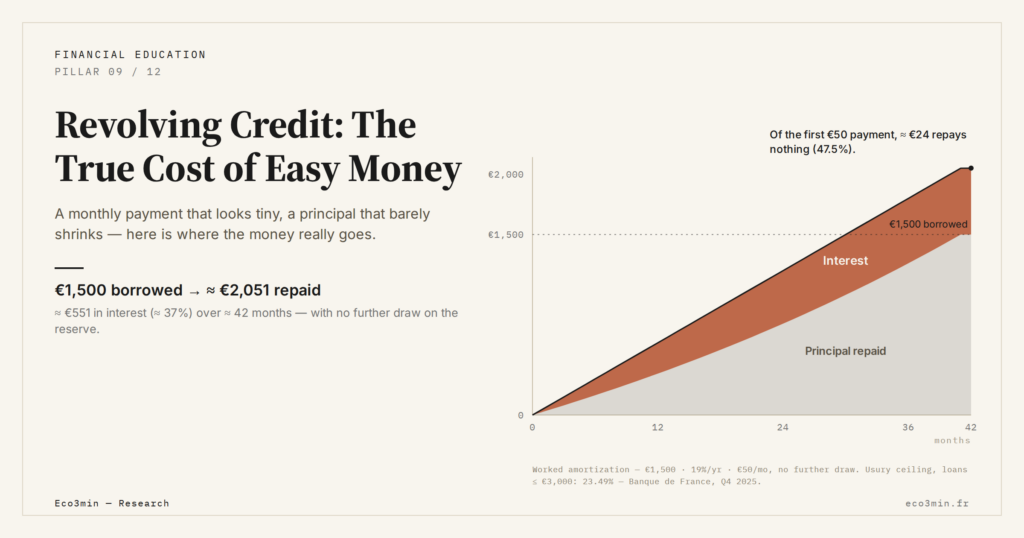
A simplified example illustrates the effect:
- reserve of €1,500 fully drawn;
- 19% rate per year;
- chosen monthly payment: €50.
In this configuration, a substantial portion of the €50 goes to interest. Principal repayment is slow, which:
- significantly extends the repayment period (often several years);
- raises total cost (several hundred euros of interest on €1,500 borrowed);
- keeps the customer near the credit limit, hence tempted to redraw on the reserve.
This suggests the key parameter is not just the rate, but the combination of high rate + low minimum payment + self-replenishing reserve. It is this trio that turns an occasional cash management tool into a potential spiral.
This mechanism illustrates a broader limit of financial education as it is often presented: tools are understood, but their place in time is not always clear. As the analysis on structuring financial decisions over time shows, the main risk does not come from a single bad product, but from prolonged use of a tool designed for exception, integrated too early — or for too long — in a household budget trajectory.
What users really want to know
What many seek to understand is whether revolving credit is simply a practical tool for smoothing expenses, or whether it creates a financial dependence that is hard to reverse. The real question is not whether this credit is “good” or “bad” in itself, but whether it remains controllable over time or risks locking in a durable share of monthly income.
A quiet trap: from cash-flow comfort to permanent debt
The dominant consensus views renewable credit as a “small-amount” product with limited effects. The implicit assumption is that these credit lines remain tied to occasional, low-value purchases, rapidly repaid.
A structured analysis of income-constrained households leads to a different reading: revolving credit often becomes a permanent adjustment variable between income and current expenses. Several key mechanisms:
- Substitution for bank overdraft: when banks tighten authorized overdrafts, a portion of households shifts to renewable reserves offered by non-bank players or store cards.
- Implicit indexing on inflation: if constrained expenses (housing, energy, food) rise faster than incomes, the temptation grows to finance “discretionary” items through this reserve.
- Ratchet effect: once the habit is in place, every unexpected expense (repair, annual bill, moving costs) is absorbed by the credit, preventing the reserve from returning to zero.
Over several years, revolving credit can thus play the role of a structural “buffer”, but at the cost of a very high cost of capital for the household, even as companies and governments fund themselves on far more favorable terms.
Historical and macroeconomic perspective
Between 2010 and 2019, the low-rate period contributed to normalizing recourse to consumer credit. The APR on revolving credit lines was already elevated, but the general level of rates created the illusion of a “normal” cost.
The regime change after 2022 is twofold:
- Policy rates rose from near 0% to several percentage points in less than two years across most developed economies;
- Cumulative inflation in 2021–2024 eroded purchasing power, forcing many households to arbitrate between savings, consumption and credit.
In this new framework, a renewable credit at more than 18% to 20% is no longer a marginal product: it becomes a transmitter of monetary policy to the most fragile budgets. Macroeconomic bulletins, which track the evolution of inflation, employment and rates, help situate this phenomenon within the broader trajectory of the economy (macroeconomic barometer and roadmap).
For an overview of financial education and budget management mechanisms, revolving credit fits within the broader family of tools that turn cash-flow gaps into durable debt.
Concrete indicators to spot when risk is rising
Several signals can help measure whether revolving credit remains a tool of occasional comfort or becomes a structural fragility:
- Monthly payment / net income ratio: when total consumer credit (including revolving) exceeds ≈10% to 15% of monthly net income, financial flexibility shrinks substantially.
- Time without returning to zero: if the reserve has not been fully repaid even once over 12 to 18 months, it often signals near-permanent indebtedness.
- Share of current expenses financed by credit: the more revolving credit funds food, energy or rent (directly or via other transfers), the more fragile the household budget model.
- Rate gap with other solutions: a revolving APR more than 8 to 10 points above a conventional amortizing loan of the same amount signals a particularly heavy cost of capital.
A simple KPI to track is to calculate, at least once a year, the weighted average effective rate across all short-term financing (overdraft, installment payments, store cards, revolving reserves). If this average rate is far above the policy rate of the reference central bank, it reveals a high risk premium paid by the household.
Common reading errors on revolving credit
- Confusing “small monthly payment” with “small cost”: a payment of €30 or €40 may seem trivial, but spread over several years at 18% to 20%, it corresponds to a very high total cost. The right reading is to compare total amount repaid to amount used.
- Looking only at the reserve ceiling: some assume that a €1,000 or €1,500 ceiling limits risk. In reality, what determines the financial weight is mainly the length of time the reserve remains in use.
- Isolating revolving from the rest of the budget: treating this credit “separately” leads to underestimating its impact on the ability to save, invest or absorb a shock (job loss, separation, health expense). The analysis must integrate all household financial flows.
What the consensus underestimates, and what could change the picture
Mainstream projections rather assume gradual inflation normalization and stabilization of policy rates. Within this framework, revolving credit would be absorbed as a marginal financing tool, manageable through existing consumer protection mechanisms.
Another reading highlights several fragility zones:
- Risk of stagnant real incomes: if wages rise more slowly than prices over 2025–2027, the gap will often be bridged by short-term credit.
- Proliferation of installment-payment offers similar to revolving credit: some solutions presented as “3 or 4 installments” rely on logic close to revolving credit, with tacit renewal of the credit line.
- Unacknowledged role as a social shock absorber: in several economies, consumer credit effectively cushions part of the gap between macro shocks (inflation, energy, housing) and living standards, raising its sensitivity to economic downturns.
Conversely, several factors could limit the magnitude of the risk: tighter pre-contractual disclosure rules, stricter rate caps, stronger constraints on the automatic re-marketing of existing renewable reserves.
Possible scenarios around revolving credit
Scenario 1 – Regulated stabilization (current central scenario)
This scenario assumes that policy rates stay in an intermediate zone, that inflation moves close to central bank targets between 2025 and 2027, and that nominal incomes continue to rise. Revolving credit then remains concentrated on a fraction of households and expenses, with contained but persistent risk for certain profiles.
Scenario 2 – Heightened pressure on fragile households
If growth slows more than expected or inflation reaccelerates on a few key items (housing, energy, food), recourse to renewable credit could intensify. In that case, real rates would become particularly heavy for already-indebted households, increasing defaults and debt restructurings. Observers tracking the broader structure of financial markets would read this as a leading signal of consumption fragility.
Scenario 3 – Targeted regulatory tightening
Another plausible scenario is a regulatory tightening on marketing practices, rate levels or repayment-schedule transparency. This could reduce certain abuses, but also limit access to this type of financing for households that use it as a safety net. The challenge would then shift toward other forms of credit or sharper consumption trade-offs.
Concrete implications for investors, companies and individuals
For investors, revolving credit is a discreet thermometer of household financial health. A rise in non-performing loans on this segment could signal broader consumption fragility, to be integrated into a wider reading of cycles and rate structures (see, for example, the analyses of the yield curve and macro scenarios).
For consumer-oriented companies, the rise of these forms of financing can temporarily support revenue, but at the price of a more abrupt risk of reversal if households reach their borrowing limits. Understanding how customers fund their purchases becomes a strategic element of commercial steering.
For individuals, the main issue is to measure the real weight of interest paid over time and to understand how this cost reduces the future capacity to save, build a safety reserve or fund longer-term projects. Revolving credit is only a tool; what determines whether it remains a simple cushion or becomes an invisible trap is how long it stays open and at what rate.
In the end, several trajectories remain possible. Revolving credit is not the most visible financial risk today, but it concentrates part of the tensions between past inflation, elevated rates and constrained budgets. This risk is less spectacular than others, and therefore easier to overlook — but it sheds light, by contrast, on the actual state of consumption and household financial resilience.
Questions readers often ask
Is revolving credit always more expensive than a conventional consumer loan?
In most recent cases, the APR of a renewable credit line is markedly higher than that of an amortizing loan of the same amount. Exceptions exist on very short durations or promotional offers. Comparison should be made at comparable duration and amount, on total amount repaid.
How can one tell if an installment payment hides a revolving credit?
The main signal is the presence of a reusable reserve without a new credit assessment, associated with a dedicated card or account. If the contract provides for automatic renewal of a credit line usable beyond the first transaction, it amounts to a revolving mechanism, even if the commercial label differs.
Why do revolving credit rates remain so high despite falling inflation?
Lenders price in the cost of their own refinancing, but also a higher default risk than on other products. Even if inflation recedes, the combination “short term + riskier profiles + operational costs” keeps rates close to the regulatory maximum.
Does early repayment of revolving credit really make a difference?
On a high-rate product, any reduction in the period of use has a disproportionate impact on total interest. Shortening the time during which the reserve is drawn mechanically lowers the total cost, even if the rate itself does not change.
- 3 takeaways
- Revolving credit is not just a high rate: it is the combination of self-replenishing reserve + low monthly payments + long duration that drives total cost up substantially.
- In a regime of policy rates durably higher than between 2010 and 2019, renewable credit becomes a major channel for transmitting macro tensions to household budgets.
- This risk remains less visible than others, but the evolution of revolving outstandings and defaults offers an early signal of the actual resilience of consumption.
Last updated — 28 July 2026
Disclaimer – Financial Information: The analyses, commentary, and content published on eco3min.fr are provided for informational and educational purposes only. They do not constitute investment advice or a solicitation to buy or sell financial instruments. Past performance is not indicative of future results. All investment decisions involve risk and are the sole responsibility of the reader.
Read next
Full pillar →Series I and EE Savings Bonds: Locked Formulas in a Moving Rate World
US savings bonds lock a rate formula at the moment you buy them, for the life of the…
Where the Livret A’s Money Goes: The Caisse des Dépôts Circuit and Social-Housing Finance
The savings held on Livret A accounts do not sit idle. A regulation-set share is centralised at the…
France’s LEP vs the Livret A: A Means-Tested Higher Rate, Explained
France’s Livret d’épargne populaire is often described as "the Livret A, only better". The description misleads: the LEP…