Why Property Markets Remain Cyclical Despite Public Policy
Lags, incentives and structural rigidities explain why public policies modify but do not eliminate cycles in residential property markets.
This tag analyses the dynamics of private credit: leverage expansion phases, refinancing conditions, liquidity stress and contraction. The credit cycle amplifies or restrains the real economic cycle and is often a leading indicator of turning points. Financial crises almost always emerge from an excess of credit followed by an abrupt tightening.
Lags, incentives and structural rigidities explain why public policies modify but do not eliminate cycles in residential property markets.
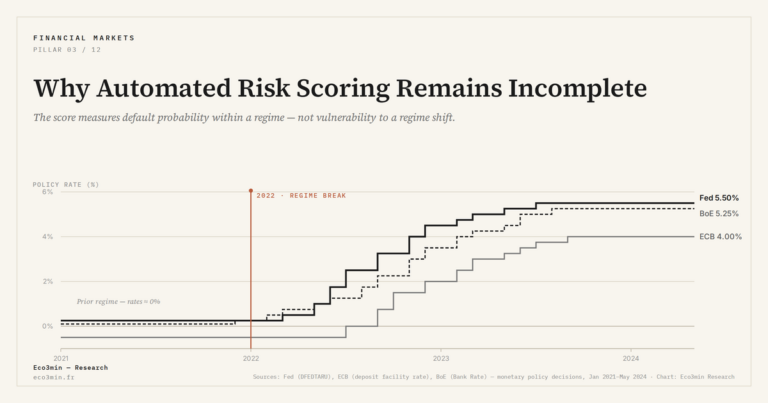
Automated credit scoring measures conditional default probability within a given environment, not vulnerability to regime shifts that historical data fail to capture.
Economic slowdowns rarely begin with falling demand in the data. They typically start with tighter credit conditions, with documented transmission lags of 9 to 18 months. Credit acts as a leading signal of the cycle.
Identifying an ongoing credit cycle remains a methodological challenge. Data are released with delays, signals are contradictory, and cognitive biases distort interpretation. Definitive diagnoses are typically only possible in hindsight.
A credit crunch marks a sudden contraction in credit supply, decoupled from borrower fundamentals. Its macroeconomic effects propagate unevenly, hitting bank-dependent agents far harder than those with market access.
Household and corporate credit do not activate the same macroeconomic mechanisms: one supports aggregate demand, the other conditions productive capacity. Aggregating both masks divergent dynamics with different implications for potential growth.
Bank intermediation amplifies credit cycles asymmetrically: tightening in stress phases unfolds two to three times faster than easing in recovery phases. Capital ratios and risk models attenuate but do not eliminate this procyclicality.
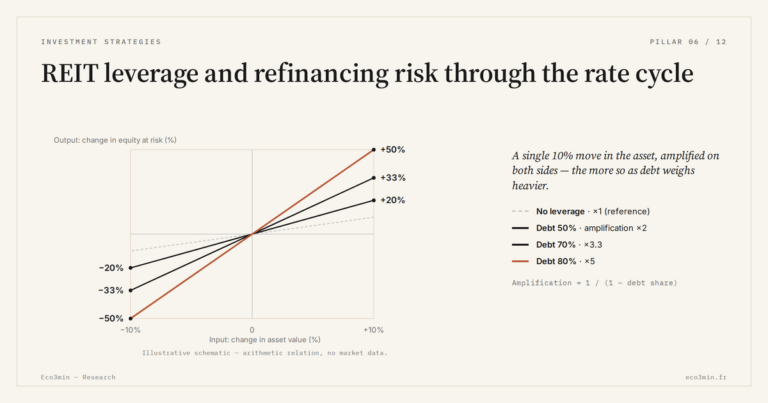
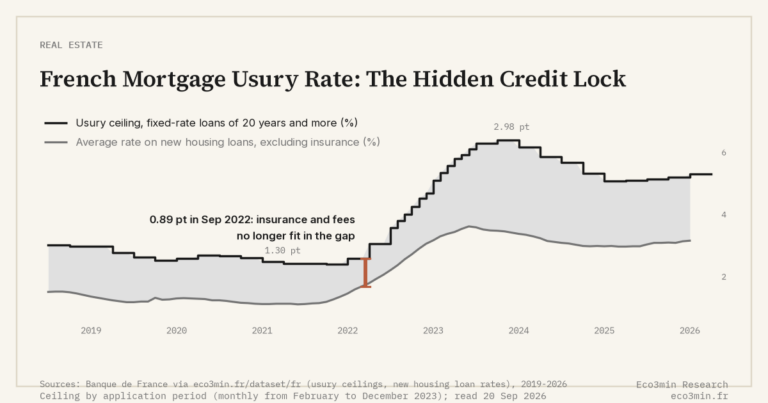
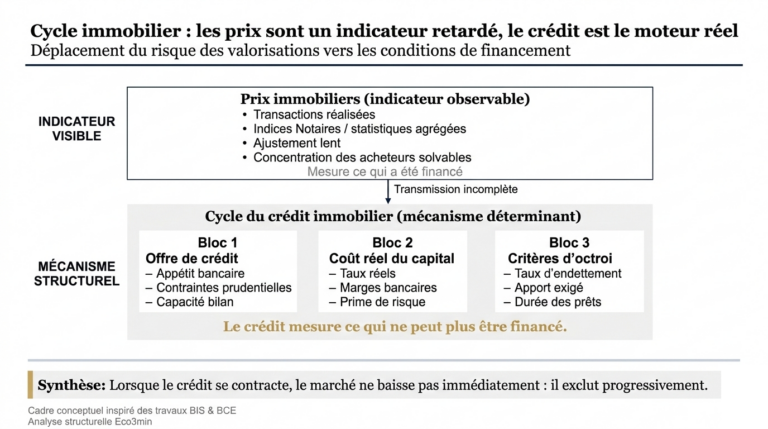
Real estate combines long maturities, high household leverage and supply rigidities. This configuration makes property prices particularly sensitive to financing conditions and amplifies credit-cycle dynamics.
Outstanding credit can keep growing even as activity decelerates. The stock-flow distinction explains the lag between new credit production and the existing balance, and why focusing on the stock alone misleads cyclical diagnostics.
Two economies can post identical headline growth and face opposite trajectories ahead. Productive credit funds capacity that pays itself back; demand credit brings forward future spending. Distinguishing them rests on a single mental test — what would remain of growth if credit stopped expanding?