Slow Accumulation vs Financial Acceleration: Two Opposing Logics
A single financial mechanism can produce radically different trajectories depending on how time is mobilised — through gradual accumulation or concentrated acceleration. The asymmetry of risk this creates is often left unstated.

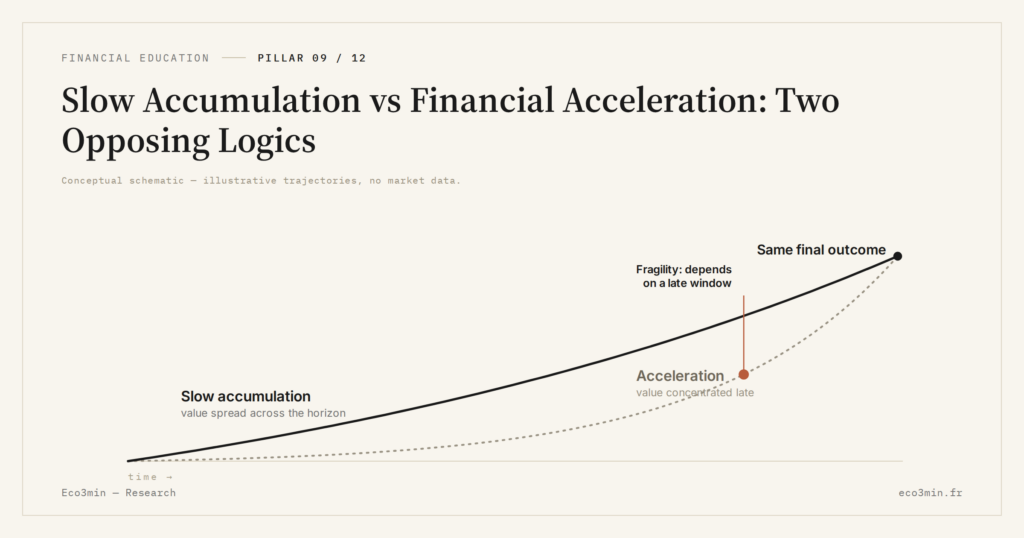
Comparison between progressive, time-based accumulation logic and the more risk-laden pursuit of financial acceleration.
TL;DR
A single mechanism splits into two opposite risk profiles, with accumulation drawing returns from duration and acceleration concentrating them into a few favourable windows whose disruption hits the outcome hardest.
- Gradual accumulation builds its edge step by step without leaning on any single event, while acceleration looks fast on paper but rests on an unbroken favourable sequence, so volatility, a flow interruption or a regime change weighs disproportionately on the result.
- Cheap money from 2015 to 2020 lowered the price of waiting and favoured acceleration financed at low cost; since 2022, with real rates back in positive territory in several developed economies, duration has regained economic value of its own.
- What governs fragility is how few key periods a trajectory leans on: the more concentrated they are, the more a single disruption distorts the path once conditions diverge from the central scenario.
A single financial mechanism can produce radically different trajectories depending on how time is mobilized. On one side, gradual accumulation that bets on continuity and repetition. On the other, a search for acceleration that concentrates effort on a few phases meant to compensate for the rest. This contrast underpins many financial projections today, often without being made explicit. For context: our reference page on everyday financial trade-offs across economic regimes.
Two Relationships to Time, Two Risk Asymmetries
Slow accumulation rests on a simple assumption: the regular repetition of an imperfect but continuous process. Returns are not assumed to be exceptional, but relatively stable through time. Cumulative performance therefore comes mostly from the duration of exposure rather than from one-off intensity. Regular contributions push that duration into a different equation, since each payment compounds over its own remaining term under the compound interest formula with monthly contributions.
Financial acceleration, by contrast, seeks to compress value creation into shorter windows. This contrast in tempo feeds our analysis on the order rather than the nature of financial decisions, which examines why sequencing weighs more than content. Time becomes less a structural ally than a constraint to overcome. This logic implicitly assumes the ability to capture favourable disruptions — timing, leverage, specific opportunities — while controlling intermediate phases.
Part of the consensus views these two approaches as essentially reflecting individual preferences. That reading underestimates a key point: the asymmetry of risk created by reliance on long-term duration versus reliance on rare inflection points.
What a Compounded Trajectory Actually Reveals
Used as a trajectory tool rather than a simple end-result generator, a compound interest calculator highlights an often overlooked fact: the apparent slowness of early phases is not a weakness but a condition of robustness. Gaps build up gradually, without depending on any isolated event.
Acceleration-based trajectories, by contrast, often display rapid growth on paper but rest on a continuous favourable sequence. Any disruption — volatility, interruption of flows, regime change — disproportionately affects the final outcome.
Why This Contrast Has Become More Visible Since 2024
The return of durably higher policy rates has changed the cost of time. Between 2015 and 2020, low rates reduced the price of waiting and favoured acceleration strategies financed at low cost. Since 2022, with real rates back in positive territory in several developed economies, time-based continuity has regained an economic value of its own.
This shift does not mechanically make slow accumulation superior, but it weighs more heavily on trajectories that depend on late acceleration. Time again acts as a filter, not a simple multiplier.
What the Consensus Assumes — and What This Reading Qualifies
Dominant projections often assume that fast phases offset slack periods. This assumption rests on an implicit stability of financing and liquidity conditions. The analysis here diverges on a precise point: the continuity required by acceleration is more demanding than the continuity needed for gradual accumulation.
This suggests that the main risk is not the headline return but the temporal concentration of favourable assumptions. The fewer the key periods on which a trajectory depends, the greater its fragility.
What the Reader Is Actually Trying to Understand
Behind this contrast, the real question is not which logic is “better”, but which one depends least on a perfect scenario. Many readers seek to understand whether a financial trajectory can remain coherent when actual conditions diverge from the central scenario.
What Could Invalidate This Reading
A prolonged phase of steady growth, with durably low volatility and stable financial conditions, would narrow the robustness gap between slow accumulation and acceleration. Conversely, more disrupted cycles or frequent ruptures would reinforce the advantage of trajectories less dependent on timing.
Observable Economic Implications
For households, this contrast affects the perceived regularity of real wealth accumulation. For firms, it shapes the sustainability of projects built on flows concentrated in time. For markets, it conditions the resilience of valuations when growth assumptions need to be spread out rather than accelerated.
Equating an accelerated trajectory with superior efficiency. This reading is misleading because it ignores the increased dependence on a few key periods and the fragility induced by any disruption of continuity.
What This Dynamic Concretely Implies
- Duration of exposure matters more when parameters are unstable.
- Trajectories dependent on acceleration concentrate temporal risk.
- Initial slowness can mask structural robustness.
To place this contrast in a broader analytical framework on temporal biases and financial mechanisms, the Financial Education pillar page synthesises the main blind spots related to projections, lags and cumulative effects.
This is not the central scenario today, but the most underestimated risk lies in overstating the achievable acceleration. When time stops being neutral, slowness stops being a flaw.
Last updated — 13 August 2026
Disclaimer – Financial Information: The analyses, commentary, and content published on eco3min.fr are provided for informational and educational purposes only. They do not constitute investment advice or a solicitation to buy or sell financial instruments. Past performance is not indicative of future results. All investment decisions involve risk and are the sole responsibility of the reader.
Read next
Full pillar →Series I and EE Savings Bonds: Locked Formulas in a Moving Rate World
US savings bonds lock a rate formula at the moment you buy them, for the life of the…
Where the Livret A’s Money Goes: The Caisse des Dépôts Circuit and Social-Housing Finance
The savings held on Livret A accounts do not sit idle. A regulation-set share is centralised at the…
France’s LEP vs the Livret A: A Means-Tested Higher Rate, Explained
France’s Livret d’épargne populaire is often described as "the Livret A, only better". The description misleads: the LEP…