Structured Asset Allocation: Core, Satellites and Defensive Sleeves
In an environment of elevated real rates and concentrated performance, a structured allocation framework — core, satellites, defensive — primarily serves to make portfolio imbalances visible rather than chase returns.

Adjusting an asset allocation without depending on perfect timing: what a core / satellite / defensive structure reveals in an environment of elevated rates and persistent volatility.
TL;DR
A core / satellites / defensive reading is less an allocation rule than a grid that makes visible the risk concentrations a classic balanced portfolio tends to hide under positive real rates.
- Since summer 2025, part of household savings has shifted toward money-market and bond instruments, with euro-area money-market yields near 3–3.5% at end-2025.
- Over the four weeks to late November 2025, flows into global equity ETFs fell roughly 30% versus their 2023–2024 average — caution without panic.
- Performance concentration in a handful of names remains an under-appreciated fragility; the equity-to-bond ratio is becoming a central monitoring indicator into 2026.

Recent observable market signals
- Global equity flows: over the four weeks ending late November 2025, flows into global equity ETFs declined by roughly 30% relative to their 2023–2024 average, reflecting heightened caution without panic dynamics.
- Return of money market instruments: with yields near 3–3.5% in the euro area at the end of 2025, money market ETFs are once again a structural component of many portfolios.
- Crypto assets: in early December 2025, the three largest assets accounted for roughly 75% of total market capitalization, compared with around 65% in 2022, amplifying internal concentration risk.
- Erratic volatility: since September 2025, the volatility index has alternated between phases of stress and rapid lulls, characterizing a regime that does not lend itself to binary readings.
Underlying macroeconomic reading
Since the summer of 2025, markets have been sending a paradoxical signal. US equities continue to trade close to historical highs, with valuation multiples around 20–21x, above their long-term average. At the same time, a growing share of flows is moving toward investment grade bonds and money market instruments, attracted by yields that have once again become competitive. Adjacent reading: how the regime reframes every vehicle.
This configuration fits within a broader repricing of the real cost of money. When nominal rates stop falling but inflation normalizes, real policy rates become the key variable for understanding the pressure on risk assets and the hierarchy of expected returns.
At the micro level, concentration is the principal point of fragility. At the end of 2025, fewer than ten stocks accounted for more than a quarter of the capitalization of many traditional global ETFs. This asymmetry increases the dependence of overall performance on a limited number of individual trajectories.
What this configuration implies in risk terms
An allocation structured around a long-term core, thematic satellites and a defensive component primarily serves to make imbalances visible. It does not aim to optimize a one-off return, but to clarify exposure across different market regimes.
This type of reading fits within a broader approach to investment strategies, where the challenge is not to predict highs or lows, but to maintain coherence between horizon, accepted volatility and portfolio structure.
The core / satellites / defensive structure is not a fixed allocation rule, but the operational expression of an investment discipline applied over time.
This role of discipline as a factor of coherence and robustness is developed in the reference analysis on investment discipline, which underpins the strategies covered on Eco3min.
When markets become highly concentrated or real rates remain persistently positive, insufficiently structured portfolios tend to accumulate several risks without fully recognizing them.
This structural reading of allocation benefits from being complemented by quantitative frameworks that visualize the distribution of risk, liquidity and yield in an environment of higher rates. These approaches serve primarily as reading tools rather than universal rules.
Key indicators to monitor over time
- Equity-to-bond ratio: a pronounced drift from the initial structure signals a risk shift that is often gradual and barely visible.
- Sector and geographic concentration: an excessive share of the top 10 holdings in equity exposure reduces effective diversification.
- Average bond duration: beyond certain thresholds, sensitivity to rate moves becomes a dominant volatility factor.
- Weight of highly volatile assets: a marginal exposure can have a disproportionate impact on the overall risk profile.
Plausible macro-financial scenarios over a 3–12 month horizon
Scenario 1 — Gradual landing
Growth remains moderate, inflation continues to normalize and rates stabilize. Equity markets move erratically but without a major break, while defensive assets recover a stabilizing function.
Scenario 2 — Prolonged valuation pressure
Sustained elevated real rates or a more pronounced slowdown in earnings drive a targeted correction across the most concentrated segments, without necessarily triggering a systemic crisis.
Scenario 3 — Sharper economic slowdown
A clearer deterioration in activity leads to a decline in bond yields and a broader correction in risk assets, restoring a central role for defensive sleeves.
Cross-cutting indicator: the joint trajectory of earnings and real rates remains the most structuring variable for interpreting these scenarios.
Conclusion
In an environment defined by the end of sustainably low rates, asset allocation again becomes an exercise in risk management before being a search for performance. A polarized reading — core, satellites, defensive — does not bring certainty, but offers a more legible framework for understanding where a portfolio’s fragilities truly lie when facing the economic cycles ahead.
- An unmanaged allocation tends to accumulate invisible risks during stable market phases.
- Concentration is today one of the main sources of silent fragility.
- Regular monitoring of a few simple ratios corrects a large portion of structural drifts.
Last updated — 12 July 2026
Disclaimer – Financial Information: The analyses, commentary, and content published on eco3min.fr are provided for informational and educational purposes only. They do not constitute investment advice or a solicitation to buy or sell financial instruments. Past performance is not indicative of future results. All investment decisions involve risk and are the sole responsibility of the reader.
Read next
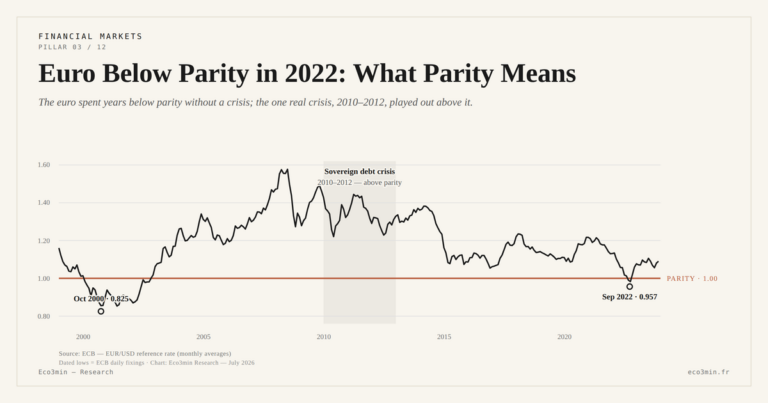
Full pillar →Euro Below Parity in 2022: What Parity Means
In September 2022, the euro fell below parity with the dollar, to around 0.95, a low not seen…
Eurozone Fragmentation: Sovereign Spreads and the Euro
The euro is issued by a monetary union without a complete fiscal union: nineteen sovereign debts coexist under…
The Euro’s Energy Import Bill: the Gas Shock and the Currency
In 2022, the surge in gas prices turned the euro area's historic current-account surplus into a deficit and…