Why Automated Risk Scoring Remains Incomplete
Automated credit scoring measures conditional default probability within a given environment, not vulnerability to regime shifts that historical data fail to capture.

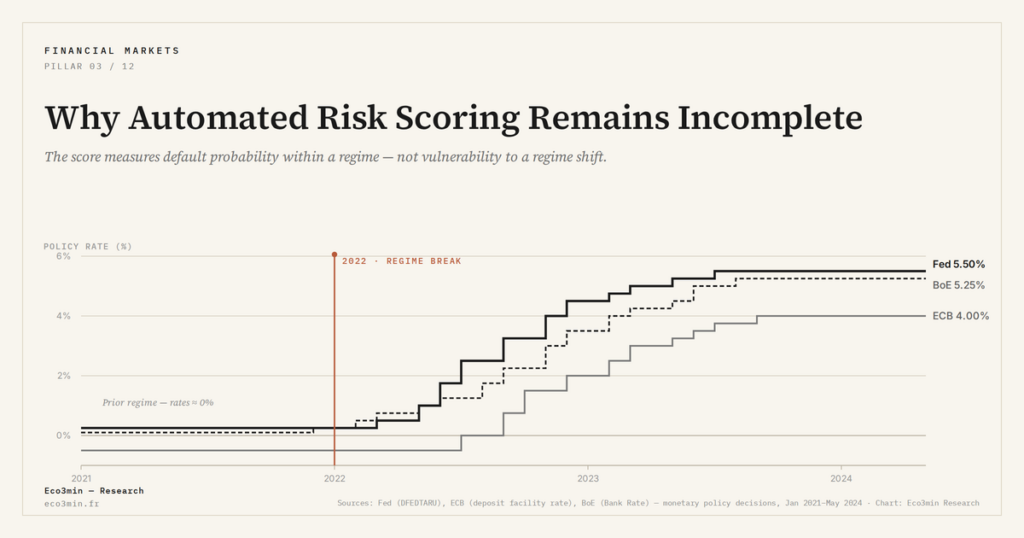
Automated risk scoring rests on past data and often overlooks macroeconomic regime shifts.
TL;DR
An automated score can be statistically precise yet still misjudge a borrower whose solvency depends on a macro regime the model implicitly assumes will hold.
- Between 2022 and 2024, major central-bank policy rates rose from near 0% to roughly 4%-5.5%, yet many models kept assigning high scores to borrowers whose solvency depended on durably cheap capital.
- Scoring measures the conditional probability of default within a given environment; it does not capture vulnerability to a regime change, a gap that stays invisible while the macro frame holds.
- After the 2008-2009 break and the post-2021 inflation shock, observed default rates rose with a six- to eighteen-month lag, and ratings calibrated on prior data reacted late.
Automated scoring tools promise a more objective assessment of risk. Yet these models remain largely blind to macroeconomic dynamics. They extrapolate past regularities without integrating regime breaks. A common confusion conflates statistical precision with economic understanding. Examining this limit helps separate risk measurement from macro-financial reading.
When the score is precise — but out of context
AI-based credit risk scoring systems rely mostly on microeconomic histories: past defaults, payment behavior, observed financial ratios. This approach improves short-term statistical consistency, but it implicitly assumes that the macroeconomic frame remains stable. Related coverage: what the spread says about the credit regime.
Yet recent episodes are a reminder that regime shifts are rarely linear. Between 2022 and 2024, monetary tightening pushed the policy rates of major central banks from levels close to 0% into ranges between roughly 4% and 5.5%. Many models nonetheless continued to assign elevated scores to borrowers whose solvency depended on durably low cost of capital.
This dissociation illustrates a structural limit: automated scoring measures the conditional probability of default within a given environment, not vulnerability to a regime change.
The implicit consensus: more data = less risk
Part of the institutional consensus assumes that the continuous enrichment of databases mechanically improves the quality of risk assessment. Dominant projections bet on better default anticipation thanks to the rising granularity of financial information.
The analysis diverges on a key point: a larger data volume does not equate to a better macroeconomic reading. Models capture individual behavior with precision but remain blind to systemic shocks not observed in the training sample. Macro risk is not residual noise; it is a frame change that makes historical probabilities less relevant.
This blind spot is not neutral: it also reflects the displacement of human biases into models, which favor statistical stability at the expense of reading macroeconomic breaks.
This distinction connects with the broader framework developed in the analysis of structural risks linked to AI’s transformation of finance, where fragility stems precisely from this dependence on past regularities.
Key mechanism: the blind spot of regime shifts
A scoring model learns from sequences in which the rules of the game are relatively constant: moderate growth, fluid credit access, stable collateral valuations. When these parameters shift simultaneously, the estimated risk function becomes unstable. An unstable risk function is precisely the ground on which algorithmic bias in credit scoring becomes visible.
Between 2008 and 2009, then more recently during the post-2021 inflation shock, observed default rates rose with a 6- to 18-month lag depending on the segment. Automated ratings, calibrated on prior data, often reacted late, since the macro signal (credit tightening, margin compression) was not directly integrated.
This lag does not mean the model is «wrong»: it answers a different question — the relative risk between agents, not the absolute risk tied to a regime change.
Why this topic is becoming more sensitive now
The current environment combines durably elevated rates, more heterogeneous growth and a gradual prudential tightening. This triptych widens the gap between stable microeconomic scores and latent macro vulnerabilities. The topic gains importance as the environment ceases to be transitory.
What readers really want to understand
Behind the question of automated scoring, the concern is less the technical quality of models than their ability to flag a risk that is not yet visible in the data. The point is not whether a score is «good», but whether it remains relevant when the economic frame changes rapidly.
Counter-arguments and tipping variables
Some argue that integrating macro variables (rates, inflation, growth) will be enough to correct this weakness. That hypothesis assumes, however, that relationships between these variables and default risk remain stable. A regulatory shift, a liquidity shock or monetary policy more restrictive than expected could invalidate these parametric adjustments.
Key indicator to watch
An often-neglected KPI is the gap between the distribution of credit scores and the trend in aggregate financial conditions (credit spreads, volume of new loans). A widening of this gap over several quarters signals a possible underestimation of macro risk.
- Automated scoring measures conditional risk, not exposure to a regime shift.
- Accumulating data improves statistical precision without guaranteeing a macroeconomic reading.
- The gap between micro scores and aggregate financial conditions is a signal of latent fragility.
This observation does not undermine the usefulness of scoring tools, but invites placing them within a broader frame of financial innovation analysis. Several trajectories remain possible: either models adapt slowly to the new regime, or macro risk stays underappreciated until it materializes. This is not the central scenario today, but that is precisely what makes it easier to overlook.
Last updated — 30 July 2026
Disclaimer – Financial Information: The analyses, commentary, and content published on eco3min.fr are provided for informational and educational purposes only. They do not constitute investment advice or a solicitation to buy or sell financial instruments. Past performance is not indicative of future results. All investment decisions involve risk and are the sole responsibility of the reader.
Read next
Full pillar →Euro Below Parity in 2022: What Parity Means
In September 2022, the euro fell below parity with the dollar, to around 0.95, a low not seen…
Eurozone Fragmentation: Sovereign Spreads and the Euro
The euro is issued by a monetary union without a complete fiscal union: nineteen sovereign debts coexist under…
The Euro’s Energy Import Bill: the Gas Shock and the Currency
In 2022, the surge in gas prices turned the euro area's historic current-account surplus into a deficit and…