High yield or investment grade: the credit spread through the cycle

Credit is a second engine in fixed income, independent of duration. A high yield ETF and an investment grade ETF of the same maturity do not track the same signal: the former depends on the credit cycle, the latter remains governed by rates.
TL;DR
A high yield fund's headline yield is compensation for an expected default rate; whether it reaches the holder depends on the credit-cycle phase that converts it into a realised return.
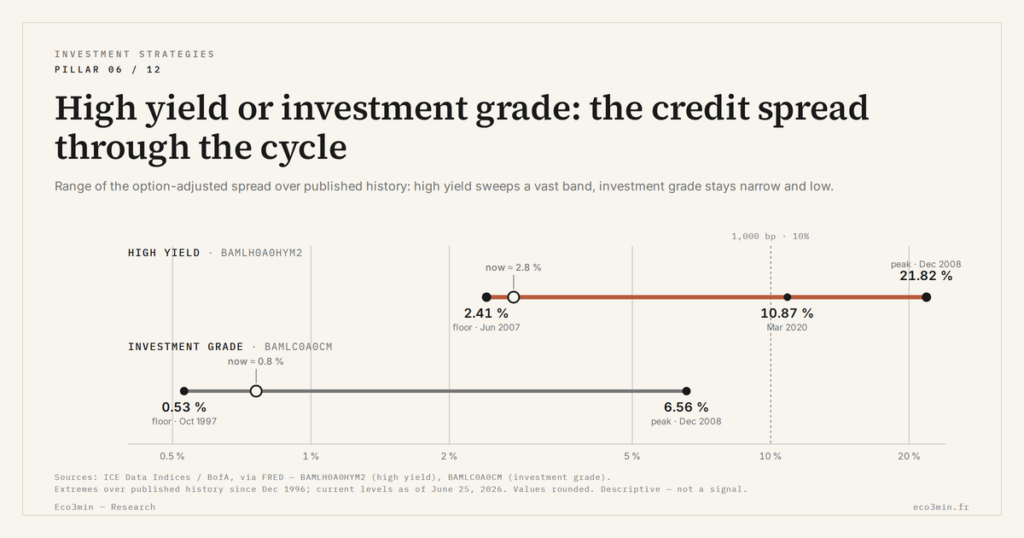
- In stress phases high yield behaves more like an equity than a bond: per ICE BofA index data, the US high yield spread widened from a few hundred basis points to over 1,000 in the 2008 and March 2020 shocks, falling alongside equities.
- Investment grade sits in an intermediate position, its spread narrow and far less cyclical, so an IG fund behaves first like a rate fund and only decouples from sovereigns in the sharpest credit-stress episodes.
- Two causes of spread widening resolve differently: anticipated economic deterioration can persist until the cycle turns, while a liquidity squeeze like March 2020 tends to reverse once liquidity returns.
- Holding several credit-sensitive exposures at once (high yield, emerging-market debt, subordinated bank debt) concentrates the credit axis rather than diversifying it, since they share the same risk appetite and widen together in a turn.
Choosing a credit segment is choosing an exposure to the cycle, not merely a yield. This page describes how high yield and investment grade behave by phase, without naming a segment to buy.
In fixed income, credit is a second engine, independent of duration. A high yield ETF and an investment grade ETF of the same maturity do not respond to the same signal: the former tracks the credit cycle and the risk premium demanded of fragile issuers, the latter remains more governed by rates. Stress phases make this stark: ICE BofA index data shows the US high yield spread widening from a few hundred basis points to over 1,000 during the 2008 and March 2020 shocks, then compressing into recovery. This page describes how each segment behaves across the credit cycle, how that differs from the pure rate effect, and why conflating the two risks misleads. The basic distinction between the two rating tiers belongs to the high yield / investment grade distinction, treated separately; this page focuses on behaviour by cycle. It describes an asset’s behaviour; it issues no buy signal.
1. Credit, an engine independent of duration
The credit spread is the premium the market demands to lend to an issuer that might default, over and above the risk-free rate. That premium varies with the economic cycle and with risk appetite, independently of the level of rates. An investment grade ETF gathers issuers judged solid, whose spread is narrow and relatively stable; a high yield ETF assembles fragile issuers, whose spread is wide and highly cyclical. The same maturity can therefore house two radically different behaviours, depending on whether the dominant engine is the rate or the spread.
This independence from duration is the central lesson. A fund can be short in maturity — hence little sensitive to rates — yet highly sensitive to credit stress; conversely, a fund of long sovereigns, free of any default risk, is highly sensitive to rates but insensitive to the credit cycle. Reading a bond holding therefore requires separating these two axes: duration doses the reaction to rates, the credit segment doses the reaction to the cycle. Conflating them leads to attributing to one a behaviour that stems from the other. Adjacent reading: the rate-regime reading of bond ETFs.
High yield’s most striking behaviour appears in stress phases: it then behaves more like an equity than a bond. When risk rises, it falls, at the precise moment the investor would expect a bond asset to cushion. Investment grade, for its part, retains more of its bond profile, its reaction staying dominated by rates rather than by the default premium. This difference in nature, not in degree, is what makes the segment choice structuring.
Investment grade occupies an intermediate position worth spelling out. Its spread is not zero — it compensates a low but real default risk — yet it is narrow and far less cyclical than high yield’s. As a result, an investment grade fund behaves first like a rate fund, with a thin credit overlay: it takes the duration effect first, and only decouples from sovereign behaviour in the sharpest credit-stress episodes. Between the default-free sovereign and the highly cyclical high yield, investment grade offers a moderate credit profile, which makes it the segment where the rate axis and the credit axis blend most closely.
2. The spread through the credit cycle
The spread does not deform at random: it follows the credit cycle. In an expansion phase, when defaults are rare and risk appetite high, the spread compresses, and high yield outperforms mechanically: its higher yield is not erased by defaults, and the spread compression adds a capital gain. In a turn, that same higher yield is more than offset by the widening spread and rising expected defaults; high yield then falls sharply. It is the same position that pays in expansion and costs in a turn, from the cycle alone. A related answer: our piece on the credit cycle.
The 2008 and March 2020 shocks materialised this dynamic. According to ICE BofA index data, the US high yield spread moved from a few hundred basis points to over 1,000, before compressing into recovery. The high-yield spread series tracks this measure across decades. For the holder of a high yield fund, these episodes translated into a sharp decline, simultaneous with the fall in equity markets — the illustration that the diversification expected of a bond asset did not materialise at the moment it would have been useful.
It matters to distinguish two causes of spread widening, because they do not resolve the same way. A widening tied to anticipated economic deterioration — rising expected defaults — reflects worsening fundamentals and can persist as long as the cycle does not turn. A widening tied to a liquidity squeeze, as in March 2020, reflects above all a rush toward the safest assets and tends to resolve quickly once liquidity returns. The boundary between the two segments is itself mobile: in a stress phase, downgraded issuers cross the line — the “fallen angels” — which changes index composition and can force mechanical selling by funds constrained to hold investment grade only.
3. Why the headline yield misleads
A high yield fund’s headline yield is a misleading selection criterion. A high yield does not represent earned income, but compensation for an expected default rate: part of it is meant to be absorbed by defaults, and the realised return is what remains once those defaults arrive. In a benign credit phase, few defaults materialise and the yield largely flows through; in a turn, the default rate rises and a portion of that headline yield never reaches the holder, while the price falls on top.
Comparing a high yield fund and an investment grade fund on yield alone therefore compares two numbers that do not mean the same thing: one, a near-certain coupon; the other, a risk-laden expectation. The credit cycle is what converts the second into a realised figure, and it does so unevenly across phases. That is why selecting between segments is not a question of “best yield” but of cycle phase: the same segment does not play the same role depending on whether credit is compressing or widening.
- Credit is an axis independent of duration: a fund can be short in maturity and highly sensitive to credit stress, or long and free of default risk.
- The high yield spread follows the credit cycle: it compresses in expansion (high yield outperforms) and widens in a turn (high yield falls like an equity).
- A high yield fund’s headline yield embeds an expected default rate; comparing it to an investment grade fund’s yield compares two quantities of different nature.
- Segment selection reads by cycle phase, not by instantaneous yield nor by a buy signal.
4. Holding selection and macro signal: two distinct readings
The credit spread lends itself to two readings to be kept apart. The first, that of this page, is a selection reading: how to choose between high yield and investment grade by cycle phase, as exposures within a bond portfolio. The empirical detail is laid out in matching investment choices to the macro phase. The second is a macro reading: the spread as a leading indicator of the state of the cycle, even of the probability of a recession and its effects on equity markets. This second reading belongs to a distinct analytical frame, developed separately in the credit spread as a leading signal; it is not the subject of this page, which stays on exposure selection.
The confusion between these two readings is common because the same figure — the spread — serves in both. But reading the spread to anticipate the macro cycle, and reading the spread to choose a segment of exposure, are two different exercises: the first asks what the spread says about the economy, the second what it implies for the behaviour of a fund one holds. Keeping the distinction avoids using a macro indicator as a holding instruction, which it is not.
One practical consequence follows for portfolio construction. Holding several credit-sensitive exposures at once — high yield, emerging-market debt, subordinated bank debt — does not diversify the credit axis; it concentrates it. These segments all depend on the same risk appetite and the same cycle, and they widen together in a turn. Apparent diversification by the number of lines can therefore mask a single-factor exposure that surfaces precisely when it is least wanted, in correlated fashion across what looked like distinct holdings.
Finally, credit meets the question of correlation: it is in a credit-stress phase that high yield loses its diversifying role and falls with equities. The behaviour of credit under stress and correlation is treated separately. Placed within the whole, the credit segment emerges as a selection axis in its own right, distinct from duration and inflation. It is this grid that situates credit within the bond comparison, and that allows one to do the work of matching exposure to the cycle rather than reacting to an instantaneous yield.
Last updated — 12 July 2026
Disclaimer – Financial Information: The analyses, commentary, and content published on eco3min.fr are provided for informational and educational purposes only. They do not constitute investment advice or a solicitation to buy or sell financial instruments. Past performance is not indicative of future results. All investment decisions involve risk and are the sole responsibility of the reader.
Read next
Full pillar →Beneficiary Designations, the Step-Up in Basis, and the 10-Year Rule: How US Accounts Transfer at Death
At death, most US financial accounts pass outside the will, straight to a named beneficiary, under tax rules…
The Fee Stack in Variable Annuities: M&E Charges, Riders, and Subaccount Costs
A variable annuity does not carry one fee, but a stack of them. Mortality and expense charges, subaccount…
The Conventional 401(k)-Match-First Funding Order: Where It Comes From, How It Works
The question of what order to fund accounts in usually draws a fixed list, presented as a rule…