
BAMLH0A0HYM2: what this FRED ticker means and how to read the HY OAS it publishes

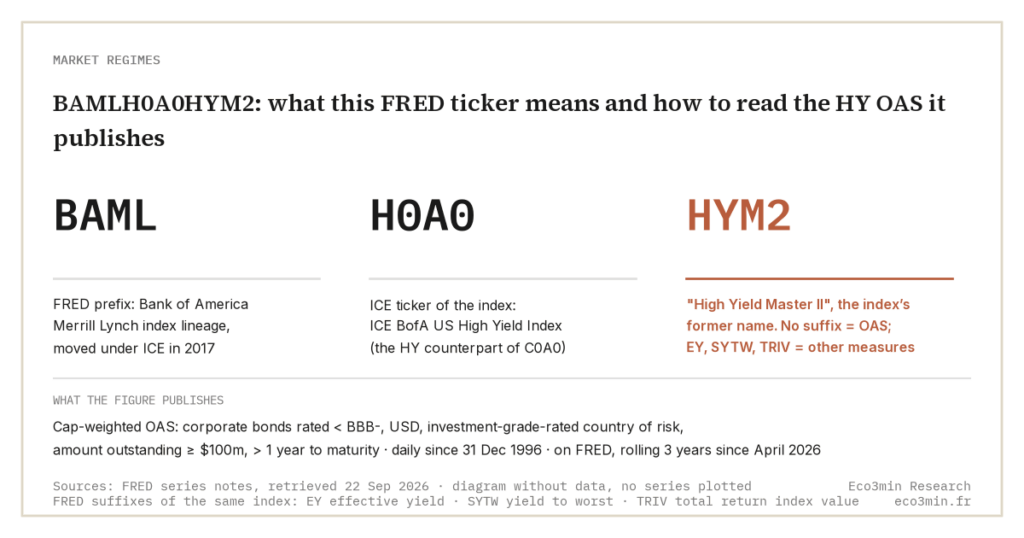
FRED ticker BAMLH0A0HYM2 publishes the daily Option-Adjusted Spread of the ICE BofA US High Yield index. Behind the code sits a defined issuer scope, a standardized calculation methodology, and a governance history worth unpacking.
TL;DR
FRED's BAMLH0A0HYM2 publishes the daily ICE BofA US High Yield OAS, covering USD corporate bonds rated below BBB-, and four methodology choices govern what that daily number actually captures.
- The code carries its history: BAML is the Bank of America Merrill Lynch legacy, kept through ICE's 2017 acquisition; the series starts on 31 December 1996, covering nearly three decades and six credit-stress cycles, with no continuity to pre-1997 Lehman or Barclays series.
- The daily figure is a market-cap-weighted OAS, rebalanced monthly, with defaulted bonds exiting at month-end; unlike CPI, NFP or GDP it is never revised after publication, which keeps the historical series clean for backtests.
- The aggregate hides three things: rating dispersion (the CCC tail isolates via BAMLH0A3HYC), a shifting sector mix (energy above 14% of the index in 2013 per Muzinich, 18% by summer 2014 per J.P. Morgan), and private credit entirely, about $2.1 trillion worldwide in 2023, three-quarters of it in the US (IMF, April 2024 GFSR).
Knowing the methodology is not a technical refinement: it is the prerequisite for comparability between figures cited in the literature and the series that FRED actually publishes. This satellite breaks down the four structural choices that define what the spread measures.
Decoding the BAMLH0A0HYM2 ticker
The BAMLH0A0HYM2 code follows the ICE/BofA Bond Indices naming convention. The sequence is not arbitrary: BAML is the legacy of Bank of America Merrill Lynch Indices, the historical owner of the index family before its acquisition by Intercontinental Exchange in 2017. H0A0 is ICE’s own ticker for the index, the ICE BofA US High Yield Index, the high-yield counterpart to the C0A0 used for investment grade. HYM2 abbreviates “High Yield Master II”, the index’s former name, kept in the FRED code; no suffix denotes the Option-Adjusted Spread, and the other measures of the same index carry their own suffix (EY for effective yield, SYTW for yield to worst, TRIV for the total return index value). Code continuity through the governance change was deliberate: institutional users (central banks, asset managers, market infrastructure) had built systems around this nomenclature, and altering it would have broken decades of reference series.
The Federal Reserve Bank of St. Louis republishes this series on FRED under the ticker BAMLH0A0HYM2, with daily updates excluding US bank holidays. The series begins on 31 December 1996, providing nearly three decades of history at ICE, sufficient to cover six credit-stress episodes (peaks above 650 basis points in 1998, 2001-2002, 2008-2009, 2011, 2016 and 2020), which constitutes the empirical scope of any macro reading of the spread. Since April 2026, however, FRED displays only a rolling three years of observations for ICE BofA series (FRED series note, read on 22 September 2026): the long history lives at ICE Data Indices or in an earlier extract, no longer on the FRED page.
The ICE/BofA Methodology in Four Structural Choices
The index construction rests on four methodological decisions that determine what the daily figure actually measures. None of these decisions is neutral, but none is arbitrary; they are documented in the ICE Index Methodology Document, with updates published on the ICE Data Services website.
Issuer Scope
The ICE BofA US High Yield Master II index includes corporate bonds rated below BBB- (Baa3 at Moody’s), with an investment-grade-rated country of risk (average of Moody’s, S&P and Fitch sovereign ratings), publicly issued in the US domestic market and denominated in US dollars, with more than one year of remaining maturity, a fixed coupon schedule and a minimum amount outstanding of $100 million. Original-issue zero-coupon bonds, 144a securities and pay-in-kind securities qualify; defaulted and DRD-eligible securities are excluded (FRED series notes, read on 22 September 2026). This precision matters: an analyst referring to “the HY spread” from a different source (for example the Bloomberg Barclays US Corporate High Yield index, or the JP Morgan US HY index) compares related but not strictly identical quantities. Level differences across these indices on the same day come down to inclusion rules and default-handling conventions.
Rebalancing, Inclusion and Default Treatment
Index rebalancing occurs on the last calendar day of each month. Newly eligible issues enter on that date, and bonds that no longer meet the criteria exit. The default-treatment rule is a particularly important methodological point: a bond that defaults remains in the index until the end of the calendar month in which the default was recorded, then exits. This rule has a visible consequence on the daily series in cases of mass defaults concentrated over a few days: the anticipated default premium reroutes immediately into the spread of remaining bonds, but the defaulted bond itself continues to widen the aggregate index for a few additional days before exclusion.
OAS Calculation
The Option-Adjusted Spread is calculated for each bond as the constant yield spread that, added to the Treasury rate at each maturity along the curve, equates the present value of the bond’s cash flows to its market price, after accounting for embedded optionality (call, put, prepayment). The aggregate index OAS is then computed as the market-cap-weighted average of individual OAS values. This cap-weighting carries an important consequence: large issuers carry a structurally heavier weight in the aggregate spread, and an isolated move on a single sizable name can shift the index by several basis points. This is why intra-index dispersion is an indispensable analytical complement to the aggregate level.
Temporal Scope and Historical Revisions
The series begins on 31 December 1996. Earlier series did exist (notably the Lehman Brothers High Yield Index, acquired by Barclays in 2008 and later integrated into Bloomberg in 2016), but they are not continuous with the current methodology. Any historical reading reaching back before 1997 therefore requires comparability caveats. ICE Data Indices puts its rules through an annual review (the Annual Fixed Income Index Rule Review; the 9 April 2024 edition fed the retained changes into the November 2024 constituent lists) and publishes each change in a methodology notice. The published history remains a single series since 1996, but an analyst cross-referencing figures on either side of a rule review should be aware that a few basis points of margin may exist.
Reading the Daily Figure
FRED publishes the value at the close of the New York business day, with a few hours’ lag relative to ICE’s intra-day calculation. FRED publishes the value in percent with two decimals (2.68 on 18 September 2026), which is whole basis points (268 bps) in most reproductions. A spread of 312 bps published on a Tuesday was calculated based on Monday’s end-of-day US prices; a European user consulting the series early in the day therefore sees a value already slightly out of date relative to live market conditions.
The daily figure is not revised after publication, except in cases of documented operational error. This ex-post stability is an asset for backtests: the historical values one reads today on FRED are, save for marginal cases, identical to those that would have been read at the time. This distinguishes HY OAS from other classic macro series (revised CPI, revised NFP, revised GDP), where the first-release value can differ substantially from the final value. For the spread, the figure displayed is the final figure.
The daily frequency also means HY OAS captures intra-month moves that many other macro indicators smooth out. This is what allows reading the current spread configuration since 2023 over short windows (4 to 12 weeks), inaccessible to monthly indicators such as the Moody’s default rate. The underlying BAMLH0A0HYM2 series can also be downloaded as a clean historical extract for time-series analysis outside FRED.
Three Methodological Choices With Analytical Consequences
The ICE/BofA methodology is not neutral in its analytical implications. Three points deserve explicit naming because they are a regular source of reading errors.
First, the aggregate index masks dispersion by rating. The HY OAS published by FRED is the market-cap-weighted average of BB, B, and CCC bond OAS. A compression of the aggregate can mask deterioration in the CCC tail if BB spreads compress faster. The ICE BofA US High Yield CCC & Lower index (ticker BAMLH0A3HYC) allows that segment to be isolated, and its spread to BAMLH0A0HYM2 is an intra-segment dispersion indicator. More context: our sub-pillar on financial stress signals.
Second, the sectoral composition evolves over time. The weight of the energy sector in US high yield exceeded 14% of the index in 2013 (Muzinich, January 2024) and reached 18% by summer 2014 with shale oil production, according to J.P. Morgan (cited by Peritus Asset Management, June 2017), before retreating to 15% in 2017. The same HY OAS level at two different dates can therefore reflect very different sectoral risk compositions. That evolution partially explains why the 2015-2016 episode, concentrated on the energy sector, produced an aggregate widening that did not carry the typical macro signature of a diffused default cycle.
Third, the BB+ and below scope excludes private credit, which has experienced massive growth since 2015 (private credit amounted to about $2.1 trillion in assets and undeployed commitments worldwide in 2023, three-quarters of it in the US, according to the IMF’s April 2024 Global Financial Stability Report). HY OAS therefore measures only the publicly issued portion of the corporate HY segment. Deterioration that first manifested in private credit (less liquid, less observable, with no daily benchmark) could precede its appearance in BAMLH0A0HYM2 by several quarters. This limitation cannot be circumvented from the FRED series alone; it requires cross-referencing with Senior Loan Officer surveys or BDC (Business Development Company) public disclosures.
From Ticker to Macro Reading
The BAMLH0A0HYM2 methodology described here is the technical prerequisite to any macro reading of the spread. Once those methodological choices are understood, the daily figure becomes readable as a composite indicator, but that macro reading is itself a distinct object, treated as an anticipation measure. The macro reading of HY OAS as a recession signal and of equity reversals constitutes the primary interpretive framework of this cluster.
This foundation satellite belongs to the family of leading systemic-stress indicators identified by Eco3min, whose common function is to capture hidden tensions before they manifest in published macro aggregates. The methodological difference with the IG index (BAMLC0A4CBBB and other investment-grade series) is treated as a separate object in the cluster, because it involves partially different calculation choices that deserve their own development.
- BAMLH0A0HYM2 publishes the Option-Adjusted Spread of the ICE BofA US High Yield Master II index, scope BB+ and below, USD-denominated, investment-grade-rated country of risk, at least $100 million outstanding.
- The series begins on 31 December 1996. There is no direct comparability with earlier indices (Lehman, Barclays).
- Rebalancing is monthly; defaulted bonds exit at the end of the month of default recognition, which can widen the aggregate index for a few days.
- The aggregate index masks dispersion by rating (BB vs B vs CCC) and an evolving sectoral composition; these dimensions are necessary analytical complements to a level-only reading.
Last updated — 6 October 2026
Disclaimer – Financial and Legal Information: The analyses, commentary, and content published on eco3min.fr are provided for informational and educational purposes only. They do not constitute investment advice or a solicitation to buy or sell financial instruments. Past performance is not indicative of future results. All investment decisions involve risk and are the sole responsibility of the reader. Data, charts and calculated series are provided as is and may contain errors or lag behind their source: check any figure against the primary source cited before relying on it. Content describing laws, regulations or contracts reflects the law as of its publication date and does not constitute legal or tax advice; applying it to a specific situation requires a qualified legal or tax professional.
Read next
Full pillar →HY OAS: why this credit spread is a leading signal of recession and equity reversal
The HY OAS, published by FRED under code BAMLH0A0HYM2, bundles three risk premia (perceived default, liquidity, aggregate risk…
Weak or Strong Euro: Imported Inflation and Competitiveness
The euro's level acts on the area's economy through two opposing channels: it changes the price of imports,…
How to Read EUR/USD: What Moves a Currency Pair
EUR/USD is the price of one euro expressed in dollars: when it reads 1.14, one euro trades for…