
HY OAS below 300 bps: reading the record credit-spread compression in 2024-2026

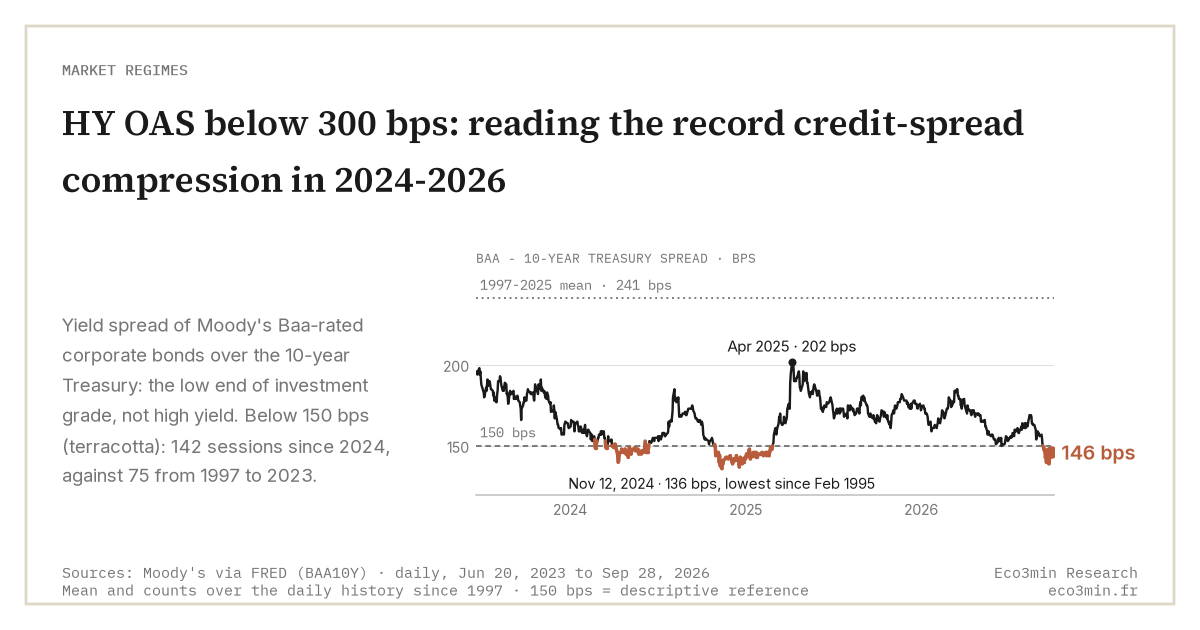
Since October 2024, HY OAS has spent most of its time below 300 basis points, a regime the series had only seen twice before, in 1997-1998 and 2004-2007. This compression coexists with four dynamics that, taken individually, would argue for a wider spread.
TL;DR
Four forces that usually widen spreads (an easing cycle now interrupted, defaults still present, a refinancing wall, geopolitical fragmentation) coexist with an HY OAS at 268 bps, a level the series has rarely held since 1997.
- HY OAS stood at 268 bps on 18 September 2026, 49% below the 521-bp 1997-2025 mean (FRED ticker BAMLH0A0HYM2); the series has only held durably below 300 bps in 1997-1998, 2004-2007 and since October 2024.
- Three readings compete: structural demand from CLOs ($1.4 trillion in April 2025, against a $263 billion post-crisis trough) and HY ETFs (nearly $23.5 billion in mid-2026 SEC filings); cleaner balance sheets (net leverage 3.6x, BB issuers 58% of the index, Barings May 2026); and 2006-2007-style complacency, none decidable from public data.
- A 3.2% one-year expected default probability for US high yield (Moody's, March 2026) and a refinancing wall pushed out to 2028-2029 sit against the compressed spread, a gap between implied and realized default risk that the spread alone does not resolve.
This article lays out the three competing readings circulating in strategy literature since 2024 and proposes a set of observable variables to arbitrate between them over time. None of the three readings is resolved here.
The Current Level Within the Historical Grid
HY OAS, published by ICE/BofA and republished by FRED under the ticker BAMLH0A0HYM2, has traded since summer 2024 around 300 basis points, with two abrupt moves to 393 and 461 bps in August 2024 and April 2025, and a level of 268 bps on 18 September 2026. This is the bottom of the historical distribution: the 1997-2025 mean is 521 bps and the median 455, putting the current spread 49% below the mean. The technical methodology of ticker BAMLH0A0HYM2 is detailed in the cluster’s foundation satellite; what deserves development here is the empirical rarity of the observed level.
Over the 1997-2026 period, HY OAS has only traded durably below 300 bps across three distinct windows. The first runs from 22 January 1997 to 12 May 1998, around the onset of the Asian crisis: 226 sessions below 300 in 1997, with a low of 244 bps on 17 October 1997. The second stretches from late December 2004 to 9 July 2007, in two legs (a month in early 2005, then 15 December 2006 to 29 June 2007 without interruption), with the series low of 241 bps on 1 June 2007, at the height of pre-GFC complacency. The third has been underway since 4 October 2024 and already counts 372 sessions below 300 bps, more than either predecessor. In between, the 2017-2018 compression stopped at 316 bps and the 2021 one at 301.
These four windows share a common feature: they all correspond to phases of simultaneous compression of global risk aversion and anticipated default premium. But their macro contexts were very different. 1997: robust growth, strong dollar, beginnings of Asian tensions. 2005: Fed mid-hiking cycle, before the 2006 pause. 2006-2007: monetary policy on hold after hikes, housing-market complacency. The current phase has an even more singular context, deserving point-by-point examination. A companion piece: our mapping of the current macro regime.
Four Rarely-Compatible Dynamics
The current compression coexists with four dynamics that, in the historical regularity of the series, have not combined simultaneously.
Initial Fed Easing Cycle
The Federal Reserve entered a rate-cutting cycle in September 2024, took the target down to 3.50-3.75% by 11 December 2025, then interrupted it by raising the target to 3.75-4.00% on 17 September 2026. Historically, easing-cycle entries have produced variable HY OAS configurations: clean compression in 2019 (mini-cycle), gradual widening in 2007 (pre-GFC entry), limited reaction in 2001. A sustained spread compression below 300 bps in the initial phase of an easing cycle, as is the case today, is not a standard pattern across documented episodes.
HY Default Rate Above the Mean
Moody’s put the one-year expected default probability for US high yield at 3.2% in March 2026 (analysis “US corporate default risk in 2026”, published 28 April 2026), down year on year, while warning that a modest confidence shock would surface stress quickly. This expected default level is moderate but not unusually low. It signals that credit-risk materialization has not vanished, contrary to what a durable sub-300-bp compression would suggest. The gap between the anticipated default rate (implied by the compressed spread) and the realized default rate (Moody’s) is one of the analytical blind spots of the current regime.
A Refinancing Wall Pushed Out to 2028-2029
About 20% of the US high yield index matures within three years and another 22% within three to four years, according to Barings (May 2026): the refinancing wall has moved out to 2028-2029 as 2026-2027 maturities were refinanced early. These refinancings will need to be done at market conditions which, depending on signature quality and sector, can diverge significantly from the original 2020-2021 issuance conditions. If a meaningful share of refinancings fails or is done at substantially higher spreads, the effective default rate would mechanically accelerate — a latent risk not captured by the current spread compression.
Active Geopolitical Fragmentation
The fragmentation of supply chains, capital flows and international trade relationships since 2022 constitutes a latent risk factor for US corporate margins. A meaningful share of HY issuers in the consumer-discretionary and industrial segments faces the impact of this fragmentation via input costs and supply-chain reorganization capex. This effect is diffuse and does not feed mechanically into HY OAS, but it should, in theory, justify a higher risk-aversion premium than the one implicit at 300 bps.
The simultaneous coexistence of these four dynamics with a durable HY OAS compression below 300 bps is statistically atypical. Over the 1997-2025 series, no prior episode combined all four elements. The closest analogue, 2006-2007, had different fundamentals: nearer maturities, a default rate at its cycle low, no active geopolitical fragmentation, and a monetary cycle on hold after hikes rather than coming out of cuts.
Three Competing Readings
Three non-exclusive interpretations circulate in the credit-strategy notes published since 2024. They do not mutually exclude and may partially coexist.
Structural Compression (CLO + Retail ETF)
Under this first reading, the current compression is mainly explained by the profound transformation of the HY investor base over the past fifteen years. The CLO (Collateralized Loan Obligations) market stands at $1.1 trillion outstanding at end-2024 and $1.4 trillion in April 2025, against a $263 billion post-crisis trough (Guggenheim Investments, updated 11 August 2026). Although CLOs primarily invest in leveraged loans, their buying pressure transmits to HY spreads via indirect arbitrage: issuers tilt toward the cheaper financing vehicle, mechanically aligning spreads. On the retail side, the two main HY ETFs hold nearly $23.5 billion according to their latest N-PORT reports filed with the SEC ($16.1 billion for HYG at 31 May 2026, $7.3 billion for JNK at 30 June 2026): modest relative to the market, but with flows that are procyclical by construction.
Implicit consequence: if the structural reading is correct, HY OAS durably underprices credit risk relative to what a purely active market would demand. The signal function of the spread is structurally biased downward — a larger widening magnitude would be required to signal stress equivalent to a historical episode. the dashboard of financial stress signals extends this reading across the cycle.
Macro Absorption (Improved Corporate Balance Sheets)
The second reading argues that US corporate balance sheets have structurally improved since 2020, which would empirically justify a lower default premium. Barings puts net leverage for US high yield issuers at 3.6x in May 2026 and notes that BB-rated issuers now make up 58% of the US market, against 49% a decade ago: average index credit quality is close to its historical best. Pushing maturities out to 2028-2029 reduces near-term refinancing risk by the same token.
The limit of this reading is that it examines the median aggregate and may mask dispersion. If the tail of the distribution (CCC issuers, recent LBOs) deteriorates while the median improves, a default cycle concentrated on a reduced fraction of the index can coexist with an aggregate spread compression.
Cyclical Complacency (2006-2007 Parallel)
The third reading is the 2024-2026 analogue of the diagnosis applied ex post to 2006-2007: the market systematically underprices a risk it cannot yet identify, through excess confidence in the Fed reaction function, in debt absorption, or through behavioral inertia. This reading is by construction uncomfortable because it is never verifiable ex ante.
The 2006-2007 parallel deserves careful articulation, however. On a pure statistical plane, the 2006-2007 cycle low (241 bps on 1 June 2007; 325 bps on average in October 2006) and the current window’s low (260 bps on 28 August 2026) sit in the same zone, and several sentiment indicators show similarities (realized-volatility compression, narrow intra-segment dispersion). But the macro context differs: in 2006, the Fed hiking cycle was near its end; in 2026, the cutting cycle has been interrupted by a hike. Corporate balance sheets were on average less robust in 2006 than today. The “cyclical complacency” reading is therefore not a copy-paste of 2006-2007 — it points toward a potentially comparable behavioral dynamic, in a partially different fundamental frame.
Observable Variables to Arbitrate Over Time
None of the three readings can be validated ex ante from publicly available data alone. Three observable variables nonetheless allow progressive arbitration over time, without any of them constituting an operational threshold.
BB-CCC rating dispersion is the first variable. The spread differential between BB-rated and CCC-rated bonds has oscillated between 359 and 1,506 basis points over 2010-2025, median 642, with sharp widenings at every entry into a stress cycle; it stood at 928 bps on 18 September 2026 (BB 155, CCC 1,083), above its long-run median while the aggregate spread sits at its lows. If dispersion remains contained despite observable deterioration of CCC-issuer fundamentals, the “structural compression” interpretation is supported. If dispersion widens rapidly at stable aggregate HY OAS, the tail of the distribution is deteriorating and the median masks the deterioration — consistent with the “macro absorption with dispersion” interpretation.
2026-2027 maturity-wall absorption rate is the second variable. If issuers refinance without difficulty at spreads close to original issuance level, the macro-absorption reading is supported. If a meaningful share of refinancings is deferred, extended, or done at substantially higher spreads, the cyclical reading gains consistency and a deferred default cycle becomes probable. Related discussion: why a persistently strong dollar has not broken markets.
Spread reaction to moderate-amplitude shocks is the third variable. This variable has already spoken twice: the spread widened 85 bps in ten sessions in August 2024 (308 to 393) and 152 bps in April 2025 (309 to 461), before returning below 300 within weeks. As long as widenings resolve at that speed, the dominant-structural-demand hypothesis remains valid. If a compression break occurs on a shock of moderate magnitude, that is the most actionable observation of a regime shift. The implied-volatility series sets out how the indicator is built.
Dated update, 22 September 2026. The spread fell to 268 bps on 18 September 2026, 49% below the 1997-2025 mean of 521 bps, after a 260-bp low on 28 August; the window opened in October 2024 now totals 372 sessions below 300 bps, the longest in the series. Two elements of the frame above have changed since writing: the easing cycle stopped, with the Fed raising its target to 3.75-4.00% on 17 September 2026, its first hike since July 2023; and the spread twice showed it can widen fast, to 393 bps on 5 August 2024 and 461 bps on 7 April 2025, returning below 300 within weeks in both cases (Eco3min calculation on BAMLH0A0HYM2 and DFEDTARU).
Honest Analytical Status
The current compression is over-determined in the analytical sense: several credible explanations coexist, and publicly available data does not allow ex ante arbitration between them. Three interpretations are explicitly named rather than synthesized into a single reading, because a synthesis would impose a verdict that the empirical material does not warrant. This analytical honesty carries a practical consequence: the reading framework for HY OAS as a leading signal must be applied to the contemporary regime by integrating this indeterminacy, not by forcing through it.
The HY-VIX divergence characteristic of the current regime adds a connected analytical layer: if compression can be structural, divergence with VIX is consistent. If it is macro, divergence with VIX is consistent. If it is cyclical, divergence is too. Triangulation of HY OAS / VIX / corporate fundamentals does not arbitrate between the three interpretations — it merely confirms that the regime is atypical. The live BAMLH0A0HYM2 dataset can be consulted directly for any reader wanting to track the spread evolution in real time.
A reasonable companion question, do credit spreads still predict recessions, receives a top-of-funnel framing that usefully complements the cluster-level reading developed here. The whole belongs to the family of leading indicators and market regimes identified by Eco3min.
- At 268 bps on 18 September 2026, HY OAS is 49% below its 1997-2025 mean of 521 bps; the series has only seen two other durable windows below 300 bps, in 1997-1998 and 2004-2007.
- Four rarely-compatible dynamics coexist: an easing cycle interrupted by the Fed’s 17 September 2026 hike, defaults still present, maturities pushed out to 2028-2029, active geopolitical fragmentation.
- Three competing readings circulate: structural compression (CLOs $1.4tn in April 2025, HY ETFs nearly $23.5bn in mid-2026), macro absorption (net leverage 3.6x, 58% BB in the index), cyclical complacency (partial 2006-2007 parallel), and no publicly available data allows ex ante arbitration.
- Three observable variables allow progressive arbitration over time: BB-CCC dispersion (928 bps on 18 September 2026, against a 642 median since 2010), absorption of the 2028-2029 maturities, and how fast a widening resolves.
Last updated — 6 October 2026
Disclaimer – Financial and Legal Information: The analyses, commentary, and content published on eco3min.fr are provided for informational and educational purposes only. They do not constitute investment advice or a solicitation to buy or sell financial instruments. Past performance is not indicative of future results. All investment decisions involve risk and are the sole responsibility of the reader. Data, charts and calculated series are provided as is and may contain errors or lag behind their source: check any figure against the primary source cited before relying on it. Content describing laws, regulations or contracts reflects the law as of its publication date and does not constitute legal or tax advice; applying it to a specific situation requires a qualified legal or tax professional.
Read next
Full pillar →HY OAS: why this credit spread is a leading signal of recession and equity reversal
The HY OAS, published by FRED under code BAMLH0A0HYM2, bundles three risk premia (perceived default, liquidity, aggregate risk…
Weak or Strong Euro: Imported Inflation and Competitiveness
The euro's level acts on the area's economy through two opposing channels: it changes the price of imports,…
How to Read EUR/USD: What Moves a Currency Pair
EUR/USD is the price of one euro expressed in dollars: when it reads 1.14, one euro trades for…