Monetary Policy and the Business Cycle: When Timing Becomes the Real Signal
Monetary policy decisions do not have the same impact at every phase of the business cycle. How the cycle acts as an amplifier or shock absorber for rate adjustments.

Monetary policy is often analysed as an isolated lever. In practice, its effectiveness depends closely on the phase of the business cycle in which it is deployed, which explains effects that are sometimes lagged, sometimes amplified, sometimes underwhelming.
TL;DR
The same rate move lands differently across the cycle: the ECB puts the cost of its 2022-2023 tightening at 2 points of growth a year on average over 2022-2025 (Economic Bulletin 3/2023), and the same dose bites harder once balance sheets and confidence compress.
- A rate decision first shifts the marginal cost of capital, then diffuses into investment, employment and demand; the cycle phase decides whether it works as a preventive brake or a sharper shock, the same tool producing opposite outcomes.
- At end-2025, euro-area headline inflation was back at 2.0% (December, Eurostat) with annual growth down to 1.1% in the fourth quarter, a late-stage slowdown in which restrictive effects keep spreading even as cyclical momentum fades.
- Published cycle indicators are lagged, revised and sometimes contradictory, so policy can be set for a phase the economy has already left, and the cost is cumulative misalignment rather than a single diagnostic error.
- Three markers track the cycle-policy fit: the output gap (observed versus potential growth), corporate margin dynamics as a leading sensitivity signal, and credit dynamics reflecting effective transmission.
The initial mechanism is discreet but decisive. A rate decision first acts on the marginal cost of capital and on financing conditions, before diffusing into investment, employment and demand. This channel is well known. What is less acknowledged is that its intensity varies sharply depending on whether the economy is in expansion, slowdown or turning point.
The Same Tool, Different Effects Across Cycle Phases
In late-cycle expansion, when growth is already close to potential, restrictive monetary policy mainly acts as a preventive brake. The aggregate order of magnitude is known: for the tightening begun in December 2021, roughly 450 basis points of hikes, the ECB’s model-based assessment (Economic Bulletin 3/2023) puts the impact at 2 points of GDP growth a year on average over 2022-2025, about 0.4 point per 100 basis points, with the peak effect on activity in 2023. The IMF’s April 2024 World Economic Outlook (chapter 2) adds that transmission is stronger where household debt is high and house prices overvalued, and more so when policy is tightening than when it is loosening.
By contrast, in a slowdown phase, the same adjustment can produce a more pronounced effect. Investment sensitivity rises when margins compress and confidence deteriorates. This gap explains why apparently similar decisions lead to very different macro trajectories.
This logic complements the broader analysis of monetary policy transmission to the real economy, by showing that the business cycle acts as either an amplifier or a shock absorber depending on the moment.
This cyclical reading cannot be isolated from the broader framework of monetary policy and interest rates, whose effects rarely diffuse instantaneously. It connects in particular with the analysis of monetary transmission lags, which shows that the impact of a decision depends as much on its timing as on the economic phase in which it is implemented. The full chronology is retraced in the Eco3min view of the earnings-cycle response to monetary policy.
The Consensus and Its Main Limitation
The central scenario adopted by many participants assumes a relatively linear articulation: tightening at the top of the cycle, easing at the bottom. This reading facilitates modelling and communication.
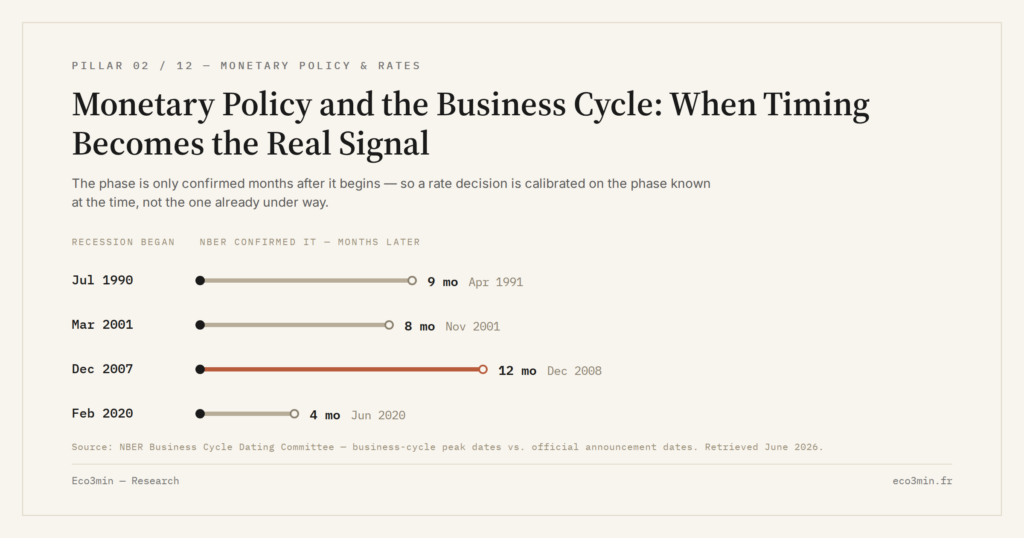
The analysis diverges on one key point. The cycle is not observable in real time with precision. Published indicators are lagged, revised, sometimes contradictory: the NBER dated the last four US recessions 4 to 12 months after they began (July 1990 announced in April 1991, December 2007 in December 2008, February 2020 in June 2020), and Eurostat’s estimate of euro area growth in the second quarter of 2026 moved from +0.4% on 30 July to +0.6% on 7 September. Monetary policy can therefore be calibrated for a perceived cycle phase while the economy has already shifted into another. The issue is not the occasional diagnostic error, but the cumulative effect of misaligned decisions.
When the Cycle Becomes a Source of Lag
Between 2022 and end-2025, developed economies experienced rapid tightening, an extended phase of high rates, then a cutting cycle. At end-2025, headline inflation in the euro area was back at 2.0% to 2.1% (October to December, Eurostat), while growth had slowed to 1.1% year on year in the fourth quarter, from 1.6% in the first. In the United States, the Fed was still cutting (from 4.25-4.50% in September to 3.50-3.75% in December 2025) against real GDP growth steady at around 2% year on year (BEA). This configuration suggested a euro area in late-stage slowdown, but without outright contraction.
As of 22 September 2026, the phase has changed again without notice: the energy shock tied to the Middle East conflict lifted euro area inflation to 3.2% in August (Eurostat), the ECB raised its deposit rate to 2.25% on 17 June and 2.50% on 16 September, and the Fed its target to 3.75-4.00% on 17 September, while euro area growth was only 0.6% year on year in the first quarter and 1.2% in the second. A tightening applied to an economy still absorbing the 2024-2025 cuts: exactly the configuration this article describes.
In this context, part of the restrictive effects continues to spread even as cyclical momentum weakens. The cycle here acts as a lag factor: monetary policy reacts to past imbalances while the economy is still absorbing earlier shocks.
What the Reader Is Actually Trying to Understand
The real question is not so much whether monetary policy is restrictive or accommodative, but whether the economy is still reacting to decisions taken in expansion or already to a late-cycle regime. Behind this question lies a simple concern: confusing a cyclical slowdown with a mere pause.
Plausible Scenarios and Points of Fragility
Mainstream projections rely on gradual normalisation, without abrupt rupture. This scenario rests on the assumption that potential growth remains sufficient to absorb the high cost of capital.
An alternative scenario nonetheless deserves attention. If the slowdown extends while financial conditions remain tight, the cumulative effect could appear later, as a more pronounced adjustment in employment or investment. Conversely, a positive demand shock or fiscal easing could neutralise part of the monetary effect, altering the reading of the cycle.
Observable Economic Impacts
For firms, this articulation translates into reduced visibility on the cost of capital. Projects launched in the upswing can become less profitable in the downswing, independently of any new monetary decisions. For households, the impact is slower: mortgages, durable consumption and savings respond with a lag often greater than a year.
In financial markets, this temporality explains episodes of disconnection between immediate macro indicators and valuations, as participants seek to anticipate not the next decision, but the precise phase of the ongoing cycle.
Useful Indicators for Reading the Cycle–Monetary Articulation
- Output gap (observed vs potential growth): indicates whether the economy is overheating or running below potential.
- Corporate margin dynamics: leading signal of rate sensitivity.
- Credit dynamics: reflects effective transmission across cycle phases.
Reading Perspective
This is not the central scenario today, but the hypothesis of a growing gap between the real cycle and monetary policy remains underestimated. The difficulty is not predicting the next decision, but accurately positioning the economy within the transmission sequence.
What This Articulation Concretely Implies
- Monetary policy cannot be read independently of the business-cycle phase.
- The same rate adjustment can produce opposite effects depending on the moment.
- Current macro signals often reflect decisions taken several quarters earlier.
Last updated — 22 September 2026
Disclaimer – Financial Information: The analyses, commentary, and content published on eco3min.fr are provided for informational and educational purposes only. They do not constitute investment advice or a solicitation to buy or sell financial instruments. Past performance is not indicative of future results. All investment decisions involve risk and are the sole responsibility of the reader.
Read next
Full pillar →Real Rates: The True Cost of Capital Is Repricing
Why real rates are reasserting themselves as markets' anchor and how to recalibrate investment and financing decisions facing…
Real Interest Rates: The Quiet Signal Reshaping Markets
Real interest rates: why their persistence in positive territory in 2026 is reshaping the rules for bonds, equities,…
OAT-Bund Spread: A Quiet Gauge of French Sovereign Risk
OAT-Bund spread: how this yield gap has become a key signal on French sovereign risk, fiscal policy and…