
Why Commodities React Differently to Inflation
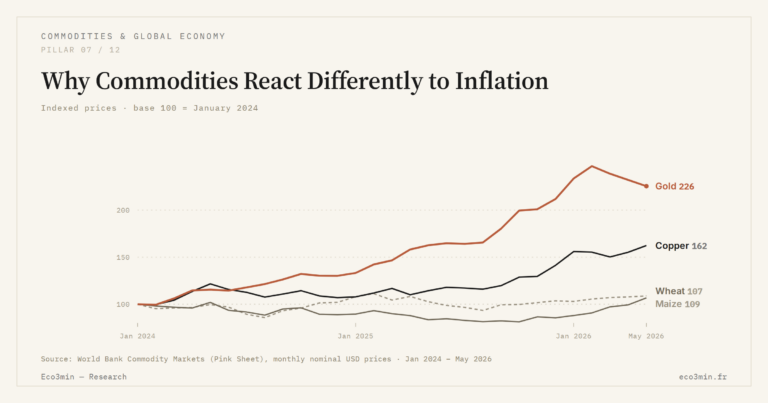
Inflation does not affect commodities uniformly. Cost structures, demand elasticity, and exposure to financial flows produce divergent price reactions across energy, metals, and agriculture.
https://eco3min.fr/en/commodity-regimes-physical-constraints-energy-transition/
Inflation does not affect commodities uniformly. Cost structures, demand elasticity, and exposure to financial flows produce divergent price reactions across energy, metals, and agriculture.
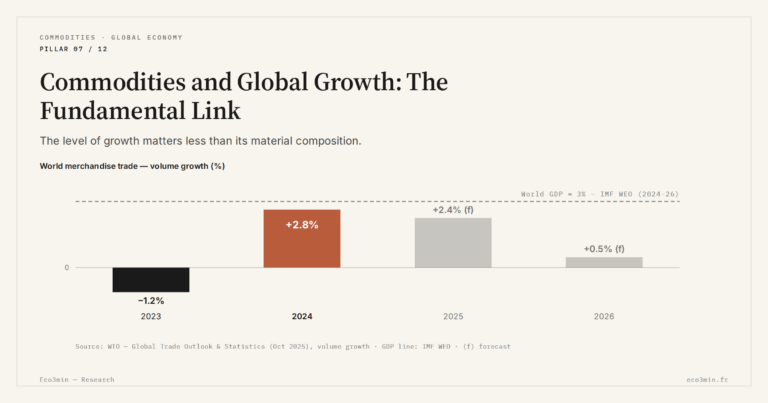
Global growth shapes commodity demand through industrial activity, infrastructure, and trade — but with sectoral and geographic lags. Aggregate GDP matters less than its composition and the elasticity of available supply.
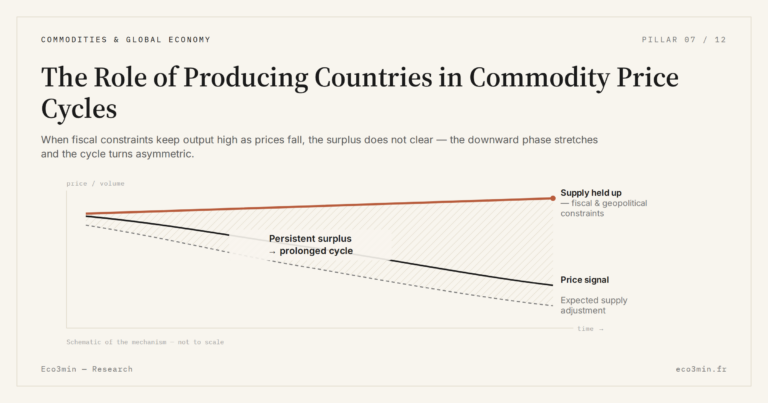
Commodity cycles do not only reflect global demand. A decisive share of their amplitude and duration stems from the choices of producing countries — fiscal trade-offs, quota coordination and geopolitical priorities that often delay supply adjustments and prolong imbalances.
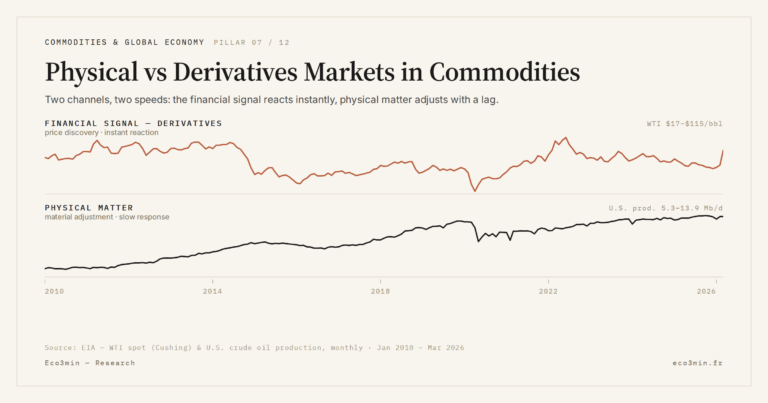
Commodity prices result from the interaction between physical and derivatives markets. Financial volumes dominate trading, but material balance still structures durable equilibria. Understanding the distinct role of each channel clarifies what price moves actually signal.
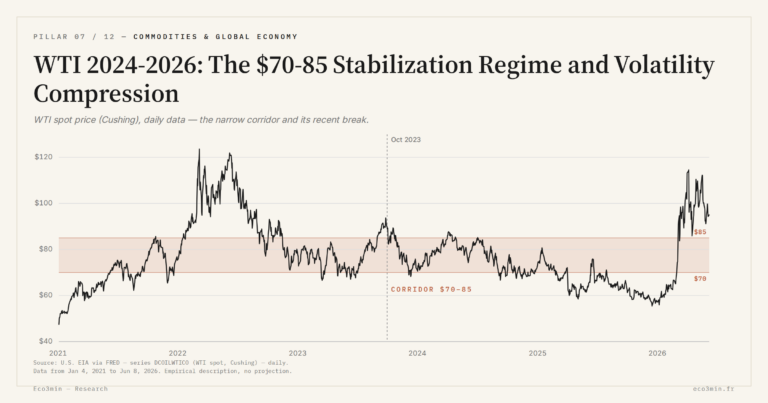
From October 2023 to the end of 2024, WTI held a narrow $70-85 corridor with compressed realized volatility; 2025 let it slide below $70 and 2026 broke it to the upside ($114.58 on April 7). Three structural readings coexist: slowed…
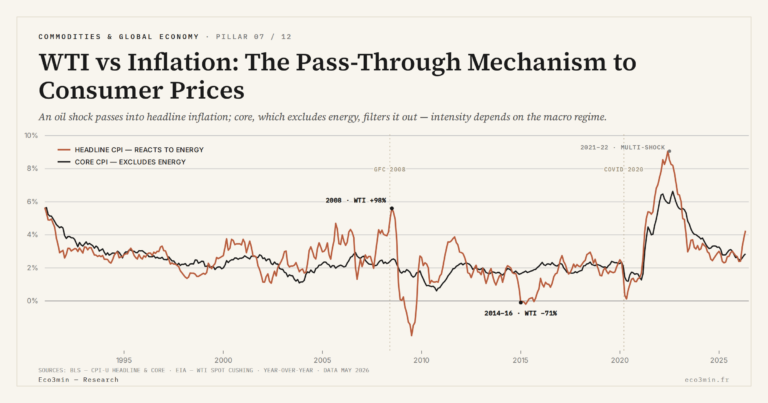
When WTI rises 30%, how much CPI inflation results? Estimated pass-through transmits 0.2 to 0.4 of the shock to headline CPI over six months, weaker on core, with intensity varying by macro regime — pre-GFC, post-GFC, post-COVID. TL;DR Eco3min calculations…
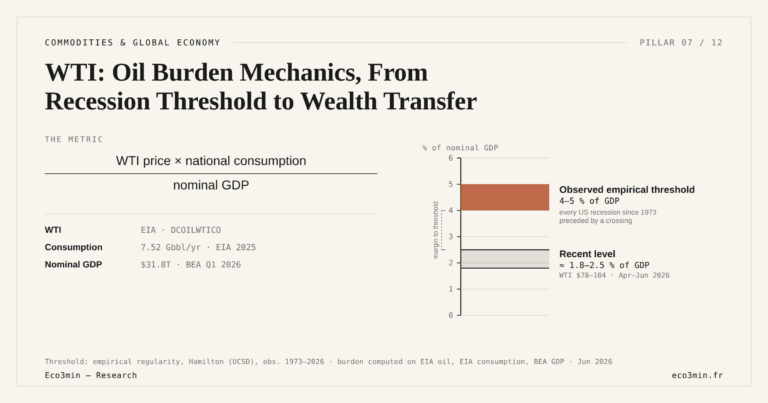
The oil burden measures oil’s weight in the economy: WTI price × national consumption / nominal GDP. Formalized by James Hamilton from 1983 onwards, the metric indicates that above 4-5% of GDP, three transmission channels produce a cumulative dynamic that…

Since 1973, WTI has traversed seven major shocks. Each combines in variable doses three ingredients — physical supply constraint, structural demand pull, financial stress — whose identification enables reading the nature of the shock rather than its magnitude alone. TL;DR…
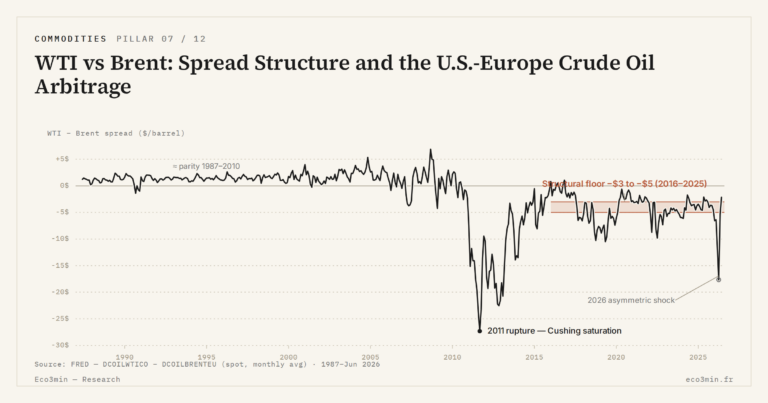
Since 2011, WTI has structurally priced $3 to $5 below Brent. This discount is not anecdotal: it results from three mechanical factors — U.S. export capacity, Cushing logistics, pricing geography — that clarify what each benchmark actually measures. TL;DR WTI…
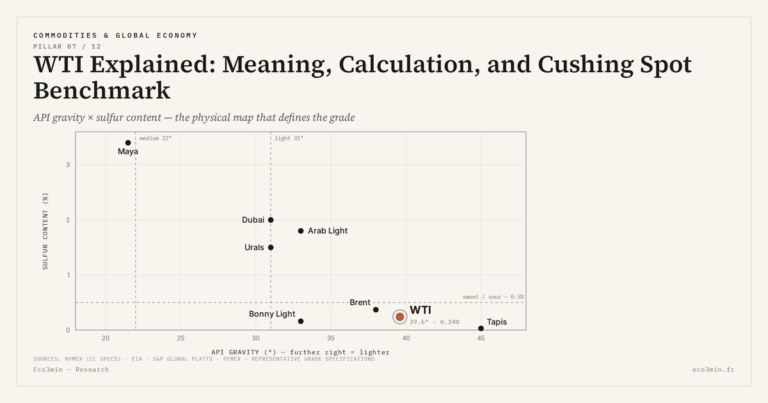
WTI is a precise object: light sweet crude at 39.6 degrees API and 0.24% sulfur, priced at Cushing, Oklahoma, tracked by FRED’s DCOILWTICO series at daily frequency since 1986. These three technical coordinates condition every macroeconomic reading that follows. TL;DR…