WTI 2024-2026: The $70-85 Stabilization Regime and Volatility Compression

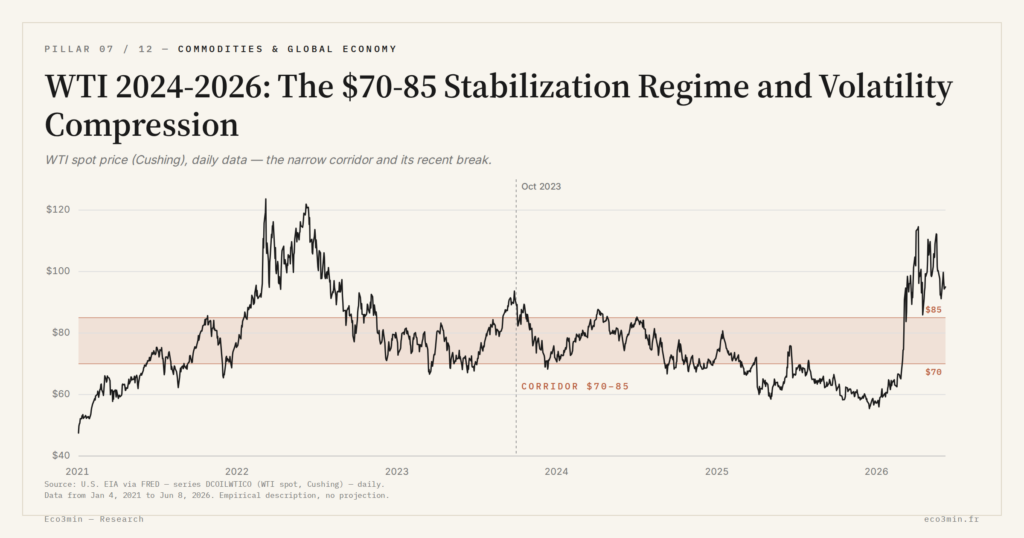
From October 2023 to the end of 2024, WTI held a narrow $70-85 corridor with compressed realized volatility; 2025 let it slide below $70 and 2026 broke it to the upside ($114.58 on April 7). Three structural readings coexist: slowed Chinese demand, U.S. shale as swing producer, a U.S. SPR down to 40% of capacity.
TL;DR
A $70-85 WTI corridor held from October 2023 to end-2024 for 80% of sessions, before sliding below $70 in 2025 and breaking to the upside in 2026.
- On demand, China: petroleum and other liquids consumption up +4.9% in 2023 then +2.4% in 2024 (EIA), from +5.7% a year over 2003-2019, with electric vehicles above 45% of Chinese new-car sales in 2024.
- On supply, shale: a $65 Permian new-well break-even, $61-70 across basins (Dallas Fed Energy Survey, Q1 2025), damps moves both ways on a 6-to-18-month cycle, tempered by post-2020 capital discipline favoring buybacks over drilling.
- The SPR at 285 of 714 Mb on September 11, 2026 (40% of capacity, EIA): 128 Mb drawn since end-2025 against the 2026 shock, after the 272 Mb pulled between September 2021 and July 2023; about 429 Mb would be needed to refill, an asymmetric lever on shocks.
This piece maps the three readings. It does not rank them: each contributes to explaining the stabilization, and each carries a different durability horizon.
1. The $70-85 Stabilization Regime: Empirical Facts
Since October 2023, WTI has traded in a narrow corridor. Per FRED DCOILWTICO, over the October 2023 to December 2024 period (311 sessions), 100% of trading sessions occurred between $65 and $90 ($66.73 to $89.35), and 80% between $70 and $85 — unusual concentration for a commodity that historically traverses $50-amplitude corridors over two years. The average over the period is $77, the 90-day rolling standard deviation $3.9 on average ($2.5 to $5.5), versus $5.1 on average over the 2010-2020 decade. The corridor does not hold beyond that: in 2025 the average falls to $65.4 ($55.44 to $80.73) and only one session in five stays between $70 and $85; over October 2023-September 2026 as a whole, the share of sessions inside the corridor is down to 46%. The wider context: The relative dynamic of gold and crude oil.
WTI realized volatility over the same period is also compressed. Calculated as the annualized standard deviation of daily returns over a 30-day rolling window, it sits between 20 and 40% eight times out of ten over October 2023-December 2024 (median 31%) — versus an average of 38% (median 33%) over 1990-2020 and peaks above 300% in April 2020. The OVX (CBOE Crude Oil ETF Volatility Index, FRED OVXCLS) confirms this relative compression: 34 on average over October 2023-December 2024 versus 39 over 2007-2023. For the equity-volatility analogue, see our VIX dataset.
The contrast with previous phases is sharp. Over 2010 to mid-2014, WTI traded between $65 and $113 with average realized volatility of 25%. Over 2014-2020, the corridor widens considerably ($26 in February 2016 to $108, before the April 2020 collapse) with episode-contrasted volatility. Over 2021-2023, after the COVID and Ukraine episodes, the corridor remains wide ($47 to $124). The October 2023-December 2024 period is therefore a qualitative break: the first phase of prolonged stabilization in a narrow corridor since 2014.
As of September 22, 2026. The regime described here came undone in two steps. In 2025, WTI slid below the corridor (average $65.4, low of $55.44 on December 16, 2025) without a pickup in volatility (30-day median 26%). In 2026, it broke to the upside: $114.58 on April 7, 2026, the highest since March 2022, and still $107.02 on September 15, 2026, the latest FRED print; 30-day realized volatility reached 104% and the OVX 121, against 50 on September 18, 2026. The three readings that follow describe the forces that produced the 2024 corridor; they did not prevent its rupture, and the third (the SPR) was put to the test: 128 Mb drawn between end-2025 and September 11, 2026, down to 285 Mb (EIA).
Historical comparisons across longer periods give additional perspective. The early 2010-2014 corridor was a result of strong demand from China, an OPEC+ acting as cartel with little disruption, and a U.S. shale industry still ramping up. The post-October 2023 corridor emerges from very different conditions: weaker Chinese demand, a U.S. shale industry mature and disciplined, and an SPR partially drawn down. These different underpinnings make the current corridor structurally distinct, even though the empirical range happens to fall in a similar zone. The lesson is not that history repeats, but that similar empirical patterns can emerge from different structural configurations — which complicates inference from the surface description of the corridor to its expected persistence.
This compression is neither a prediction of a stable future nor a causal reading. It is an empirical description of the regime. For the role of this stabilization in U.S. macro, the reference is the cluster’s WTI as comprehensive macro signal which synthesizes the three analytical functions of the U.S. barrel. For the live WTI series tracked at daily frequency, see current WTI tracking on Eco3min.
2. Reading 1: Slowed Chinese Demand
The first reading emphasizes the structural slowdown of Chinese oil demand. Per EIA data (International Energy Statistics, petroleum and other liquids), Chinese consumption rose +4.9% in 2023 then +2.4% in 2024, versus +5.7% per year on average over 2003-2019. This deceleration is triple: slowdown of Chinese economic growth (shift from 6-7% per year pre-2019 to 4-5% post-2022), maturation of the auto fleet and shift toward electric vehicles (EVs represent more than 45% of Chinese new car sales in 2024 per BloombergNEF), and structural decline of heavy industry in favor of services.
Quantitatively, the growth gap is substantial. If China consumed 4.7 Mb/d in 2000 and 16.4 Mb/d in 2024, linear extrapolation at the +4.5% pace would have given a 2024 expected level substantially higher. This Chinese demand shortfall relative to the historical trajectory mechanically weighs on the global price, since China represents the principal source of incremental demand since 2000.
The durability horizon of this reading is intermediate. On one hand, the structural slowdown of Chinese growth is probably durable (demographic transition, end of the investment super-cycle). On the other hand, factors can reverse the trend: massive Chinese fiscal reflation, slowdown of EV adoption, idling of competing refineries. None of these reversals is inscribed in current data; none is excluded over a 2-3 year horizon either.
3. Reading 2: U.S. Shale as Swing Producer
The second reading emphasizes the role of U.S. shale as a swing producer capable of responding rapidly to price variations. Per Dallas Fed Energy Survey (quarterly survey of Texas, Louisiana, New Mexico operators), the average break-even for profitably drilling a new well in the Permian basin is $65 (first-quarter 2025 survey, unchanged from a year earlier), within a $61-70 range across basins; covering the operating expenses of an existing well takes $26-45 ($41 on average). This cost structure allows Permian operators to keep drilling even at WTI at $70, while being able to gradually slow down if the price falls below $60, which happened in late 2025.
Shale dynamics act as a damping mechanism in both directions. When WTI rises above $90, operators accelerate drilling and production rises with a 6-9 month lag, bringing supply back to demand. When WTI falls below $65, drilling slows and cumulative production declines over 12-18 months (through natural decline of existing wells combined with the halt of new ones), bringing supply down and the price back up. This short-cycle mechanic, specific to shale, is very different from the long-cycle of traditional offshore projects (Brazil, Mexico, North Sea) which have production lead times of 5-7 years.
The durability horizon is tied to two factors. First, shale productivity per well drilled: productivity gains (lateral length, fracking optimization) have so far compensated for the decline of “sweet spots”. Dallas Fed reports 2024-2025 nevertheless signal a slowing of this productivity improvement. Second, capital discipline among public operators: since 2020, they have adopted a shareholder-return policy (dividends, buybacks) rather than aggressive drilling growth — moderating the supply response relative to earlier cycles.
To understand how this shale swing-producer role interacts with the structural WTI-Brent differential, the cluster addresses it in WTI-Brent spread in the current regime.
4. Reading 3: Partially Refilled U.S. SPR
The third reading emphasizes the state of the U.S. Strategic Petroleum Reserve. Per DOE (Department of Energy), the SPR was drawn down by 272 Mb (million barrels) between late September 2021 (619 Mb) and July 2023 (347 Mb, EIA weekly series), in the context of Biden’s March 2022 decisions aimed at moderating prices after the Russian invasion of Ukraine. The rebound brought the stock back to 413 Mb at end-2025, constrained by the federal budget and DOE-targeted purchase prices ($67-72). The 2026 shock then took it down to 357 Mb at end-May and 285 Mb on September 11, 2026, 40% of the 714 Mb maximum capacity — the lowest level since the weekly series began.
The structural implication is dual and asymmetric. On one hand, the marginal draw-down capacity is limited: with 285 Mb, another intervention on the scale of 2022 (180 Mb drawn in 6 months) would reduce the SPR to about a hundred million barrels. The capacity for rapid intervention in case of supply shock, already weakened relative to 2021, is weaker still after the 128 Mb drawn since end-2025. On the other hand, the refill capacity is substantial: to bring the SPR back to full capacity, about 429 Mb would need to be purchased on the market — significant demand flow that would constitute a mechanical floor on the price if refill accelerated. A complementary angle: our analysis of energy and metals as physical markets.
The durability horizon depends on political trade-offs. An administration wanting to accelerate the refill would buy above current prices, contributing to supporting the market. An administration less concerned with this objective would maintain the current slow pace. The SPR as a variable is therefore both a structural instrument (capacity to intervene against shocks) and a cyclical instrument (flow of purchases or sales on the market). The closest historical precedent is the post-1990 refill following the Gulf War draws, which proceeded gradually over several years and accompanied rather than dominated the price dynamic of that period.
To understand how this current regime translates into U.S. macro — oil burden ~2.5% well below the critical threshold, core inflation little sensitive to narrow WTI moves — the cluster addresses the question in the current ~2.5% oil burden vs 4-5% threshold and in WTI stability and core inflation.
None of the three readings is exclusive; the three coexist and reinforce each other. The “Chinese demand” reading caps the price from above. The “shale swing” reading stabilizes from below. The “SPR” reading introduces shock asymmetry (weak capacity to draw down to moderate a rise, significant capacity to refill to support a decline). The result observed over October 2023-December 2024 — $70-85 corridor with compressed volatility — is consistent with the superposition of the three forces; the 2025 slide and the 2026 rupture mark their limit. Beyond the cluster, this regime fits within commodities and global macroeconomics and within physical energy markets and geoeconomics which structure the Eco3min analysis of physical markets.
- From October 2023 to December 2024, WTI in the $70-85 corridor for 80% of sessions and 30-day realized volatility at a 31% median (vs 38% average over 1990-2020); slide below $70 in 2025, upside break in 2026 ($114.58 on April 7)
- Reading 1 — slowed Chinese demand: +4.9% in 2023, +2.4% in 2024 (EIA) versus +5.7% a year over 2003-2019, consequence of economic slowdown + EV adoption (>45% new car sales 2024) + heavy industry decline
- Reading 2 — U.S. shale swing producer: Permian new-well break-even $65 per the Dallas Fed (Q1 2025), short-cycle mechanic that dampens in both directions, moderated by capital discipline post-2020
- Reading 3 — SPR at 285 Mb (40% capacity, September 11, 2026): draw-down capacity weakened and already used in 2026, substantial refill capacity (429 Mb) — intervention asymmetry on shocks
Last updated — 22 September 2026
Disclaimer – Financial Information: The analyses, commentary, and content published on eco3min.fr are provided for informational and educational purposes only. They do not constitute investment advice or a solicitation to buy or sell financial instruments. Past performance is not indicative of future results. All investment decisions involve risk and are the sole responsibility of the reader.
Read next
Full pillar →Reading the refinery utilisation rate: the threshold, the season, the turnarounds
A refinery runs full near ninety percent, not a hundred: the last slice of nameplate capacity is a…
IMO 2020: the regulatory shock that rewrote product spreads
An environmental rule on marine sulfur can move a refining spread more than a swing in crude. IMO…
The 2022–2023 refining golden age: anatomy of an episode
In 2022, refined fuel prices climbed faster than crude. That gap, measured by the 3-2-1 crack spread, reached…