Commodities and Global Growth: The Fundamental Link
Global growth shapes commodity demand through industrial activity, infrastructure, and trade — but with sectoral and geographic lags. Aggregate GDP matters less than its composition and the elasticity of available supply.

Macroeconomic analysis of the link between global growth, physical demand, and commodity price dynamics.
TL;DR
Commodity demand tracks the composition of global growth more than its headline rate: with world growth near ≈3% across 2024–2025, sectoral and geographic mix drove which markets stayed tight. The supporting detail is laid out in the Eco3min framework on commodity price formation.
- Global growth stayed moderate near ≈3% across 2024–2025 per aggregated projections from international macroeconomic institutions, yet several commodities still faced localised tensions.
- What drives physical demand is the material intensity of activity: services-led growth, industrial investment and infrastructure expansion exert different pressure for the same headline GDP.
- Since late 2024, persistent positive real rates raised the cost of capital and slowed certain mining and energy projects, stiffening supply and keeping markets sensitive to even moderate growth.
- Geographic distance between sources of growth and zones of production, plus fragmented value chains, means weaker growth need not bring a quick reflux of tensions built up over years.
Commodity demand is closely tied to the path of global growth. Industrial expansion, infrastructure spending, and international trade shape the volumes consumed. Yet the link is neither immediate nor linear. Geographic and sectoral lags reshape how macro signals are read. This page examines the fundamental link between global growth and commodity markets.
A physical driver, not a simple macro indicator
Global growth acts on commodities through a very concrete channel: the material intensity of economic activity. An acceleration in global GDP does not translate mechanically into a proportional rise in demand, but into differentiated pressure depending on the dominant sectors. Growth driven by services does not carry the same impact as a phase of industrial investment or infrastructure expansion.
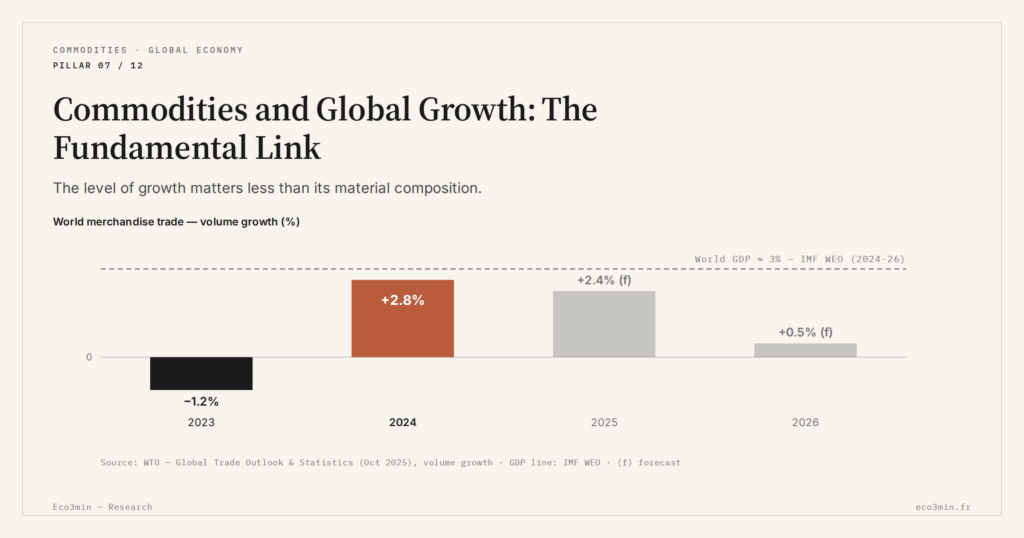
Between 2024 and 2025, global growth remained moderate, around 3% (3.4% in each of those years according to the IMF, World Economic Outlook consulted in September 2026), while world merchandise trade rebounded 2.8% in volume in 2024 after −1.2% in 2023, with the WTO expecting +2.4% in 2025 and +0.5% in 2026 (Global Trade Outlook, October 2025). Even so, certain commodities continued to face localized tensions. This suggests that the overall level of growth matters less than its sectoral and geographic composition. The silver case is examined separately in the breakdown of silver demand across industry, jewelry and investment.
Regional lags and supply-chain inertia
An often underestimated point lies in the geographic dissociation between sources of growth and zones of production. A recovery concentrated in emerging Asia or in selected industrial economies does not instantly activate global supply. Value chains remain fragmented, with logistical and industrial lags that dampen or amplify the effects of growth. The same logic extends in extraction inelasticity and gold’s stock-to-flow ratio.
This mechanism is closely tied to the contrast between physical volumes and price signals, developed in the reference analysis of physical supply and financial demand in price formation. Global growth can therefore support expectations well before physical flows actually adjust.
Why this link is becoming more readable now
Since late 2024, the persistence of positive real interest rates has reshaped productive investment dynamics. A higher cost of capital has slowed certain mining and energy projects, making supply more rigid. Against this backdrop, even moderate global growth is enough to exert sustained pressure on certain commodities, in the absence of rapid capacity adjustment.
Dominant consensus and alternative reading
Part of the consensus expects that a gradual slowdown in global growth should mechanically ease commodity markets. This scenario rests on the assumption of sufficient supply elasticity and rapid transmission from macro signals to volumes.
An alternative reading places greater emphasis on structural inertia: investment lags, regulatory constraints, and production-chain fragmentation. Within this framework, weaker growth does not guarantee a rapid reflux of tensions, since the imbalances were built up over several years.
What readers really want to understand
The real question is not so much whether global growth is accelerating or slowing, but whether its current profile is compatible with available supply. Behind this question lies, above all, the fear of misreading a global macro signal by neglecting the lags and asymmetries specific to commodity markets.
Key variables linking growth to physical demand
- Share of industrial investment in global growth
- International trade measured in volumes, not in value
- Installed production capacity and sector-level utilization rates
- Financial conditions affecting extractive projects
What could invalidate this reading
A pronounced negative demand shock, a synchronized contraction of major economies, or an unexpected acceleration in productivity could reduce the material intensity of growth. Conversely, prolonged financial tightening or logistical disruptions would reinforce the decoupling between global growth and any easing of commodity markets.
Observable macroeconomic implications
When global growth remains sufficient to support physical demand without allowing rapid expansion of supply, commodity prices become a transmission channel toward inflation and industrial margins. Companies exposed to inputs then undergo a gradual adjustment, even in the absence of broad economic overheating.
This dynamic fits within the wider framework presented on the pillar page Commodities and the global economy, which lays out the structural foundations of these interactions.
What this dynamic concretely implies
- Global growth acts as a differentiated driver, not a uniform one.
- Adjustment lags explain the persistence of tensions.
- Global macro signals must be read through their composition.
This is not the central scenario retained by all market participants, but the reading highlights a frequently neglected point: as long as global growth retains a significant material component, commodity markets remain sensitive to slow and lasting imbalances — easier to ignore than abrupt shocks.
Questions readers tend to ask
Is weak global growth enough to push prices lower?
Not necessarily. If growth remains concentrated in commodity-intensive sectors, physical demand can hold up despite a moderate aggregate GDP figure.
Why do some commodities react more than others?
Sensitivity depends on their role in infrastructure, heavy industry, or global trade, as well as on the substitution capacity available.
Can services decouple growth and commodities?
Partially. An economy more oriented toward services reduces material intensity, but the effect is slow and varies across regions.
Last updated — 22 September 2026
Disclaimer – Financial Information: The analyses, commentary, and content published on eco3min.fr are provided for informational and educational purposes only. They do not constitute investment advice or a solicitation to buy or sell financial instruments. Past performance is not indicative of future results. All investment decisions involve risk and are the sole responsibility of the reader.
Read next
Full pillar →Reading the refinery utilisation rate: the threshold, the season, the turnarounds
A refinery runs full near ninety percent, not a hundred: the last slice of nameplate capacity is a…
IMO 2020: the regulatory shock that rewrote product spreads
An environmental rule on marine sulfur can move a refining spread more than a swing in crude. IMO…
The 2022–2023 refining golden age: anatomy of an episode
In 2022, refined fuel prices climbed faster than crude. That gap, measured by the 3-2-1 crack spread, reached…