
Why Rate Hikes Don’t Always Lower Real Estate Prices
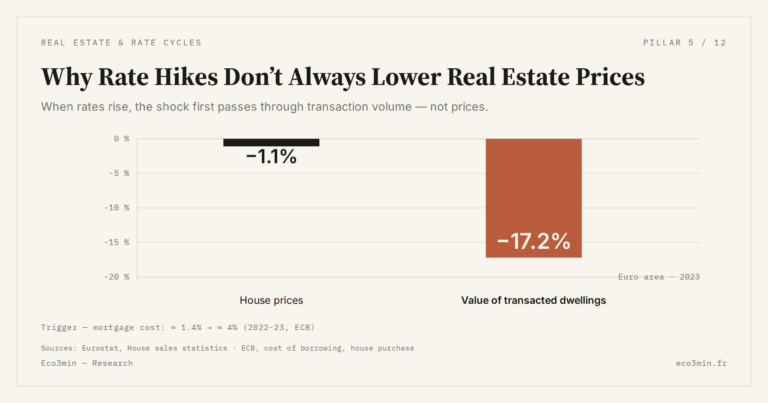
The credit channel, transaction inertia and supply rigidity explain why rising rates do not always translate into an immediate decline in real estate prices.
https://eco3min.fr/en/real-estate-credit-rate-cycles/
The credit channel, transaction inertia and supply rigidity explain why rising rates do not always translate into an immediate decline in real estate prices.

Lags, incentives and structural rigidities explain why public policies modify but do not eliminate cycles in residential property markets.

Gross cash flows, hidden costs and time horizons explain why rental yield frequently overstates the real economic performance of residential property investments.
Economic slowdowns rarely begin with falling demand in the data. They typically start with tighter credit conditions, with documented transmission lags of 9 to 18 months. Credit acts as a leading signal of the cycle.
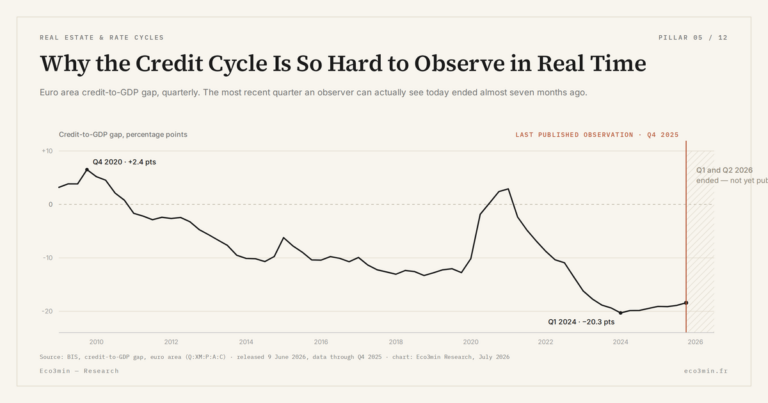
Identifying an ongoing credit cycle remains a methodological challenge. Data are released with delays, signals are contradictory, and cognitive biases distort interpretation. Definitive diagnoses are typically only possible in hindsight.
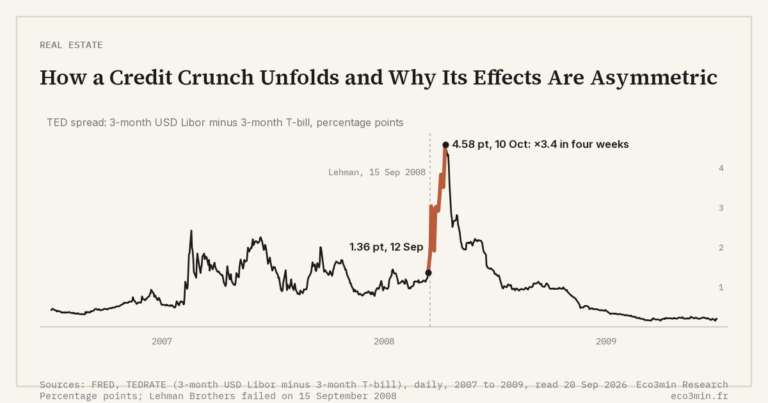
A credit crunch marks a sudden contraction in credit supply, decoupled from borrower fundamentals. Its macroeconomic effects propagate unevenly, hitting bank-dependent agents far harder than those with market access.
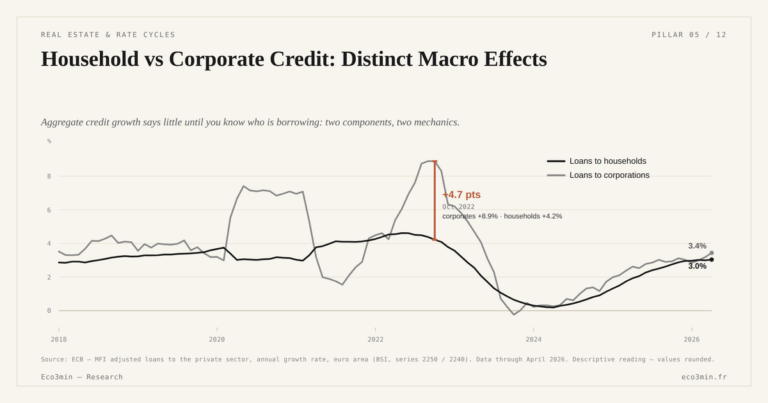
Household and corporate credit do not activate the same macroeconomic mechanisms: one supports aggregate demand, the other conditions productive capacity. Aggregating both masks divergent dynamics with different implications for potential growth.
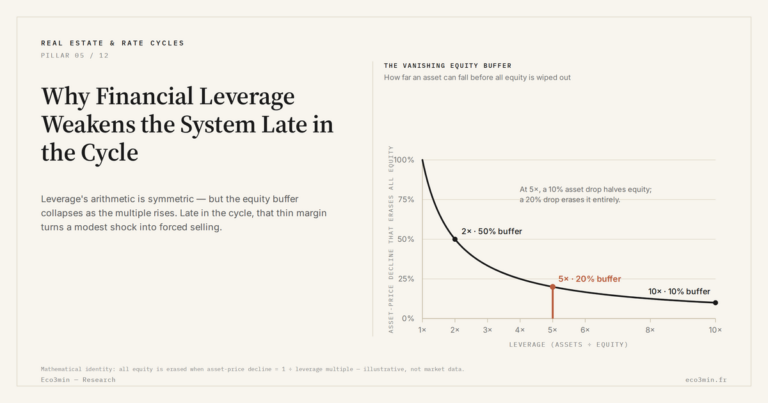
Financial leverage amplifies returns during expansion but produces non-linear effects during reversals. Forced deleveraging generates feedback loops that turn modest shocks into systemic stress.

Bank intermediation amplifies credit cycles asymmetrically: tightening in stress phases unfolds two to three times faster than easing in recovery phases. Capital ratios and risk models attenuate but do not eliminate this procyclicality.

Real estate combines long maturities, high household leverage and supply rigidities. This configuration makes property prices particularly sensitive to financing conditions and amplifies credit-cycle dynamics.