
How Credit Conditions Shape Asset Valuations
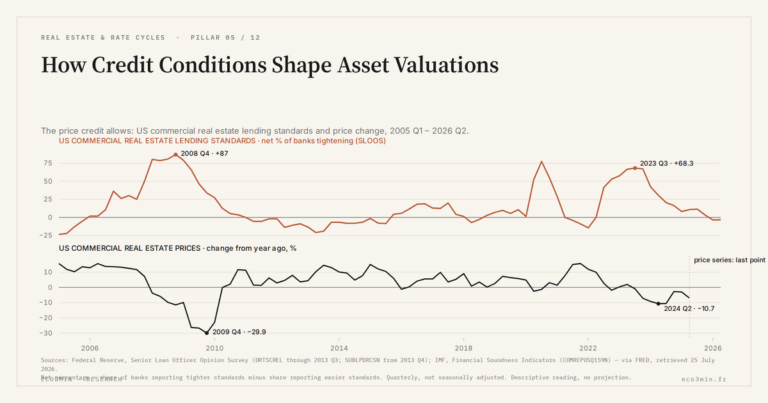
Credit availability, leverage and liquidity shape asset prices well beyond fundamentals. The procyclical loop linking financing conditions to valuations amplifies both expansion and correction phases.
https://eco3min.fr/en/real-estate-credit-rate-cycles/
Credit availability, leverage and liquidity shape asset prices well beyond fundamentals. The procyclical loop linking financing conditions to valuations amplifies both expansion and correction phases.
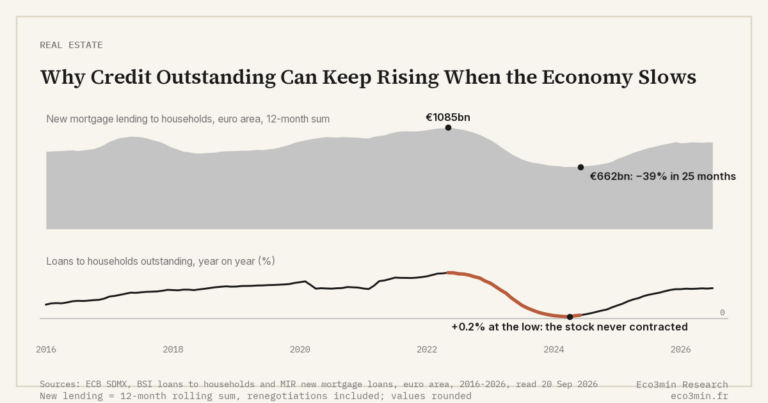
Outstanding credit can keep growing even as activity decelerates. The stock-flow distinction explains the lag between new credit production and the existing balance, and why focusing on the stock alone misleads cyclical diagnostics.
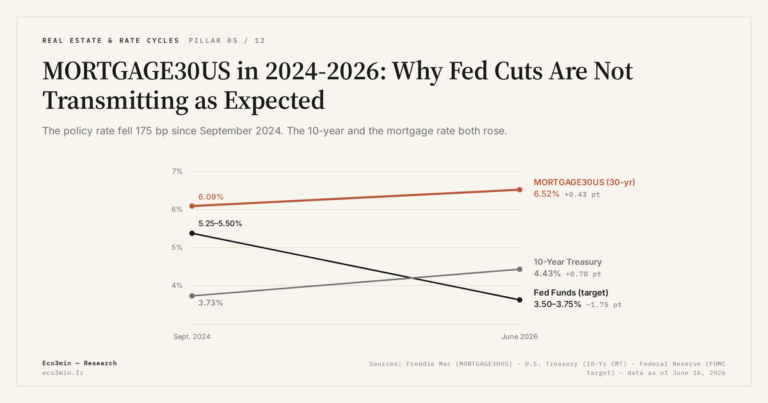
May 2026: MORTGAGE30US prints around 6.5-6.9% even though the Fed started its cutting cycle in September 2024 and Fed Funds has fallen roughly 150 basis points. Fed-to-mortgage transmission is not operating with historical elasticity. Three competing readings circulate — widened…
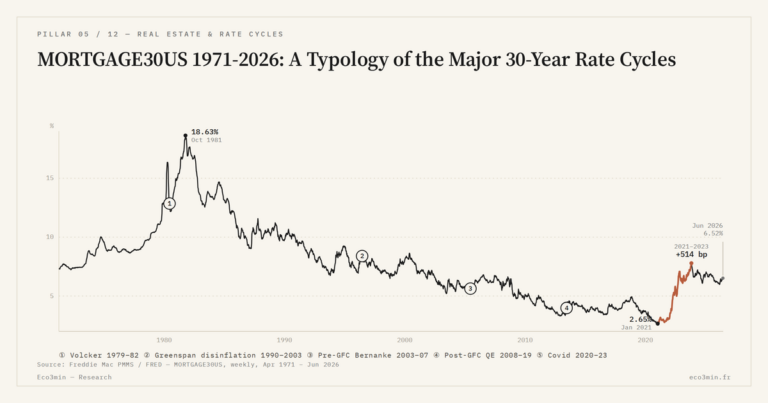
Five major cycles structure the MORTGAGE30US history since its 1971 inception: Volcker, Greenspan disinflation, pre-GFC Bernanke, post-GFC QE, COVID. Each has its trigger — monetary policy, inflation shock, financial crisis, pandemic — and a characteristic duration. TL;DR The 2021-2023 jump…
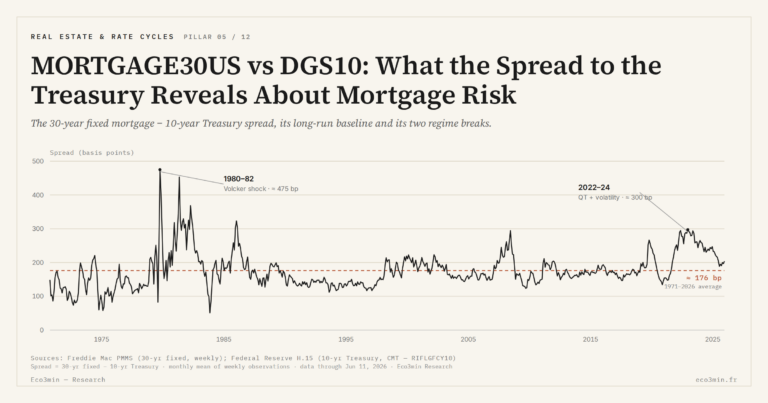
The MORTGAGE30US level says little without its distance to the 10-year Treasury. The spread, averaging around 170 basis points since 1971, breaks down into three premia — prepayment, rate volatility, MBS liquidity — making this gap the real diagnostic tool…
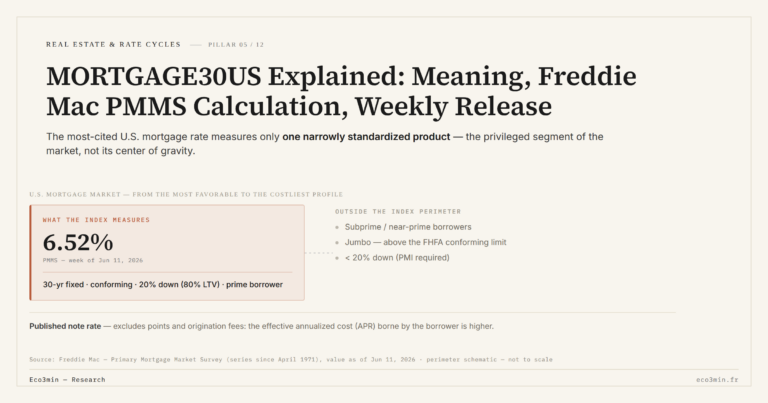
The most-cited U.S. mortgage rate, MORTGAGE30US, is a weekly aggregate Freddie Mac has built since April 1971 from a survey of national lenders. What it means depends as much on the standardized product underlying it as on the survey methodology.…
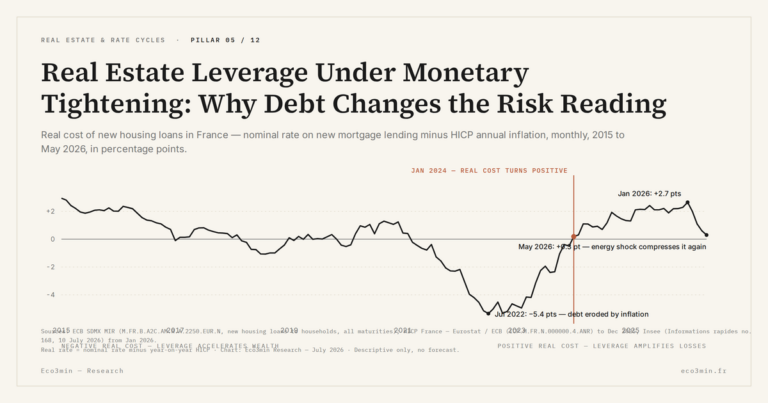
Mortgage-financed real estate is not an ordinary asset. Under monetary tightening, leverage amplifies risk and reframes the patrimonial reading. Real cost of debt and illiquidity, not headline mortgage rates, become the central variables.

Tighter financing conditions do not show up in activity data on impact. Projects already underway, undrawn credit lines and fixed-rate contracts insulate the system for several quarters. The lag is regularly misread as proof that credit doesn't matter — until the delayed effects arrive together.
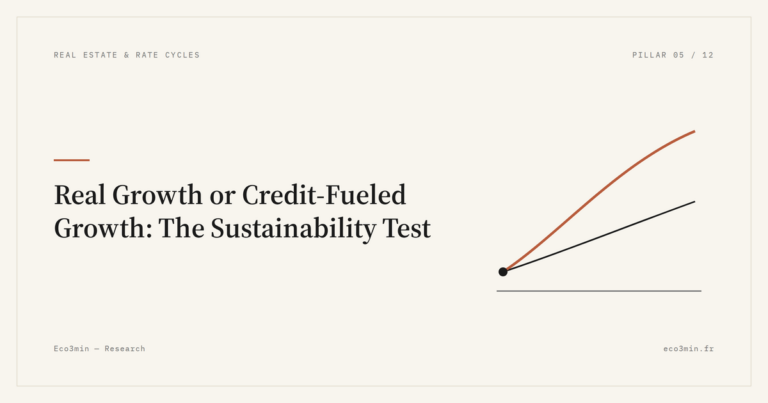
Two economies can post identical headline growth and face opposite trajectories ahead. Productive credit funds capacity that pays itself back; demand credit brings forward future spending. Distinguishing them rests on a single mental test — what would remain of growth if credit stopped expanding?

Credit cycles are structurally asymmetric: expansion stretches over years, contraction concentrates within quarters. Synchronization in lender behavior, threshold effects baked into the system, and the liquidity-price-credit spiral together produce contractions that exceed what extrapolation from normal phases predicts.