Why Rate Hikes Don’t Always Lower Real Estate Prices
The credit channel, transaction inertia and supply rigidity explain why rising rates do not always translate into an immediate decline in real estate prices.

The credit channel, transaction inertia and supply rigidity explain why rising rates do not always translate into an immediate decline in real estate prices.
TL;DR
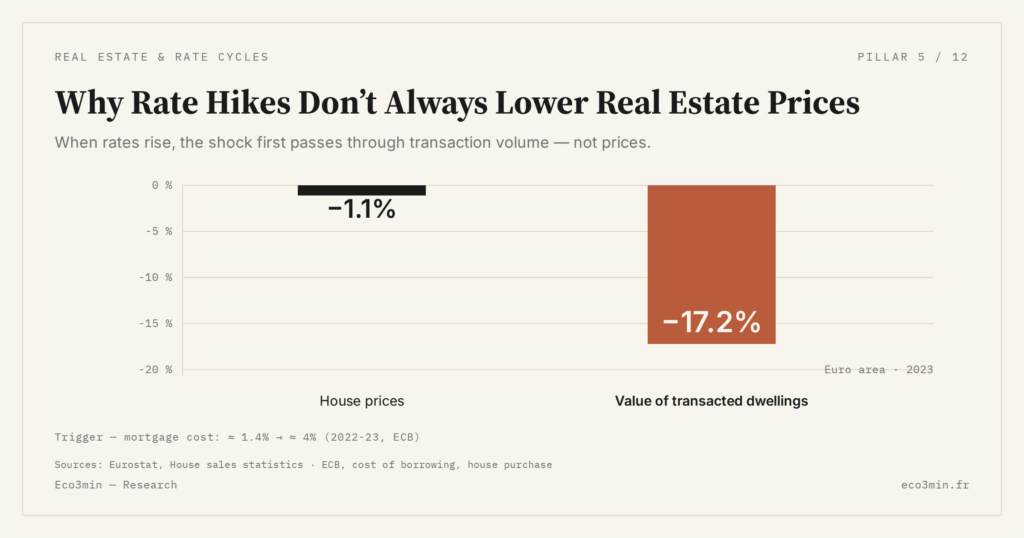
When euro-area mortgage rates climbed from roughly 1.5% to 4% across 2022–2024, transaction volumes fell 20–30% while nominal prices barely moved; real estate adjusts through time before price.
- Rate hikes hit transaction volume first rather than price: the market seizes up as solvent demand contracts, so it can look resilient even as financing conditions deteriorate.
- Sellers anchor to low-rate price levels while buyers recompute borrowing capacity from heavier monthly payments, stretching a wait-and-see phase where listings stay high but deals thin out.
- Land scarcity, construction lead times and regulatory limits block adjustment through quantity, turning a demand shock into a persistent imbalance rather than a quick correction.
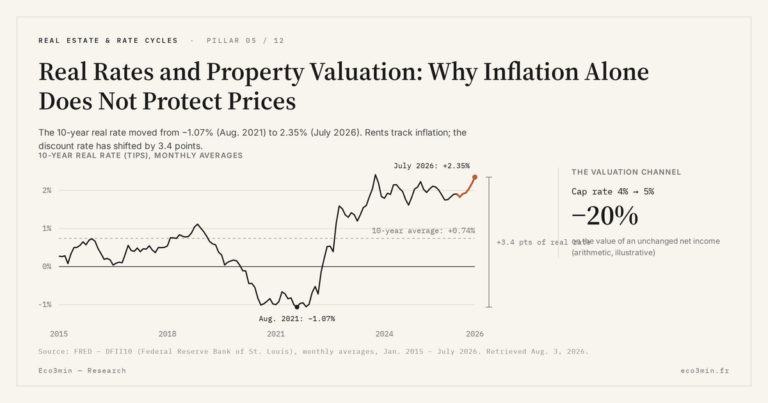
A rate hike is generally seen as an immediate brake on real estate prices. In practice, the relationship is often slower and less direct than expected. Credit availability, supply scarcity and wait-and-see behaviour moderate the transmission from rates to prices. This inertia generates time lags that blur the cyclical reading of the market. The point is to understand why rates are an important factor, but rarely a sufficient one on their own. A closer look: our deep dive into how credit and volumes drive property prices.
The topic carries particular weight since financing conditions have tightened durably without producing the rapid correction many had anticipated after the monetary tightening phase.
When Rates Rise, the Shock First Passes Through Volume
Part of the consensus assumes that rate hikes act mechanically on prices by compressing solvent demand. This reading transposes to real estate a logic closer to financial markets, where prices adjust continuously. In real estate, however, the first variable to absorb the shock is transaction volume.
Between 2022 and 2024, euro area mortgage rates moved from roughly 1.5% to ≈4%, according to European banking statistical frameworks. This range of rate variation underpins the analysis carried out in our study on the credit cycle and the lag in real estate prices. Over the same period, the number of transactions fell by around 20 to 30% in several countries, while nominal prices declined far more slowly, or even stagnated in tight zones. This suggests that rate hikes act first as a filter at the entry point, before becoming a source of pressure on prices. More on this: Why REITs fell in 2022.
This sequence explains why the market may appear resilient even as financial conditions deteriorate. The mechanism is gradual, not instantaneous.
This apparent resilience is often reinforced by the use of incomplete indicators, particularly price per square metre, which tends to mask underlying tensions when volumes contract, as analysed in the critique of price per square metre as a market indicator.
The Key Role of Expectations and Wait-and-See Behaviour
When rates rise quickly, sellers and buyers do not adjust their expectations at the same pace. Sellers often anchor on the price levels observed during the low-rate phase, while buyers recalculate their borrowing capacity from monthly payments that have become more constraining.
This gap generates a prolonged wait-and-see phase. Transactions thin out, but listed prices remain elevated. Adjustment then takes place through time, rather than through an immediate decline in face values. This phenomenon fits within the broader framework of counterintuitive real estate market reactions, where macroeconomic signals often take several quarters to be reflected in prices.
What matters is therefore not just the level of rates, but their duration and the market’s capacity to exit this unstable equilibrium phase.
Why Supply Constraints Limit Price Adjustment
Another often underestimated element concerns the structure of supply. In many urban areas, land scarcity, construction lead times and regulatory constraints sharply limit the capacity to adjust through quantity. This rigidity transforms a demand shock into a persistent imbalance.
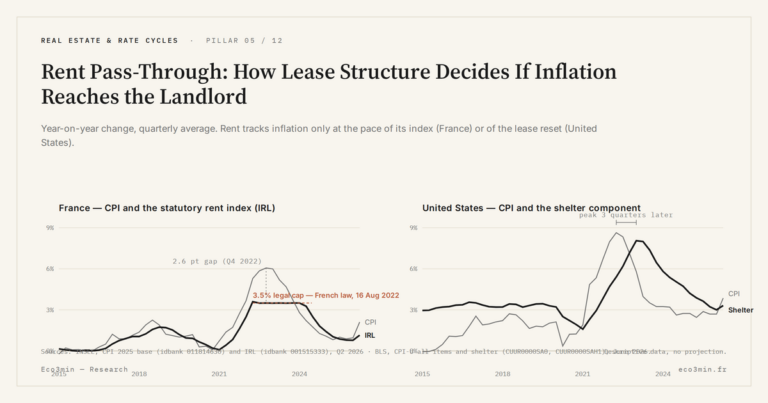
This persistence of imbalances fits within long real estate cycles, whose dynamics remain largely intact despite public interventions, a point developed in the analysis on real estate cycles and public action.
In this context, even a marked credit contraction does not always trigger a rapid price decline. The market “seizes up” more than it corrects. This logic distinguishes real estate from other rate-sensitive assets and explains why monetary transmission is slower and more heterogeneous in this segment.
What Many Are Trying to Understand Behind Rising Rates
Behind the question of rates, the main concern relates less to the direction of prices than to the reliability of observed signals. What many are looking for here is whether the absence of visible decline reflects genuine market strength or merely a time lag in the adjustment. The answer depends largely on the capacity of credit to normalise and on the evolution of volumes in the coming quarters.
What Could Accelerate or Delay the Adjustment
This scenario rests on the assumption that restrictive financial conditions persist without a major exogenous shock. Further tightening of bank lending standards, a rise in unemployment or a sharp reversal in demand could accelerate pressure on prices. Conversely, a gradual easing of rates or targeted public schemes focused on solvency could prolong the stagnation phase.
What matters is less the precise trajectory of rates than the combination of their level, their duration and the response of the credit channel.
Equating rate hikes with an automatic decline in real estate prices ignores the central role of volumes, expectations and supply rigidities in the actual market adjustment.
Observable Economic Impacts
For households, this lag translates into more selective access to credit before any visible decline in prices. For companies in the sector, contracting volumes weigh on activity well before any correction in valuations. At the macro level, monetary transmission to real estate contributes to slowing the economy through the credit channel, even when price indices still appear resilient.
These mechanisms fit within a broader reading of the real estate cycle and financing, developed on the pillar page on real estate cycles and rates.
- Rate hikes affect transaction volumes first before weighing on prices.
- Wait-and-see behaviour and the anchoring of expectations slow monetary transmission.
- Supply rigidities explain why real estate adjustment often passes through time rather than through prices.
Last updated — 12 July 2026
Disclaimer – Financial Information: The analyses, commentary, and content published on eco3min.fr are provided for informational and educational purposes only. They do not constitute investment advice or a solicitation to buy or sell financial instruments. Past performance is not indicative of future results. All investment decisions involve risk and are the sole responsibility of the reader.
Read next
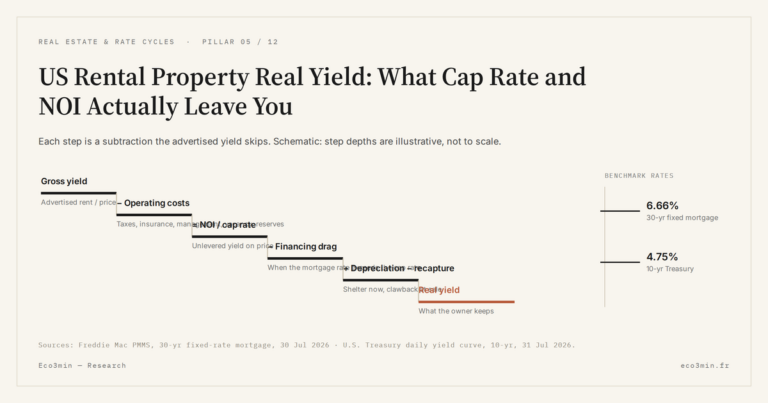
Full pillar →US Rental Property Real Yield: What Cap Rate and NOI Actually Leave You
A rental listing leads with a yield. Divide the annual rent by the price and the number looks…
Cap Rate Spread: What Rental Yield Pays Over the 10-Year Treasury
A 5% cap rate sounds attractive. But 5% against what? A risk-free 10-year Treasury yields near 4.5% in…
Vacancy and Turnover: The Cost That Erodes a Landlord’s Real Return
A listing shows full rent, twelve months a year. The owner knows the gaps between tenants, the make-ready…