How a Credit Crunch Unfolds and Why Its Effects Are Asymmetric
A credit crunch marks a sudden contraction in credit supply, decoupled from borrower fundamentals. Its macroeconomic effects propagate unevenly, hitting bank-dependent agents far harder than those with market access.

Analysis of credit crunches, the breakdown in credit supply and their asymmetric macroeconomic consequences.
TL;DR
A credit crunch contracts loan supply independently of demand, and the constraint falls hardest on borrowers dependent on banks rather than bond markets.
- In 2009, ECB data show eurozone credit to SMEs contracted by roughly 7% against about 2% for large firms, which keep bond-market access.
- The contraction is abrupt because banks react simultaneously to a common shock and regulatory thresholds force disproportionate cuts as prudential limits approach.
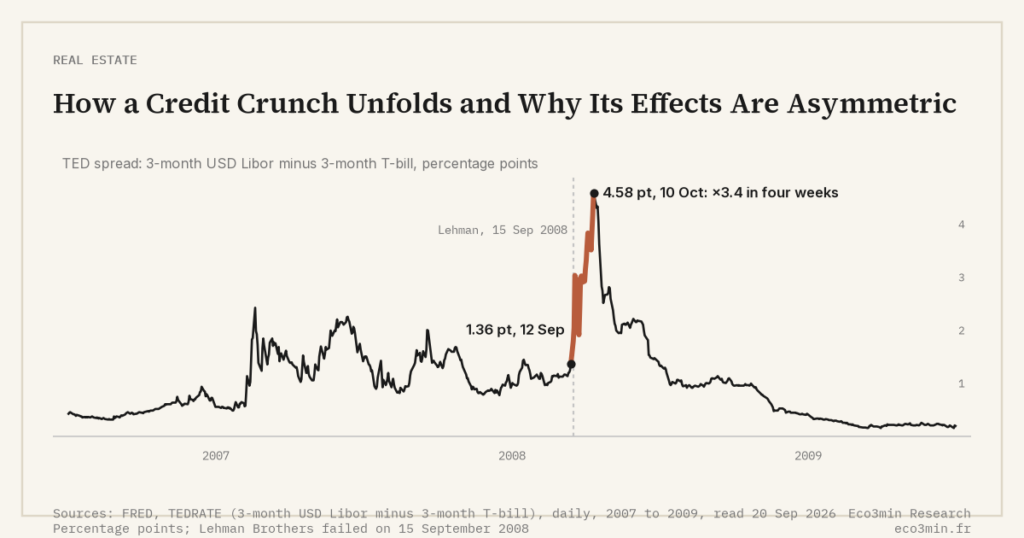
- The spread between the interbank rate and the policy rate leads liquidity frictions, as in the interbank freeze that followed Lehman's September 2008 failure.
How a Credit Crunch Unfolds and Why Its Effects Are Asymmetric
A credit crunch marks a sudden break in financing dynamics. Credit supply contracts independently of existing demand. The evidence is brought together in our reading of housing price inertia in the face of rate moves. The discontinuity affects some agents faster than others. Macroeconomic effects propagate unevenly. This asymmetry is often poorly understood. Yet it constitutes an essential feature of the cycle’s extreme phases.
A credit crunch is not simply a slowdown in credit. It refers to a sudden, involuntary contraction in supply, decoupled from borrower fundamentals.
The Triggering Mechanisms
Several configurations can trigger a credit crunch. The most common involves a sharp deterioration in bank balance sheets. As loan losses accumulate, bank capital erodes. Prudential ratios tighten. Institutions reduce their exposures to restore solvency margins.
This mechanism played out during the 2008 crisis. Subprime-related losses forced US then European banks to drastically cut their commitments. Credit to non-financial corporations in the eurozone contracted by ≈3% in 2009, an amplitude unseen since the 1930s.
A second configuration involves an interbank liquidity crisis. When banks stop lending to each other out of mutual mistrust, the refinancing system seizes up. Even solvent institutions may then reduce their credit supply for lack of resources.
The September 2008 episode — Lehman Brothers’ bankruptcy — illustrates this dynamic. The interbank market froze within days, triggering generalised credit rationing.
Why the Contraction Is Abrupt
A credit crunch is distinguished by its suddenness. Unlike a gradual tightening of conditions, it occurs discontinuously. This abruptness is explained by several factors.
Banks react simultaneously to the same signals. A common shock — deterioration in an asset class, default by a major counterparty — triggers synchronised defensive behaviour. Implicit coordination amplifies the move.
Regulatory thresholds create cliff effects. As a bank approaches its prudential limits, it must reduce its exposures disproportionately to restore its ratios.
The assessment of the credit cycle and its turning points shows that this abruptness stems from the very logic of bank financing.
The Asymmetry of Sectoral Effects
A credit crunch does not affect all agents in the same way. Companies dependent on short-term financing face an immediate impact. Those with confirmed credit lines or cash reserves get through the acute phase better.
SMEs suffer more than large corporates. Their access to bond markets is limited. They depend almost exclusively on bank credit.
ECB data show that in 2009, credit to eurozone SMEs contracted by ≈7%, against ≈2% for large companies.
Second-Round Effects
The initial credit contraction triggers propagation effects. Rationed companies cut their investments and orders. Defaults rise, further degrading bank balance sheets.
The take of the non-linear nature of turning points sheds light on this mechanism.
Employment acts as a lagged but significant adjustment variable.
Conflating a credit crunch with a simple slowdown in credit. A credit crunch refers to a break in supply, independent of demand.
What Consensus Underestimates
Standard macroeconomic models struggle to capture the discontinuities specific to credit crunches.
Growth projections tend to underestimate the magnitude of contractions during periods of financial stress.
Variables That Modify the Amplitude
Banks’ initial capitalisation and central bank intervention influence the severity of a credit crunch.
Indicator to Watch
The spread between the interbank rate and the policy rate acts as a leading indicator of liquidity frictions within the banking system.
Cross-referenced with the analysis of financing and credit dynamics, this signal helps identify ahead of time the phases of stress likely to transmit to the real economy.
What This Asymmetry Reveals
A credit crunch is an abrupt and asymmetric phenomenon, with disproportionate consequences for the agents most dependent on bank credit.
Last updated — 20 September 2026
Disclaimer – Financial Information: The analyses, commentary, and content published on eco3min.fr are provided for informational and educational purposes only. They do not constitute investment advice or a solicitation to buy or sell financial instruments. Past performance is not indicative of future results. All investment decisions involve risk and are the sole responsibility of the reader.
Read next
Full pillar →US Rental Property Real Yield: What Cap Rate and NOI Actually Leave You
A rental listing leads with a yield. Divide the annual rent by the price and the number looks…
Cap Rate Spread: What Rental Yield Pays Over the 10-Year Treasury
A 5% cap rate sounds attractive. But 5% against what? A risk-free 10-year Treasury yields near 4.5% in…
Vacancy and Turnover: The Cost That Erodes a Landlord’s Real Return
A listing shows full rent, twelve months a year. The owner knows the gaps between tenants, the make-ready…