Why the Credit Cycle Is So Hard to Observe in Real Time
Identifying an ongoing credit cycle remains a methodological challenge. Data are released with delays, signals are contradictory, and cognitive biases distort interpretation. Definitive diagnoses are typically only possible in hindsight.

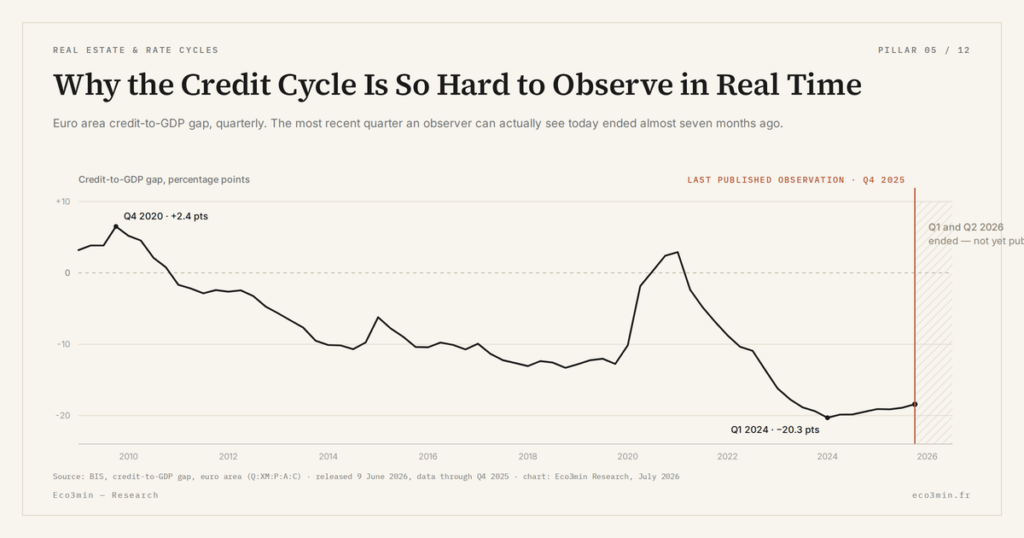
Why available data and signals make identifying an ongoing credit cycle particularly complex.
TL;DR
Lagged releases, contradictory indicators and cognitive bias make any real-time read of the credit cycle provisional; its turning points become legible only after the fact.
- Monthly credit outstanding arrives with a four-to-six-week lag and is repeatedly revised, so December figures land in February against a situation that has already moved.
- In early 2026 the signals diverge: policy rates fall while lending standards stay tight, outstanding amounts edge up while new flows stay depressed, and corporate credit holds up better than household credit.
- The ECB Bank Lending Survey and the BIS credit-to-GDP gap carry more signal than isolated data, yet confirmation, recency and narrative biases distort every observer's read, professionals included.
Why the Credit Cycle Is So Hard to Observe in Real Time
Identifying an ongoing credit cycle poses a major methodological challenge. Data are often delayed or contradictory. Signals overlap without clear hierarchy. This complexity feeds frequent reading biases. It leads to ex-post interpretations. Understanding these limits is essential for a rigorous reading of the cycle.
In hindsight, credit cycles appear obvious. In real time, their identification remains an uncertain exercise, subject to permanent revision.
The Problem of Lagged Data
Credit statistics are published with significant delays. Monthly outstanding amounts generally appear with a 4 to 6-week lag. Detailed data by sector or credit type arrive even later. Mortgage credit illustrates these observation difficulties and their consequences for diagnosis particularly well — see our reading of the housing credit cycle in the face of rate shocks.
These delays mean the observer is always analysing a past situation. By the time December data become available in February, the situation may have evolved. Inflection points are identified after the fact, not when they occur.
Statistical revisions add a layer of uncertainty. Initial estimates are regularly corrected in subsequent releases. An apparent slowdown may turn out to be a statistical artefact — or, conversely, apparent stability may mask a real turning point.
Qualitative surveys — notably the Bank Lending Survey — offer more responsive but subjective information. They capture banks’ stated intentions, not necessarily their actual behaviour.
The Overlay of Contradictory Signals
At any given moment, the available indicators send partly contradictory signals. Outstanding amounts may grow while flows slow. Lending standards may tighten while rates fall. Demand may weaken while supply remains available.
This multiplicity of signals complicates interpretation. Which indicator should take priority? Flows or stocks? Supply or demand? Price conditions or access conditions?
The study of the credit cycle and its mechanisms provides a framework for ranking these signals. But real-time application remains delicate, with each cycle exhibiting specific features.
In early 2026, the situation illustrates this complexity. Policy rates are falling but lending standards remain tight. Outstanding amounts are inching higher but new credit flows remain depressed. Credit to companies is holding up better than credit to households. What synthetic reading can be drawn from these divergent signals?
Cyclical Noise
Short-term fluctuations blur the identification of underlying trends. A month of strong credit production may reflect technical factors — quarter-end, regulatory anticipation — rather than a regime change.
Distinguishing signal from noise requires hindsight. But that hindsight is only available after the fact. In real time, the observer must arbitrate between responsiveness — reacting to early signals — and prudence — waiting for confirmation.
This trade-off has no optimal solution. Reacting too early exposes one to false signals. Reacting too late exposes one to missed turning points. Errors in either direction are unavoidable.
Cognitive Biases in Interpretation
Cycle identification is affected by recurring psychological biases.
Confirmation bias. The observer tends to favour data confirming a pre-existing reading. Those anticipating a slowdown overweight negative signals. Those remaining optimistic minimise those same signals.
Recency bias. Recent events weigh excessively in the analysis. After a period of growth, the spontaneous projection is continued growth. After a crisis, excessive vigilance sees risks everywhere.
Narrative anchoring. Once a narrative takes hold — “the economy is resilient”, “credit is picking up” — it becomes hard to revise even in the face of contradictory data. The narrative filters the interpretation of new information.
These biases affect all observers, including professionals. Forecasting errors by official institutions ahead of crises attest to this structural difficulty.
Believing it is possible to identify precisely the phase of the credit cycle in real time. Lagged data, contradictory signals and cognitive biases make this identification intrinsically uncertain. Definitive diagnoses are only possible with historical hindsight.
What Consensus Tends to Overstate
Economic commentary often presents clear-cut diagnoses on the cycle’s phase. “Credit is picking up”, “The cycle is turning”, “The expansion phase continues”. Such statements suggest a certainty the data do not support.
This false precision answers a demand. Decision-makers — investors, companies, policymakers — want clear diagnoses on which to base their choices. Uncertainty is uncomfortable. It does not sell well.
But overconfident diagnoses generate errors. They encourage outsized positioning based on illusory certainties. Turning points, when they occur, take by surprise those who had adopted the dominant narrative.
The breakdown of the mechanism of the credit crunch shows that breaks generally occur when the consensus deems them improbable.
Approaches to Reduce Uncertainty
Several methods can improve the reading of the cycle without eliminating fundamental uncertainty.
Triangulating indicators. Cross-referencing several sources — outstanding amounts, flows, surveys, prices — reduces the risk of overinterpreting an isolated signal. Convergence of distinct signals strengthens confidence in the diagnosis.
Trend analysis. Smoothing short-term fluctuations to identify underlying movements. Moving averages and filtered trends reduce noise but introduce additional delay.
Probabilistic reasoning. Framing diagnoses in terms of probabilities rather than certainties. “The probability of a turning point has risen” is more accurate than “The cycle is turning”.
Systematic revision. Updating the diagnosis regularly as new data arrive. Avoiding anchoring on a previous reading that has become obsolete.
Most Informative Indicators
Among available data, some carry superior informational content for cycle identification.
The ECB’s Bank Lending Survey provides responsive qualitative information on banks’ intentions. Its evolution generally anticipates that of credit flows.
New credit flows — more volatile but more responsive than outstanding amounts — capture inflections before they appear in stocks.
The BIS credit-to-GDP gap measures credit’s deviation from its trend. This synthetic indicator helps locate the position in the cycle but with a significant publication delay.
Credit spreads on bond markets reflect investors’ perception of risk. Their widening signals stress before it shows up in banking statistics.
What This Difficulty Implies
The impossibility of observing the cycle precisely in real time has practical implications.
For analysis, it imposes humility. Diagnoses must be formulated with their margins of uncertainty. Alternative scenarios deserve to be made explicit. Revising judgments in the face of new data is not an admission of weakness but a methodological requirement.
For decisions, it suggests not positioning excessively on a single diagnosis. Diversification, safety margins and flexibility help guard against cycle identification errors.
The credit cycle exists and structures economic dynamics. But its real-time observation remains an exercise in approximation, subject to irreducible uncertainties. Recognising this limit paradoxically constitutes the first step toward more rigorous analysis.
Last updated — 25 July 2026
Disclaimer – Financial Information: The analyses, commentary, and content published on eco3min.fr are provided for informational and educational purposes only. They do not constitute investment advice or a solicitation to buy or sell financial instruments. Past performance is not indicative of future results. All investment decisions involve risk and are the sole responsibility of the reader.
Read next
Full pillar →US Rental Property Real Yield: What Cap Rate and NOI Actually Leave You
A rental listing leads with a yield. Divide the annual rent by the price and the number looks…
Cap Rate Spread: What Rental Yield Pays Over the 10-Year Treasury
A 5% cap rate sounds attractive. But 5% against what? A risk-free 10-year Treasury yields near 4.5% in…
Vacancy and Turnover: The Cost That Erodes a Landlord’s Real Return
A listing shows full rent, twelve months a year. The owner knows the gaps between tenants, the make-ready…