Why Credit Outstanding Can Keep Rising When the Economy Slows
Outstanding credit can keep growing even as activity decelerates. The stock-flow distinction explains the lag between new credit production and the existing balance, and why focusing on the stock alone misleads cyclical diagnostics.

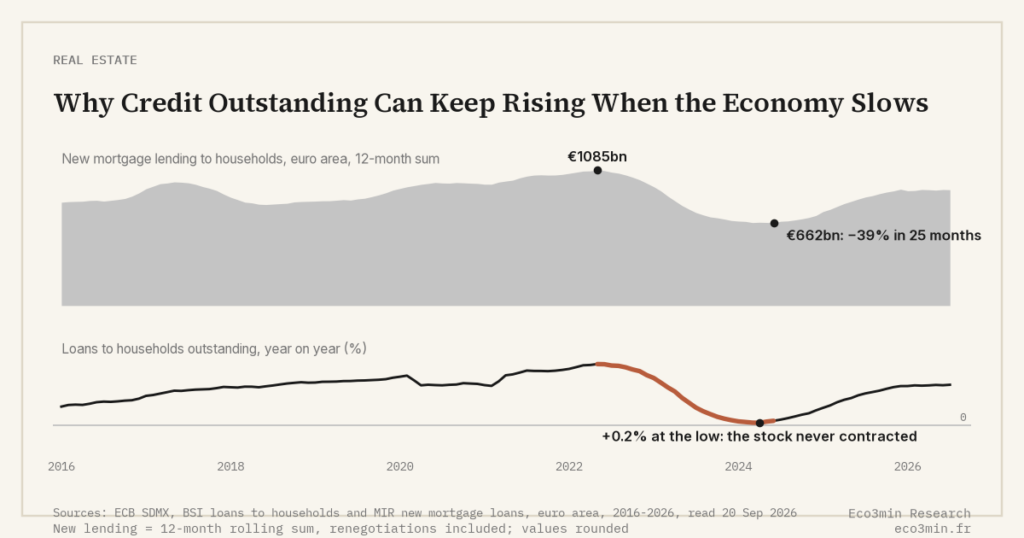
Why outstanding credit can keep expanding even as the economy enters a slowdown phase.
TL;DR
Even as new lending slows, the existing stock of credit keeps climbing for several quarters, propped up by past commitments and the slow amortization of long loans.
- In the euro area, outstanding household credit was still growing about 1.5% year-on-year at end-2025, even as new mortgage origination had dropped roughly 40% from its 2022 peak: stock and flows moving in opposite directions.
- Three inertias sustain the stock: drawdowns on committed corporate lines, tacit renewal of working-capital facilities, and the slow amortization of 20-year mortgages, so new-flow data, which leads the stock by several quarters, reads the cyclical turn earlier.
Why Credit Outstanding Can Keep Rising When the Economy Slows
A rise in outstanding credit is often read as a sign of economic strength. Yet it can persist while activity decelerates. Past commitments and stock inertia explain this paradox. The confusion is common in cyclical analysis. It leads to flawed diagnostics. Distinguishing flows from stocks is essential.
Outstanding credit represents the accumulated stock of debt. It evolves with new loans extended and repayments made. Its dynamic does not instantly mirror shifts in the financing regime. This inertia is a central feature of credit’s stock-flow dynamics.
The Fundamental Distinction Between Flows and Stocks
New credit flows measure loans extended over a given period. Outstanding credit measures the cumulative stock in place, the result of past decisions. The two metrics can move in opposite directions for several quarters. For French households, that stock has its own monthly series: the outstanding stock of French housing loans since 2011 peaked at EUR 1,315bn in March 2023.
A slowdown in new flows does not immediately translate into a decline in outstanding credit. Older loans keep inflating the stock as long as they remain unpaid. Mortgage loans, with an average duration of 20 years, contribute to the stock for two decades after origination. Eco3min documents this in the Eco3min framework on the mortgage credit cycle as a driver of property prices.
This mechanical lag creates an illusion of continuity. An observer focused only on the stock concludes that credit dynamism persists. Flow analysis reveals a turn already underway.
In the euro area, outstanding household credit was still expanding by roughly 1.5% year-on-year at end-2025, while new mortgage origination had fallen by roughly 40% from its 2022 peak.
The Mechanics of Inertia
Several factors explain why the stock persists despite slower flows.
Drawdowns on existing facilities. Corporates often hold committed credit lines. They can draw on them even when banks stop extending new ones. These drawdowns inflate the stock without reflecting financing dynamism.
Automatic refinancing. Some loans, particularly working capital facilities, roll over by tacit renewal. The stock holds steady mechanically as long as borrowers do not default.
The tenor of existing loans. Mortgage and project finance loans amortize slowly. Their contribution to the stock persists well after origination standards have tightened.
Examination of the credit cycle in its temporal dimension shows that these inertias create systematic lags between financial signals and cyclical reality.
Why This Confusion Is Common
Statistical releases tend to highlight stocks rather than flows. Stock data are more stable, more readily available and less prone to revisions. They appear more reliable for routine commentary.
This preference for stocks biases interpretation. An analyst observing continued growth in outstanding credit may conclude that credit still supports the economy. The turning-point signal contained in the flows is missed.
Central banks have gradually improved the publication of flow data. But these series remain less commented on than stock aggregates in mainstream economic coverage.
What Current Dynamics Reveal
In early 2026, the euro-area picture illustrates this lag. Total private-sector credit outstanding shows modest but positive growth. New credit flows, by contrast, remain well below their long-run average.
This configuration signals a cycle in transition. Past momentum still props up the stock. Future dynamics, conditioned by current flows, point to a weaker trajectory.
Forecasts that extrapolate the stock trend likely overstate credit’s support to activity in the coming quarters. Review of the lag between credit and economic deceleration details these delayed transmission mechanisms.
Treating growth in outstanding credit as a reliable gauge of financing dynamism. Outstanding credit is a stock that evolves with inertia. New credit flows constitute a more relevant leading indicator for anticipating shifts in economic activity.
Implications for Cyclical Reading
This flow–stock distinction reshapes the interpretation of credit data. Stable or modestly rising outstanding credit does not guarantee that credit is supporting the economy. It may simply reflect the inheritance of past decisions.
Conversely, a decline in outstanding credit, a rare phenomenon, signals active deleveraging, with repayments exceeding new loans. This configuration indicates a credit contraction already well advanced.
Transition phases are the hardest to interpret. The stock still grows while flows soften. This pattern marks the inflection point of the cycle, when past momentum masks the turn already underway.
Indicators Worth Tracking
For a finer reading of the credit cycle, several indicators complement the outstanding stock.
Monthly new credit production, published by central banks, captures the actual financing dynamic. Its trajectory anticipates that of the stock by several quarters.
The annualized growth rate of flows, rather than stocks, provides a more reactive measure of cyclical inflections.
Credit demand surveys on the borrower side complement supply-side surveys among lenders. A drop in demand signals a slowdown even when origination standards have not tightened.
What This Distinction Implies
Credit acts on the economy through its flows, not its stocks. A high outstanding stock represents an inheritance from the past. New flows determine present and future impulse.
This reality has implications for cyclical diagnostics. Observing that outstanding credit keeps rising is not enough to conclude that financing is supporting activity. The relevant question concerns flows: are new loans expanding, stagnating or contracting?
Last updated — 20 September 2026
Disclaimer – Financial Information: The analyses, commentary, and content published on eco3min.fr are provided for informational and educational purposes only. They do not constitute investment advice or a solicitation to buy or sell financial instruments. Past performance is not indicative of future results. All investment decisions involve risk and are the sole responsibility of the reader.
Read next
Full pillar →US Rental Property Real Yield: What Cap Rate and NOI Actually Leave You
A rental listing leads with a yield. Divide the annual rent by the price and the number looks…
Cap Rate Spread: What Rental Yield Pays Over the 10-Year Treasury
A 5% cap rate sounds attractive. But 5% against what? A risk-free 10-year Treasury yields near 4.5% in…
Vacancy and Turnover: The Cost That Erodes a Landlord’s Real Return
A listing shows full rent, twelve months a year. The owner knows the gaps between tenants, the make-ready…