Why Central Banks Make Recurring Policy Errors
Central banks are not omniscient. Lagged data, model dependence and the inflation/unemployment asymmetry produce recurring errors that often only become visible after the cycle has turned.

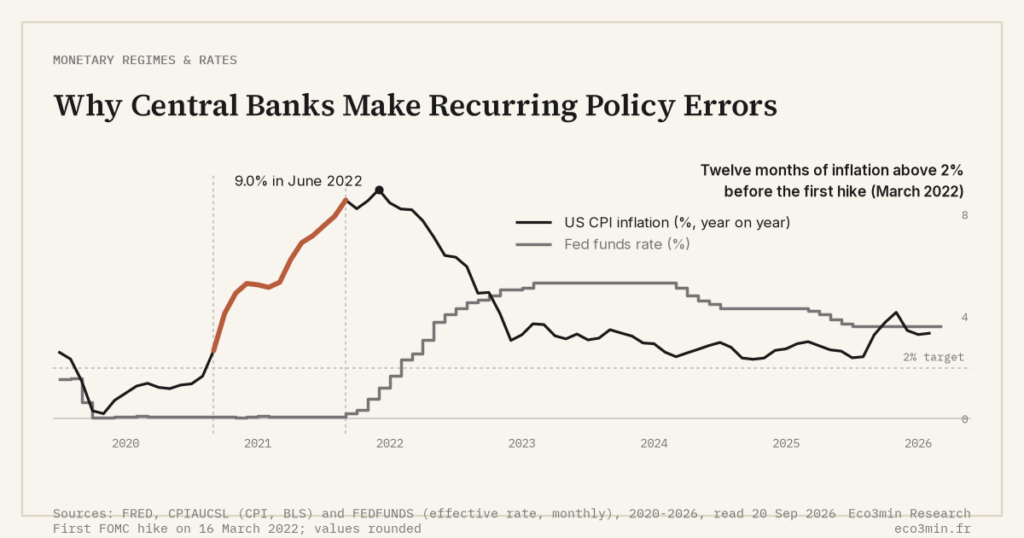
Central banks are neither omniscient nor infallible. They operate under institutional, political and cognitive constraints that produce recurring errors — often only visible in hindsight. To see how these decisions actually filter through to households and investors, see the impact of rate moves on your wealth.
This analysis sits within the sub-pillar dedicated to central bank action and its transmission mechanisms , which examines how monetary decisions diffuse, with lags and asymmetries, through the real economy.
The lag bias
Monetary decisions rest on lagged and frequently revised data. This constraint explains why tightening cycles often arrive too late, after inflation has already taken root. More on this sits in the framework on how rate regimes govern margin behaviour.
This bias is documented in
the analysis of overly accommodative policies.
Model dependence and the illusion of control
Econometric models struggle to incorporate regime breaks. Their excessive use leads to underestimating tail risks and non-linear dynamics.
These limits emerge clearly from
the framework and limits of monetary policy.
The inflation / unemployment asymmetry
Central banks react faster to unemployment than to inflation. This asymmetry produces a structural accommodative bias that fuels bubbles and imbalances.
This logic is laid out in
the priority targeting of inflation.
Overcorrections and collateral damage
Once the error becomes obvious, the correction is typically abrupt. Lagged effects then amplify the shock running through the real economy.
See on this point
the mechanisms of restrictive policies.
Central bank errors are not accidental: they stem from structural biases. Understanding them helps anticipate turning points, without claiming to forecast them.
← Back to the pillar page Monetary policy and rates
Last updated — 20 September 2026
Disclaimer – Financial Information: The analyses, commentary, and content published on eco3min.fr are provided for informational and educational purposes only. They do not constitute investment advice or a solicitation to buy or sell financial instruments. Past performance is not indicative of future results. All investment decisions involve risk and are the sole responsibility of the reader.
Read next
Full pillar →Real Rates: The True Cost of Capital Is Repricing
Why real rates are reasserting themselves as markets' anchor and how to recalibrate investment and financing decisions facing…
Real Interest Rates: The Quiet Signal Reshaping Markets
Real interest rates: why their persistence in positive territory in 2026 is reshaping the rules for bonds, equities,…
OAT-Bund Spread: A Quiet Gauge of French Sovereign Risk
OAT-Bund spread: how this yield gap has become a key signal on French sovereign risk, fiscal policy and…