France’s Livret A Ceiling: What Happens Mechanically When a Capped Savings Account Is Full

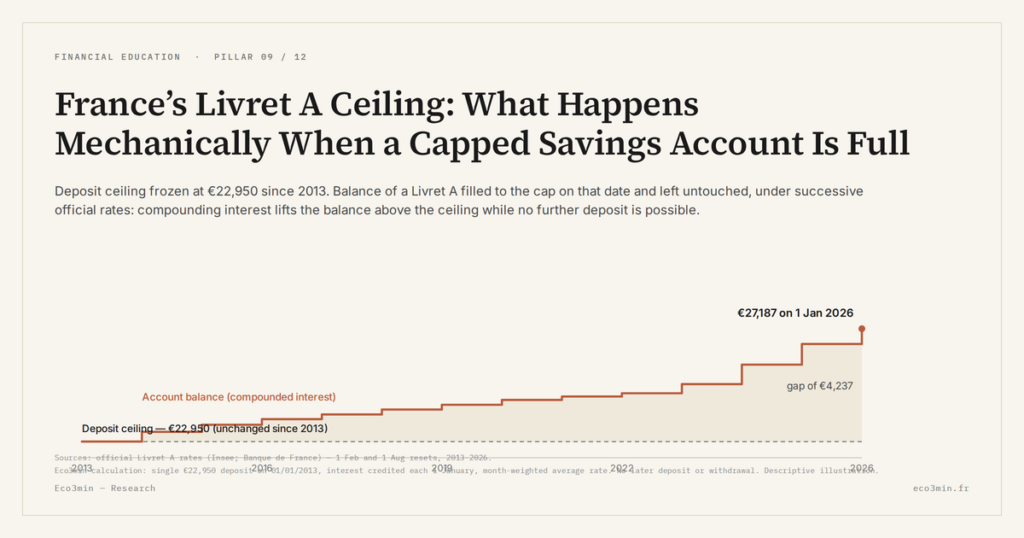
France’s Livret A ceiling, €22,950, is one of the best-known figures in French saving and one of the most misread. It applies to cumulative deposits, not to the balance, and a “full” account can sit above that figure without any rule being broken.
The Livret A ceiling is set at €22,950 in deposits, a stable figure and often a misunderstood one. The first common confusion: the ceiling applies to cumulative deposits, not to the balance. Capitalised interest can therefore carry a “full” Livret A above €22,950 without any rule being broken. The second point: once the ceiling is reached in deposits, new savings must find another container, and this article describes mechanically the routes they generally take (the LDDS, other regulated accounts, unregulated vehicles), without ever saying which to “choose”. The artefact: the exact mechanics of compounding beyond the ceiling and a descriptive mapping of where surplus savings flow, a subject that service pages handle in one line and never as a mechanism. A strictly descriptive tone: no instruction on what to “do” with savings above the cap.
In short. The Livret A ceiling, €22,950, applies to cumulative deposits, not to the balance. Interest credited each 1 January does not count as a deposit: it compounds and can carry the balance well above the ceiling, without limit and without breaching any rule. New deposits, however, are refused once the ceiling is reached. Additional savings then route toward other containers (the LDDS, other regulated accounts subject to eligibility, unregulated vehicles), which this article maps descriptively, without recommending which to use. The mechanism is universal: any capped savings vehicle raises the same overflow question. A parallel read: how retirement withdrawals are taxed.
The ceiling applies to deposits, not to the balance
The exact rule is precise and often reversed in everyday language. The €22,950 ceiling limits the total amount paid into the Livret A, that is, the running sum of deposits made by the holder. It does not limit the displayed balance. This distinction, seemingly technical, changes everything: a Livret A can show €23,500 or more and remain perfectly compliant, as long as the portion above €22,950 comes from interest and not from new deposits. The bank blocks incoming deposits once the cumulative total reaches the ceiling, but never touches interest already credited.
This mechanism follows from the nature of the rate paid: the Livret A is a regulated product whose parameters, rate and ceiling alike, are set by public decision. The ceiling is an instrument of savings policy, revised by decree, not a market constraint. For a household looking at where to hold precautionary savings, the first question is therefore not the return but the exact workings of this container. Anglophone savers will recognise the pattern: the same overflow question arises whenever a tax-advantaged account carries a contribution cap.
How interest compounds beyond the ceiling
The Livret A capitalises its interest once a year, on 1 January. A year’s interest is added to capital and itself earns interest the following year. For an account at the ceiling, this mechanism produces a slow but continuous growth in the balance, with no deposit possible. A worked figure makes it concrete: a Livret A full at €22,950, paying 1.5%, receives roughly €344 of interest on 1 January, bringing the balance to €23,294. The next year, interest is computed on this new balance, and so on. The balance therefore drifts above the ceiling year after year, by an amount that depends on the rate in force. Read alongside: France’s LEP vs the Livret A: A Means-Tested Higher Rate, Explained.
Over several years, this drift becomes material. A full account left untouched sees its balance move steadily away from the nominal ceiling: at recent rates, on the order of 1.5% to 3%, the balance gains several hundred euros a year, that is, a few thousand euros over a decade. This growth results from no deposit and reopens no deposit capacity; it merely reflects the compounding of interest on capital already at the ceiling. Two “full” accounts can therefore show different balances depending on how long ago saturation occurred and the rates crossed since.
This surplus balance remains fully available and keeps the Livret A’s features: exemption from income tax and social levies, full liquidity, capital guarantee. The only restriction concerns inflows: as long as the cumulative deposits stay at the ceiling, no new sum can be paid in, even if a withdrawal has briefly lowered the balance. A withdrawal does reopen deposit capacity up to the amount withdrawn, within the cumulative ceiling.
Two operating rules complete the mechanism. First, interest is not computed day by day but by fortnight: a sum paid in takes effect on the 1st or the 16th of the following period, and a withdrawal stops earning interest from the 1st or the 16th before it. The timing of movements therefore affects a year’s effective return, independently of the posted rate. Second, holding is strictly individual: a person may hold only one Livret A, and the ceiling cannot be circumvented by opening a second account or spreading deposits across several institutions. The €22,950 ceiling is a ceiling per person, not per account. For households at the cap, this individual limit is often the binding one, since it bounds the total tax-free regulated balance a single saver can build through the Livret A. A companion piece: our decoding of the tax-reduction question.
Where new savings go once the ceiling is reached
When the ceiling is saturated in deposits, additional savings must move to another container. The possible routes can be mapped descriptively, with none imposing itself. The most immediate is the Livret de développement durable et solidaire, subject to the same tax rules as the Livret A and capped at €12,000. Then come the other regulated accounts, whose access depends on conditions: the Livret d’épargne populaire, for instance, is reserved for households below an income threshold. Beyond regulated products, savings can move toward unregulated vehicles, whose tax treatment and risk profile differ.
The LDDS deserves a clarification: subject to the same exemptions as the Livret A and capped at €12,000 in deposits, it follows the same logic of compounding beyond the ceiling. Combined, the Livret A and the LDDS form a regulated envelope of roughly €34,950 in deposits per person, excluding the LEP. The other regulated accounts add their own ceilings, subject to conditions: the LEP is capped at €10,000, the Livret Jeune at €1,600, each with its access criteria. A household’s regulated savings are therefore bounded by a mosaic of distinct ceilings, and it is the simultaneous reaching of those bounds that pushes savings toward unregulated vehicles.
This mapping stays strictly descriptive. Each container follows its own rules of ceiling, taxation and liquidity, and the choice among them depends on each saver’s situation. The end point of this collected deposit base is a subject in itself: where this deposit base ends up once centralised throws light on the institutional role of these accounts. The question of the container should also not obscure that of the contents: the savings function of the account and the real yield of other cash vehicles belong to analyses distinct from the mechanics of the ceiling alone.
Key takeaways
- The €22,950 ceiling applies to cumulative deposits, never to the balance.
- Capitalised interest does not count as a deposit: it can carry the balance above the ceiling, without limit.
- No new deposit is accepted once the ceiling is reached; a withdrawal reopens deposit capacity by the same amount.
- One holding per person: the ceiling cannot be circumvented by multiplying accounts.
- Surplus savings route toward other containers (the LDDS capped at €12,000, regulated accounts subject to conditions, unregulated vehicles), each with its own rules.
A ceiling set by decree, not by the market
The €22,950 figure is nothing natural. It results from a succession of increases decided by the public authorities, the last bringing the ceiling to its current level in 2013, at the end of a doubling carried out in two steps in 2012 and 2013. Like the rate, the ceiling is a lever of regulated-savings policy: raising it widens the capacity for centralised collection, freezing it contains that capacity. Its stability for more than a decade means that in real terms, adjusted for inflation, the effective ceiling has eroded: the €22,950 of 2013 represents more purchasing power than the same €22,950 today. The nominal ceiling thus quietly sets a real ceiling that declines as long as it goes unrevised.
The overall read
The mechanics of the ceiling come down to a distinction and a consequence. The distinction: the ceiling limits deposits, not the balance, so that compounding interest carries a full account above €22,950 in full compliance. The consequence: new savings, once the ceiling is saturated, must find another container among a range of vehicles with distinct rules. Describing this mechanism recommends no trade-off. It indicates only how the most widespread container of French saving works, and at what point the question shifts from the Livret A toward what lies beyond it. Understanding that boundary, more than the ceiling itself, is what separates an account used to its full purpose from one merely full. Related discussion: short-term options read by holding period.
Last updated — 25 July 2026
Disclaimer – Financial Information: The analyses, commentary, and content published on eco3min.fr are provided for informational and educational purposes only. They do not constitute investment advice or a solicitation to buy or sell financial instruments. Past performance is not indicative of future results. All investment decisions involve risk and are the sole responsibility of the reader.
Read next
Full pillar →Series I and EE Savings Bonds: Locked Formulas in a Moving Rate World
US savings bonds lock a rate formula at the moment you buy them, for the life of the…
Where the Livret A’s Money Goes: The Caisse des Dépôts Circuit and Social-Housing Finance
The savings held on Livret A accounts do not sit idle. A regulation-set share is centralised at the…
France’s LEP vs the Livret A: A Means-Tested Higher Rate, Explained
France’s Livret d’épargne populaire is often described as "the Livret A, only better". The description misleads: the LEP…