Administered Savings Rates: Why France’s Livret A Is the Cleanest Case of Financial Repression

France’s Livret A pays a rate that is not a market price but the outcome of a political trade-off between rewarding household savings and containing the cost of financing social housing. Over the long run, that rate measures the financial repression borne by the saver.
Reading it correctly means separating what a public formula prescribes from what a government actually decides, then re-reading that decision across successive macroeconomic regimes.
The Livret A rate follows a regulatory formula, but the government keeps the final say: it can freeze the rate, floor it, or round it in a chosen direction. Behind the rate sits a trade-off between the saver and the financing of social housing, and over decades the instrument behaves like a textbook tool of financial repression.
- Since 1 February 2026 the rate has been set at 1.5% by decision of the finance minister, even though strict application of the formula would have produced 1.4% (economie.gouv.fr, January 2026).
- Close to 60% of the deposits are centralised at the Caisse des Dépôts, where they fund very long-term loans indexed to the Livret A rate: lifting that rate mechanically raises the cost of social housing.
- An administered rate held below inflation matches the definition of financial repression set out by McKinnon and Shaw (1973) and formalised by Reinhart and Sbrancia (2011): a transfer of purchasing power from the saver to the public borrower.
- This article sets the frame; the detailed formula, the historical record, the regime-by-regime reading, the contribution cap, the means-tested variant and the financing circuit are treated separately.
The Livret A rate is one of the most closely watched numbers in French household finance, and one of the most consistently misread. It is discussed as a market price that “rises” or “falls” under some impersonal force, the way a bond yield does. It is nothing of the sort. It is the product of a public-policy trade-off, proposed twice a year by the governor of the Banque de France and set by the finance minister, but one the executive can suspend, freeze or modulate. The tension that structures this trade-off is permanent: on one side, paying a decent return on households’ precautionary savings; on the other, containing the cost of financing social housing, since both depend on the same rate. Read over a single year, the Livret A boils down to an argument over a few tenths of a percentage point. Read over several decades, it tells a more uncomfortable story, that of the long stretches when the return on “risk-free” cash slipped below inflation and the saver transferred purchasing power, without ever deciding to, toward the state budget and the social-housing sector. Further detail: Series I and EE Savings Bonds: Locked Formulas in a Moving Rate World.
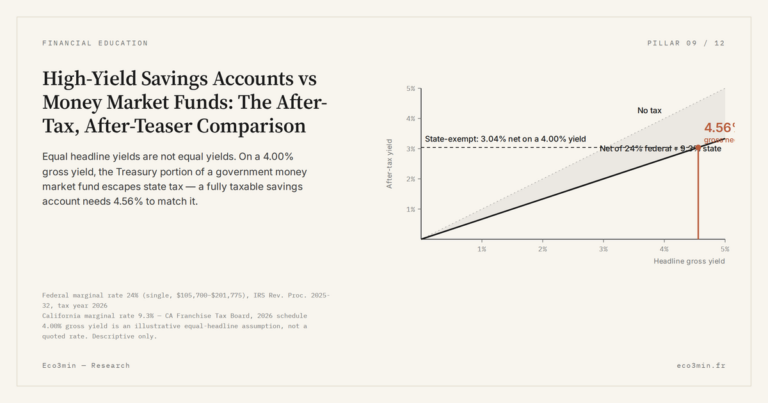
The stakes are not marginal. The Livret A is, by a wide margin, the most widely held savings vehicle in France: more than eight households in ten hold one, and close to 57 million accounts are open, for an outstanding balance that, combined with the LDDS and the LEP, approaches €700 billion. A return below inflation therefore weighs not on a handful of sophisticated savers but on nearly every household holding a precautionary reserve. That is what makes reading the rate both sensitive and politically charged: any move, up or down, redistributes purchasing power across the population, and any durable gap between the rate paid and inflation represents, aggregated across hundreds of billions of euros, a transfer of considerable size of which each individual holder perceives only a fraction. Related work: High-Yield Savings Accounts vs Money Market Funds: The After-Tax, After-Teaser Comparison.
An administered rate, not a market price
The first thing to grasp is that the Livret A return does not float freely. It is framed by a formula defined in the ministerial order of 27 January 2021 on the interest rates of regulated savings products. That formula combines, over the latest six months available, the average of headline inflation excluding tobacco as measured by INSEE and the average of a short-term money-market rate, the €STR published by the European Central Bank, with the result then rounded to the nearest tenth of a point. A legal floor of 0.5% prohibits any revision below that threshold, whatever the calculation yields. The stated logic is coherent: the rate is meant to reflect both the price increases the saver faces and the short-term rate at which a bank could place the same liquidity without credit risk.
This architecture is the product of a long maturation. For decades the Livret A rate was set in an essentially discretionary way, by administrative decision, with no mechanical reference to any indicator. Only over the 2000s did a rule indexed to inflation and a market rate gradually take hold, through successive reforms of the calculation method. The version in force, which bases the return on the average of inflation excluding tobacco and the €STR, replaced an earlier mechanism whose monetary reference was an interbank rate that has since disappeared. The move to the €STR, the euro area’s principal short-term rate, stable around 1.93% since late 2025, accompanied the broader reform of European money-market benchmarks. Measured by the ECB’s euro short-term rate (€STR) series. The current formula is therefore not a historical constant: it is the present state of a regulatory construction that has itself changed a great deal.
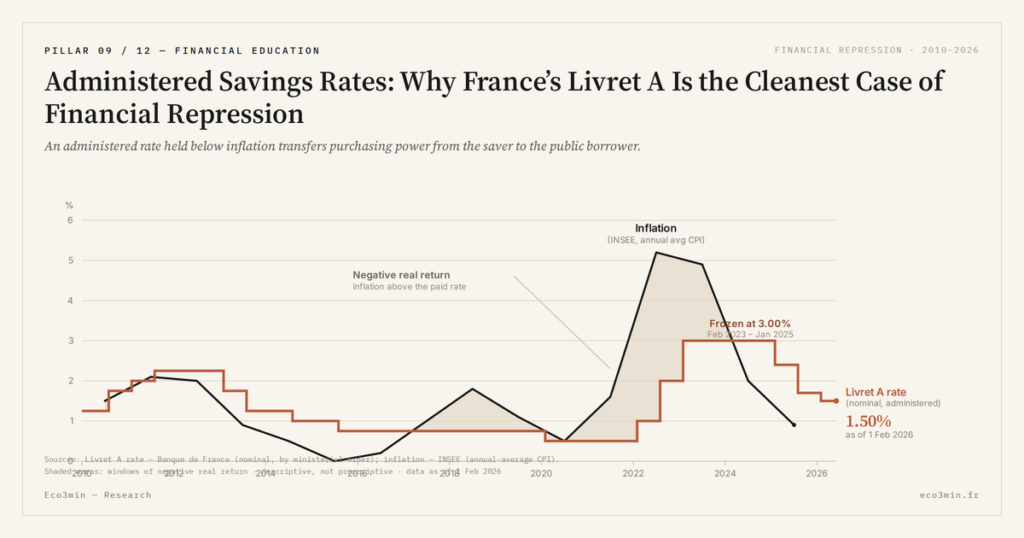
One structural feature of this formula deserves emphasis, because it bears directly on the real return: the revision is semi-annual and based on past data. The rate applicable on 1 February and 1 August reflects the inflation and short-term rates of the preceding six months, not inflation in the moment. In a period of stable prices, that lag is immaterial. In a period of rapid turning points, it becomes decisive: when inflation accelerates sharply, the rate paid stays anchored to a lower past average and runs a mechanical delay until a new revision takes effect. That scheduling lag alone is enough to produce windows of negative real return, even when the formula is applied in good faith. Where those windows fall depends on how fast prices moved, which is what France’s annual rate of consumer price growth records month by month.
Incorporating a money-market leg into the formula is, moreover, not a neutral choice. By tying the Livret A return to the €STR, the regulator brings the product close to the cost at which a bank could, without risk, place the same liquidity overnight. That indexation has a direct consequence: when the European Central Bank lowers its policy rates, the €STR recedes, and the monetary component of the formula drags the Livret A rate down, independently of inflation. The decline in rates paid through 2025 and into early 2026 owed as much to falling euro-area short rates as to receding inflation: both components of the formula pushed in the same direction. Conversely, a rebound in short rates, combined with renewed inflation, would push the formula up, which is what fuels expectations of an increase on 1 August 2026.
The formula is, in any case, only a starting point. The 2021 order explicitly provides that the Banque de France may propose to the minister that the revision resulting from the calculation be modulated, and the minister decides in the last resort. That latitude is not theoretical: it is exercised regularly, in both directions. The revision of 1 February 2026 offers a clear illustration. Strict application of the formula would have led to a rate of 1.4%, but the governor of the Banque de France proposed retaining 1.5% “in order to better protect savers’ purchasing power”, and the minister confirmed that level (economie.gouv.fr, press release of 15 January 2026). The gap is modest in absolute terms, but it is qualitatively significant: the rate paid is not the one the mechanism produces, it is the one the public decision-maker chooses.
The gap can run the other way, to the saver’s detriment. Between February 2023 and January 2025 the rate was frozen at 3% for two years, even though the path of inflation and short-term rates would have justified, over certain windows, an upward revision. The government had then chosen to cap the return, officially so as not to add to the cost of financing social housing and the cost borne by banks. The symmetry is instructive: the same hand that lifts the rate by a tenth of a point in 2026 to spare savers had blocked it two years earlier to spare borrowers. In both cases the applied rate departs from the formula, and it is precisely that departure that reveals the political nature of the instrument. The term-by-term calculation and the full catalogue of government departures are treated in a dedicated analysis of how the formula actually works.
This starting point immediately sets the Livret A apart in the landscape of savings vehicles. A euro-denominated life-insurance fund, a bond, a term deposit see their return move under the combined effect of competition, risk and market conditions. The Livret A, by contrast, has its return fixed by ministerial order, identical across every institution, from La Banque Postale to Crédit Agricole and the online banks. That uniformity is not a technical detail: it signals that the product belongs less to market finance than to economic policy. The relevant lens is therefore not comparative yield but the economics of savings vehicles and real returns, to which this cluster is attached.
An administered retail savings rate of this kind is not a French peculiarity in principle, even if the Livret A is an unusually pure example of it. Whenever a state sets, caps or subsidises the return on a mass savings product rather than leaving it to competition, it creates the same basic configuration: a rate determined by decision rather than by market, and an arbitration between the saver’s return and whatever public objective the savings are channelled toward. What makes the French case so legible is the combination of scale, longevity and an explicit indexation between the rate paid and the cost of a named public mission, which lays the trade-off bare in a way few other instruments do.
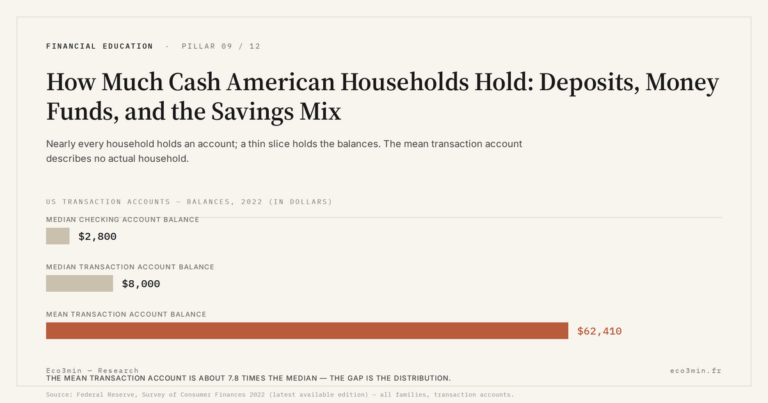
If the Livret A rate is political, it is because the money it collects is not idle. Contrary to a widespread belief, the deposited savings do not sleep in an account. A large share is centralised at the savings fund managed by the Caisse des Dépôts, which transforms it into very long-term loans. At the end of 2025, around €406.5 billion of regulated-savings deposits were managed by the savings fund, out of a total outstanding close to €700 billion, with the overall centralisation rate coming in around 59.5% (Caisse des Dépôts data, 2025 savings-fund annual report). The remainder stays on the balance sheets of the distributing banks, which must deploy it to finance small and medium-sized enterprises, environmental projects and the social and solidarity economy. Related material: How Much Cash American Households Hold: Deposits, Money Funds, and the Savings Mix.
This circuit has a long history that illuminates its logic. The Caisse des Dépôts was created in 1816, and the Livret A, launched in 1818, is its oldest deposit product. For close to two centuries its distribution was entrusted to a restricted set of networks: until 2008, only La Banque Postale, the Caisses d’Épargne and Crédit Mutuel, under the “livret bleu” name, could offer it. It was a European Commission decision in 2007, finding that distribution monopoly contrary to competition law, that led the 2008 economic-modernisation law to open distribution to all credit institutions from 1 January 2009. That opening altered the balance of the circuit: the share of deposits actually centralised now depends in part on the commercial policy of banks, free to steer their clients toward other products once they have been won over. A decree of 17 March 2011 set the centralisation rules, with a reference rate accompanied by a floor tied to the financing needs of social housing, the overall rate standing today around 59.5%, with Livret A and LDDS funds centralised up to 60% and LEP funds at 50%.
The centralised share is overwhelmingly directed toward social housing. In 2025 the savings fund extended €41.7 billion of new loans, a record level, of which around €22.9 billion went to social landlords and local authorities, the balance split between the ecological transition and other general-interest missions. These loans finance the construction and renovation of rent-controlled housing, amounting, according to the Caisse des Dépôts, to close to one in three social-housing units built in France. The decisive point lies in how these loans are priced: they are indexed to the Livret A rate. A loan granted to a social landlord is written as the Livret A rate plus a margin, so that a Livret A return of 2% translates, for example, into a financing cost of 2.67% for the borrower (economie.gouv.fr). It is this indexation mechanism that springs the political trap: raising the rate paid to the saver raises, to the decimal, the cost of social housing. Home-savings plans sit on the same fault line, since the PEL rate set for each new plan prices both a deposit and the loan attached to it.
The management of this fund rests on a large-scale maturity transformation. The deposits collected are, by nature, immediately available: the saver can withdraw the money at any time. Yet they finance loans whose maturity can reach forty years, and longer for certain uses. To reconcile that immediate liquidity with very long-term commitments, the savings fund holds a sizeable portfolio of financial assets, on the order of €203 billion at the end of 2025, intended to guarantee that withdrawals can be honoured at any moment. To this plumbing is added the recent diversification of uses: beyond social housing, the fund now finances public infrastructure and the ecological transition, and it has been announced that it would contribute, to the tune of 60% of an estimated €72.8 billion, to the construction of six new EPR2 nuclear reactors, with the Caisse des Dépôts stressing that this use should not reduce its capacity to lend to the housing sector at low cost. A related perspective: our cross-asset comparison by cycle.
The economic balance of this circuit deserves spelling out, because it bears on the trade-off. The banks that distribute the Livret A keep a little over 40% of the deposits, and additionally receive a centralisation commission, on the order of 0.3% on average since the 2009 reform, in return for collecting the deposits and managing the accounts. On the savings-fund side, the cost of the resource, that is the rate paid to the saver plus that commission, conditions its capacity to lend cheaply: when that cost exceeds the return on feasible uses, the Caisse des Dépôts may prefer to place part of the funds in financial markets rather than transform them entirely into loans. The Livret A rate is therefore not merely a price paid to the saver; it is the price of a resource that irrigates an entire apparatus of public financing, and that is what explains borrowers’ resistance to any increase.
The political economy of this arbitration is not neutral. On one side stand the savers, dispersed across tens of millions of households, each individually bearing only a small fraction of any shortfall and none of them organised around the rate. On the other stand the borrowers and their financing ecosystem, social landlords, the construction sector and local authorities, concentrated, vocal and directly affected to the decimal by every revision. A diffuse interest faces a concentrated one, and the standard logic of collective action suggests which tends to weigh more in the room when the rate is set. This does not predetermine every decision, but it frames why the burden of the trade-off has so often, over the long run, leaned toward the dispersed side.
The trade-off then becomes plain. Any rate increase benefits the saver and weighs on the social landlord; any decrease does the reverse. The government cannot satisfy both camps at once, because they are linked by the same parameter. To this tension is added a direct budgetary dimension: in return for the state guarantee that protects deposits, the savings fund paid €1.215 billion to the state in 2025. The Livret A return is therefore not a purely commercial matter between a bank and its client; it is a public-policy parameter that engages housing finance, the balance of social landlords and the state’s accounts. The full description of this circuit, from collection by the banks through to the lending uses, is developed in the analysis of how those deposits fund affordable housing.
This trade-off has observable effects on saver behaviour. In 2025 net inflows into the Livret A turned negative for the first time in roughly a decade, as the rapid fall in the rate pushed a share of households to shift toward other vehicles, notably euro-denominated life-insurance funds. The average return paid over 2025 came in around 2.16%, reflecting a rate that fell from 3% in January to 2.4% in February and then 1.7% in August. The downward path of the administered rate, decided to ease the cost of social housing and of banks, thus translated into an outflow, a sign that the political trade-off is also paid in the product’s appeal. This lens lets one read the Livret A for what it is, within the broader exercise of dissecting a regulated vehicle by its real return rather than by its headline rate alone.
Financial repression, the long-run lens
To grasp what this rate says over decades, one has to bring in a precise concept, that of financial repression. The term was coined by the economists Ronald McKinnon and Edward Shaw in 1973 to describe the set of policies that allow a state to “capture” and “under-pay” domestic savers. Originally it described policies judged to inhibit growth in emerging economies; it has since been applied more broadly, in particular to advanced economies after the 2008 crisis. Carmen Reinhart and Maria Belen Sbrancia provided its most cited formalisation in their study “The Liquidation of Government Debt” (NBER, 2011). Financial repression there gathers a cluster of devices: directing savings toward public uses through captive audiences, explicit or implicit caps on interest rates, controls on cross-border capital movements, and a tighter connection between the state and the banking system.
The central mechanism runs as follows. By keeping nominal rates below inflation, the state reduces the servicing cost of its debt and, above all, erodes the real value of that debt over time. Reinhart and Sbrancia describe this outcome as a “liquidation”: when the real rate turns negative, meaning the nominal rate slips below the inflation rate, the real value of claims declines, and the operation becomes the equivalent of an implicit tax, a transfer from creditor to debtor. Savers, creditors of the system, bear the cost; the public borrower benefits. The authors document that, for advanced economies, real rates were negative roughly half of the time between 1945 and 1980, and estimate the debt-liquidation effect at around three to four percentage points of GDP per year for the United States and the United Kingdom, more still for higher-inflation countries. They identify two major historical windows of repression: the post-war period framed by the Bretton Woods system, and the sequence opened after the 2008 crisis.
The two windows Reinhart and Sbrancia identify differ in texture, and the distinction helps place the current French moment. The Bretton Woods era combined high inflation, tight capital controls and explicit rate ceilings, a forceful and visible apparatus. The post-2008 window operates more softly: nominal rates held low by accommodative monetary policy, occasional bouts of negative real return, and far fewer overt controls, since an integrated capital market makes hard caps harder to sustain. The Livret A sits within this softer, contemporary version. Its repression is intermittent rather than permanent, surfacing in inflation spikes and policy freezes and receding in disinflation, which is exactly why a regime-by-regime reading, rather than a blanket verdict, is the honest way to assess it.
One element of Reinhart and Sbrancia’s argument is especially illuminating for the French case. Financial repression, they stress, is the more effective the more it is accompanied by a steady dose of inflation, and that inflation need not be very high nor entirely surprise agents to do its work: it is enough that the real return stay negative over time. What historically prevented savings from fleeing toward better-remunerated vehicles was, among other things, controls on capital movements, which kept the audience captive. France lived under that framework: until the late 1980s, exchange controls and a strict supervision of credit limited the saver’s options, and the Livret A, a mass administered-rate savings product, sat squarely within that environment. The apparatus has evolved, but its underlying logic, a rate set by public decision on abundant savings directed toward general-interest uses, retains those features.
What distinguishes this form of levy from ordinary taxes lies in its discretion. An income tax or a consumption tax is voted, displayed, contested; it appears in the budget debate and everyone can measure its amount. Financial repression, by contrast, operates with no budget line and no dedicated vote: the transfer occurs silently, through a negative real return that the saver does not perceive as a levy, since the capital, expressed in euros, never falls. It is that invisibility that makes it, from the standpoint of an indebted state, a convenient instrument. Reinhart and Sbrancia insist on this point: the device’s effectiveness rests precisely on the fact that it need not be perceived as a tax to produce its effects, so long as inflation regularly erodes the real value of claims.
The French Livret A thus fits this grid exactly. It is an administered rate, hence capped by public decision; it collects captive savings of several hundred billion euros; and those savings are directed, through centralisation, toward the financing of public objectives. When its return slips below inflation, it functions as an instrument for transferring purchasing power from the saver to the borrower, whether the social landlord enjoying cheap credit or, indirectly, the guaranteeing state. The word “repression” carries no moral judgment here: it designates an identified and studied device, of which the Livret A is, over the long run, one of the most legible cases in the French economy. The general mechanism, independent of the instrument, is detailed in the analysis of what financial repression actually is, and the indicators of a repressive regime are tracked separately.
Saying that “the Livret A protects against inflation” conflates the nominal rate with the real return. The product guarantees the nominal value of the capital, but that guarantee says nothing about purchasing power: if inflation exceeds the rate paid, the capital loses real value even though it never falls in euros. Protection against inflation depends on the regime, not on the product.
Formula rate versus applied rate: locating the political wedge
The most useful instrument for making the Livret A’s political dimension concrete is to set two series side by side: the rate the formula would have produced, term by term, and the rate actually applied after the government’s arbitration. The gap between them, which one can call the political “wedge”, measures what the public decision added to or subtracted from the mechanism. When the government freezes the rate at 3% while the formula would push higher, the wedge is negative for the saver. When it lifts the rate from 1.4% to 1.5% to preserve purchasing power, the wedge is positive. That wedge appears in no mainstream communication, which simply announces the final rate; it has to be reconstructed to be made visible.
Departures take several forms, worth distinguishing. A freeze holds the rate at a given level despite a formula that would command a move, as between 2023 and 2025. A floor prevents a fall below a threshold, whether legal, like the 0.5% floor, or decided case by case. A “political” rounding consists in retaining, within the latitude offered by the rounding rule, the level most favourable to the objective pursued, which in February 2026 translated into the choice of 1.5% rather than 1.4%. Each of these modulations shifts the rate paid relative to what the pure mechanism would produce, and their accumulation, departure after departure, traces the path actually borne by the saver.
A chronological clarification is required here, because it conditions the scope of the exercise. Since the setting of the Livret A by a formula indexed to inflation and a market rate is relatively recent, the political “wedge”, in the strict sense of a gap between formula and decision, is a phenomenon of the past two decades. Over earlier periods, there is no formula rate against which to measure the decision: there is only the decision itself, which was the formula. That distinction matters for correctly interpreting the long-run real return, which spans decades when the very concept of a formula rate had no meaning. Conflating the two eras would amount to laying a recent grid over a history that obeyed a different, purely discretionary logic.
The political wedge illuminates the mechanics of the trade-off, but it does not tell the whole story of the outcome borne by the saver. A rate can be generous relative to the formula and still below inflation; it can be held down relative to the formula and still above inflation. What determines the real return is not the gap to the formula but the gap to inflation. The two readings complement each other: the political wedge reveals the decision-maker’s intent, the real return reveals the effect on purchasing power. The fine decomposition of the formula and the history of departures, which allow that wedge to be reconstructed year by year, are developed in the dedicated analysis of the actual formula and its departures.
The real return on a regulated savings vehicle reads as the nominal rate paid minus the inflation rate over the same period. A positive real return means the purchasing power of the capital rises; a negative real return means it falls, even when the capital expressed in euros stays stable or grows. Applied to a long series, this decomposition turns a debate about the nominal rate into a reading of the purchasing-power transfer actually borne.
The real return: what six decades actually show
Placed in a long perspective, the Livret A reveals sharply contrasting sequences. The high-inflation period of the 1970s and early 1980s saw the booklet’s nominal return stay durably behind the rise in prices: the nominal rate could look high in absolute terms, but inflation was higher still, so that the real return was negative over long windows. At the opposite pole, the disinflation of the 1980s and 1990s, when the nominal rate stayed anchored at a relatively high level while prices receded, produced durable positive real returns. The more recent sequence illustrates yet another configuration: the Livret A stayed below the 2% threshold from 2009 to 2015, then glued to its 0.5% legal floor between 2020 and 2022, levels which, set against the inflation of those periods, again eroded purchasing power.
A measurement subtlety compounds the picture. The formula references inflation excluding tobacco, and the price index that enters it is a national average that need not match the basket any individual household actually consumes. A saver whose spending tilts toward categories rising faster than the headline index, housing or energy in certain years, faces an effective inflation higher than the one the formula uses, and therefore an effective real return lower than the published figure suggests. The gap between the index that sets the rate and the prices a given household truly pays is a second, quieter source of divergence between the nominal return and the purchasing power genuinely preserved, on top of the scheduling lag and the political wedge.
The 2022 episode deserves particular attention, because it combines two of the mechanisms described above. As inflation accelerated sharply in the wake of the energy shock, the Livret A rate, revised only twice a year on past averages, stayed well behind the rise in prices for a large part of the year: a clearly negative real return set in not by deliberate decision but through the combined effect of the scheduling lag and a nominal rate catching up to inflation with delay. Then, from February 2023, the 3% freeze took over, this time by political choice, holding the return down for two years to contain the cost of social housing. The 2022–2025 sequence thus offers, within a few years, the succession of a “mechanical” repression through formula lag and a “decided” repression through departure, before the return to a positive real return in 2026.
The 2026 configuration indeed illustrates the reverse case, more favourable but fragile. On 1 February 2026 the rate of 1.5% exceeds inflation, which stood at 0.8% in December 2025 according to INSEE: the real return has turned positive again, which the ministry explicitly highlighted. But that balance is narrow and reversible. The disinflation that allows it can reverse, as shown by the rebound in prices observed in spring 2026 under the effect of geopolitical tensions over energy, and the next revision will turn on the actual data for the half-year. A slightly positive real return in a given half-year says nothing about the cumulative path over a saving lifetime.
The distinction between a bad year and a cumulative erosion is central here. A negative real return of one or two points over a single year looks innocuous and often goes unnoticed. But these gaps compound: a succession of years where the rate paid stays one or two points below inflation produces, after a decade, a substantial loss of purchasing power on the capital, even as the balance in euros has kept rising under the effect of interest. That is why the relevant magnitude is not the real return of a single half-year but its cumulative path over a long period, the only one capable of revealing the true size of the transfer. A saver who had left capital on a Livret A through the successive repression windows would have seen, in constant euros, the reserve erode year after year without ever recording a nominal loss.
It is precisely this cumulative path that is the decisive magnitude and that cannot be read off a single year’s rate. Reconstructing the Livret A’s real return since 1960, setting the nominal rate paid against INSEE’s price index, allows one to compute what one euro deposited and never withdrawn would have gained or lost in purchasing power, and to pinpoint the windows during which the real return stayed negative. That exercise, which requires a complete and dated series and constitutes the cluster’s central artefact, is carried out separately, with its reproducible data, in the record devoted to six decades of real-return data. The present article confines itself to the frame: it establishes why the real return, and not the nominal rate, is the relevant magnitude, and why an administered instrument can transfer purchasing power over long periods without ever showing a loss in euros.
The Livret A is not a mediocre vehicle by accident: its recurrent under-remuneration is the very function of an administered rate arbitrated against public financing.
When “risk-free” becomes a transfer: reading by regime
The honest answer to the question “does the Livret A protect purchasing power?” is therefore neither yes nor no: it depends on the macroeconomic regime. In a configuration of high inflation combined with administered rates held low by political decision, the real return turns sharply negative and savings melt in purchasing-power terms; that is the most pronounced repression case. In a phase of disinflation where the nominal rate has been anchored high and prices recede, the real return turns positive again and “risk-free” keeps its promise. Between these two poles unfold intermediate configurations. That dependence on the regime turns a binary question into a conditional reading, developed in the analysis of the real return when the regime turns against savers.
An asymmetry is worth flagging in this mechanism. The periods of negative real return tend to coincide with phases of high inflation, that is precisely the moments when the saver would most need to preserve purchasing power; conversely, the real return turns positive in disinflation, when the pressure on purchasing power eases. “Risk-free” thus protects best when protection is least needed, and least when it is needed most. That asymmetry is not an accidental flaw in the product: it follows directly from the fact that inflation is at once what erodes savings and what, through the formula, should in theory lift the rate, but with delay and subject to political arbitration.
This grid also illuminates the related devices. The Livret d’Épargne Populaire, the LEP, functions as a targeted anti-inflation transfer: its rate is, by construction, anchored above that of the Livret A, and it is reserved for households whose reference tax income stays below a threshold. On 1 February 2026 it stands at 2.5% against 1.5% for the Livret A, even though applying its own formula would have produced 1.9%: here too, the public decision lifted the rate to better protect lower-income savings. The LEP thus represents a form of selective counter-repression, financed by the collective for the benefit of an income-defined group. The mechanics of means-tested, state-subsidised saving, the rate gap and the eligibility condition are examined in the analysis of means-tested savings as a targeted transfer.
Other parameters finally modulate the saver’s exposure to this transfer. The contribution cap, set at €22,950 since August 2013 and unchanged since, mechanically limits the amount a household can place in the product, and hence the size of the transfer it bears or avoids; the mechanics of that cap and the fate of savings beyond it are described in the analysis of what happens past the contribution cap. The comparison with other receptacles of precautionary savings, from cash to euro funds, is treated in the analysis of the real return on cash and euro funds compared by real yield. An instructive parallel can finally be drawn with market cash: in the United States, the real return on three-month Treasury bills obeys the same decomposition laws, without the layer of political arbitration specific to an administered rate, as examined in the analysis of the real return on US market cash.
The very nature of the Livret A as a savings function, rather than a yield vehicle, is the implicit foundation of this entire reading. Where a liquid, guaranteed reserve of this kind belongs among funding priorities is laid out in the match-first funding order. A product designed to hold an immediately available, guaranteed and tax-exempt precautionary reserve does not have, as its primary vocation, to beat inflation; its function is to secure liquidity. That distinction between function and performance, which illuminates why under-remuneration is not an anomaly but a feature, is developed in the analysis of the Livret A as a savings function.
Reading the instrument for what it is
The Livret A condenses a French singularity: a mass savings product, held by more than eight households in ten and carried by close to 57 million accounts, whose return belongs less to finance than to economic policy. The headline rate is the outcome of a trade-off between contradictory interests linked by a single parameter, and it can be read correctly only by keeping in mind what the formula would produce and what the decision makes of it. Over the long run, the magnitude that matters is not the nominal rate but the real return, and the latter has gone through repeated windows where “risk-free” cash transferred purchasing power from the saver to the public borrower, in line with the long-documented mechanism of financial repression.
This reading dictates no course of action. It does not say whether one should hold a Livret A, in what proportion, or at what moment: those questions depend on the macroeconomic regime, on each person’s tax and wealth situation, and on a trade-off this outlet has no vocation to settle. It offers only a grid for separating what, in the Livret A rate, belongs to the arithmetic of a formula from what belongs to a political choice, and for measuring, over decades, what that choice has actually cost or returned in purchasing power. The next revision, expected on 1 August 2026 on the basis of the first half-year’s data, will replay this trade-off between the saver and public financing; it will fall, like those before it, within the long sequence in which the rate of “the French saver’s favourite product” is decided at the border between finance and politics.
- The Livret A rate results from a regulatory formula framed by the 2021 ministerial order, but the government retains the power to depart from it, up or down, as illustrated by the 3% freeze of 2023–2025 and the lift from 1.4% to 1.5% in February 2026.
- Close to 60% of the deposits are centralised at the Caisse des Dépôts and lent to social housing at rates indexed to the Livret A, which mechanically links the saver’s return to the cost of housing finance and places the government in a permanent trade-off.
- An administered rate held below inflation matches the definition of financial repression: a transfer of purchasing power from the saver to the public borrower, with a loss never shown in euros.
- The decisive magnitude is the cumulative real return, not a single year’s nominal rate; its dated reconstruction, the regime-by-regime reading and the related devices are treated in the cluster’s dedicated analyses.
Last updated — 10 September 2026
Disclaimer – Financial Information: The analyses, commentary, and content published on eco3min.fr are provided for informational and educational purposes only. They do not constitute investment advice or a solicitation to buy or sell financial instruments. Past performance is not indicative of future results. All investment decisions involve risk and are the sole responsibility of the reader.
Read next
Full pillar →Where the Livret A’s Money Goes: The Caisse des Dépôts Circuit and Social-Housing Finance
The savings held on Livret A accounts do not sit idle. A regulation-set share is centralised at the…
France’s LEP vs the Livret A: A Means-Tested Higher Rate, Explained
France’s Livret d’épargne populaire is often described as "the Livret A, only better". The description misleads: the LEP…
France’s Livret A Ceiling: What Happens Mechanically When a Capped Savings Account Is Full
France’s Livret A ceiling, €22,950, is one of the best-known figures in French saving and one of the…