IMO 2020: the regulatory shock that rewrote product spreads

An environmental rule on marine sulfur can move a refining spread more than a swing in crude. IMO 2020 proved it in January 2020, before the pandemic made the effect impossible to read.
The 2020 sulfur cap is the textbook case of a rarely cited spread driver: regulation. The task is to separate what the rule did from what COVID did in its place.
The marine sulfur cap that took effect on 1 January 2020 sent the VLSFO-HSFO spread to a record, then the pandemic erased the signal within weeks.
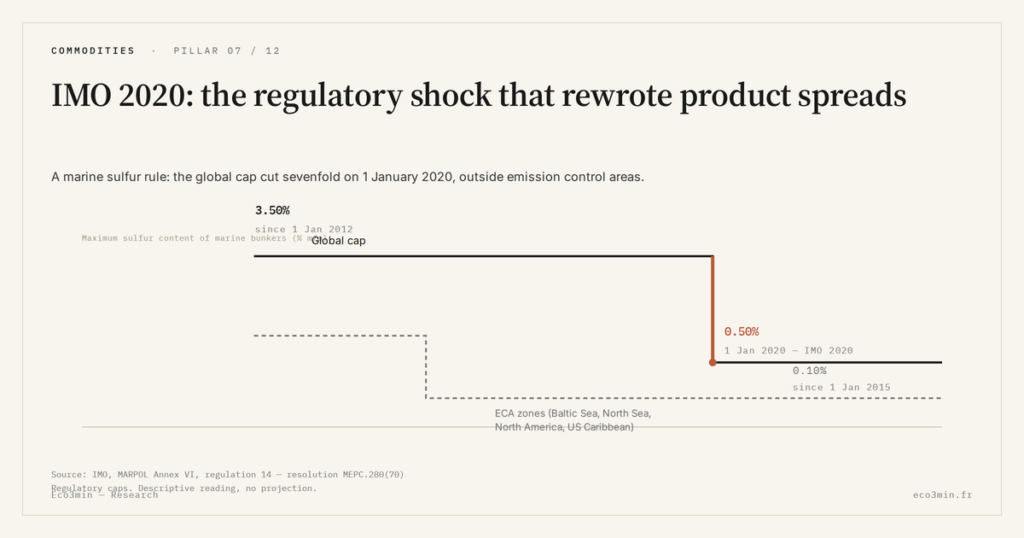
- IMO 2020 (MARPOL Annex VI) cut marine bunker sulfur from 3.5% to 0.5% on 1 January 2020, a forecast 77% drop in SOx emissions from ships (IMO).
- The spread between 0.5% and 3.5% fuel oil peaked on 3 January 2020 at $321.50/mt FOB Rotterdam barges (S&P Global Platts), then fell below $45/t during the year (ING).
- By end-September 2020, the 0.5% marine fuel Brent crack topped diesel, gasoil and jet in Europe (S&P Global): the rule durably reshuffled the product hierarchy.
What the market feared before 2020
By late 2019, one fear dominated oil trading desks: a shock to diesel. In its January 2019 Short-Term Energy Outlook, the US Energy Information Administration (EIA) projected the diesel refining margin rising from 43 cents per gallon in 2018 to 48 in 2019 and 65 in 2020, with an effect it called most acute in 2020 before fading. In the same outlook, the EIA saw distillate refinery yields climbing from 29.5% in 2018 to 31.5% in 2020, at gasoline’s expense (46.9% to 45.6%), and the premium of light-sweet over heavy-sour crude widening, with Brent gaining roughly $2.50 a barrel on that count alone. The logic ran through refining chemistry and reached all the way back to the choice of crude.
To make the new 0.5% compliant fuel (VLSFO), refiners had to draw on distillate cuts, notably vacuum gasoil (VGO). VGO also feeds diesel production. Sandy Fielden, director of oil and products research at Morningstar, later captured the worry: even sophisticated refiners feared they might not make enough compliant fuel without starving the lighter products. On a global marine fuel market of roughly 4 million barrels a day (EIA), compliant bunker demand looked set to drain distillate and lift the diesel crack. That is precisely the divergence between diesel and gasoline cracks the market expected to widen.
The sulfur cap, in practice
The rule is simple in principle. Since 1 January 2020, a ship outside an emission control area (ECA, where the cap is 0.1%) is required to burn fuel with at most 0.5% sulfur, down from 3.5% (IMO, MARPOL Annex VI). Three compliance routes coexist: switch to VLSFO, a reformulated low-sulfur fuel oil; move to marine gasoil (MGO), a pricier distillate; or fit a scrubber that washes the exhaust and lets a vessel keep burning high-sulfur fuel oil (HSFO). The 2020 cap followed earlier tightenings, including the cut of ECA marine sulfur from 1.0% to 0.1% in 2015 (EIA), so refiners were not starting from scratch.
The cost of compliance lies in desulfurization. Stripping sulfur from a heavy residue, or upgrading that residue into lighter products, requires expensive conversion units (hydrotreating, coking). The EIA noted that low-sulfur fuel would carry a premium reflecting this desulfurization cost. That is the line separating a complex refinery from a simple one, and one of the least visible drivers of a refining margin from the pump. It also explains why the shock did not hit everyone alike.
A one-month spike, then COVID
At the very start of 2020, the market first validated the script. S&P Global Platts assessed the spread between 0.5% and 3.5% fuel oil at its widest on 3 January 2020, at $321.50 per metric ton on a FOB Rotterdam barges basis. The January monthly average of the VLSFO-HSFO bunker spread reached $223.10 per ton (OPIS), and it was downhill from there. VLSFO suddenly commanded a record premium over the high-sulfur residue as compliant bunker demand jumped on day one. For a few weeks, IMO 2020 behaved exactly as advertised.
Then the calendar turned against legibility. From February 2020, the COVID crisis compressed refined-product demand (S&P Global), and March’s oil price war did the rest. The VLSFO-HSFO spread, starting near $290 per ton in northwest Europe at end-2019, briefly fell below $45 per ton during the year (ING). The dreaded diesel crack never arrived: collapsing gasoline demand pushed cheap VGO into the VLSFO pool, leaving enough distillate molecules to supply both compliant fuel and diesel (Morningstar).
The consequence reached down into ships’ holds. The scrubber calculation, which assumes a VLSFO-HSFO spread wide enough to repay the investment, fell apart: according to ING, the payback period, around one to two years early in the year, stretched to four to six years as the spread slid toward $50 per ton, and Clarksons estimated up to 700 installations could be delayed or cancelled. A one-month regulatory shock, then COVID rewrote the rest.
A lasting edge for complex refineries
Beneath the price noise, a structural reshuffle did take hold. VLSFO became the fuel of choice: in the first half of 2020 it made up nearly 70% of bunker fuel sales in Singapore, against about 11% for marine gasoil and 18% for HSFO (ING). The feared switch to pricey distillate, MGO, did not happen; refiners rerouted their streams into VLSFO instead. The transition ran without supply hiccups: in the first quarter of 2020, about 96% of ships entering Singapore burned a compliant fuel (ING), and HSFO, far from vanishing, still took 28% of Rotterdam bunker sales over the year and 34% in the fourth quarter (S&P Global), supported by scrubber-fitted vessels.
Refineries with conversion units captured the edge. By end-September 2020, the 0.5% marine fuel Brent crack topped diesel, gasoil and jet in Europe (S&P Global): a formerly residual product now paid more to refine than traditionally richer distillates. That unusual ranking is what gives relief to the jet crack, long overlooked by the standard margin calculation. HSFO itself found an outlet as coking feedstock for complex refiners, and its European Brent crack firmed, averaging -8.74 dollars a barrel in 2020 against -13.62 in 2019 (S&P Global). A simple refinery, unable to desulfurize or convert, reached neither the VLSFO premium nor that outlet.
What COVID makes impossible to measure
One limit remains, and any honest reading states it plainly. For 2020, isolating IMO 2020’s own effect from the pandemic’s is close to impossible. The only roughly clean window is the January peak, before demand contracted: there the spread answers to the rule and nothing else. Everything after blends two opposing shocks, a standard that widens spreads and a recession that crushes them.
That caution does not empty the case. It shifts its center of gravity: from a spectacular price shock, expected then erased, to a durable reshuffle of outlets and premiums. The cyclical signal was drowned; the structural imprint held, visible in the hierarchy of cracks and in how refining margins are formed across levels of refinery complexity.
Many took away from 2020 that IMO 2020 had been overhyped, a non-event since the feared diesel crack never came. That reading conflates a price signal with a change in structure. The expected price move was indeed erased, but by COVID, not by any weakness in the rule itself. The bunker mix, the VLSFO premium and the edge for complex refineries settled in for good.
A spread driver that is not the barrel
IMO 2020 leaves a lesson beyond bunkers: a refining spread does not answer to crude alone. A regulatory decision, by shifting demand from one product to another, can reshuffle premiums faster and more durably than a move in crude prices. How much of that legacy survives the next turn in marine demand, between the return of HSFO through scrubbers and the rise of alternative fuels, is the open question.
Last updated — 22 September 2026
Disclaimer – Financial Information: The analyses, commentary, and content published on eco3min.fr are provided for informational and educational purposes only. They do not constitute investment advice or a solicitation to buy or sell financial instruments. Past performance is not indicative of future results. All investment decisions involve risk and are the sole responsibility of the reader.
Read next
Full pillar →The 2022–2023 refining golden age: anatomy of an episode
In 2022, refined fuel prices climbed faster than crude. That gap, measured by the 3-2-1 crack spread, reached…
Diesel versus gasoline: why the two crack spreads diverge
The 3-2-1 crack blends gasoline and distillate into a single number, and that convenience hides something the market…
The 3-2-1 crack spread explained: refining margin in one formula
A refinery is, in the crudest terms, a spread trade: it buys crude oil, transforms it, and sells…