Jet fuel, the forgotten margin: the jet crack and the aviation link

The 3-2-1 crack spread reduces the refining margin to two products, gasoline and diesel. Jet fuel sits outside it, even though its own margin moves on a signal the other two cannot see.
Left out of the 3-2-1, the jet crack is the one refining margin tied to a single end use: air travel. It carries the aviation cycle, not just refining.
- IATA puts the jet crack’s long-run norm below USD 20 a barrel, against more than USD 60 in 2022 and early 2023, and a projected USD 57 average in 2026 (IATA, 7 June 2026), a record.
- Jet kerosene hit a record USD 172 a barrel in June 2022, driven by Russia’s invasion of Ukraine (IATA).
- The mirror image came in 2020: global passenger traffic fell 52.9% year on year in March (IATA) and jet prices sank to multi-year lows as air travel demand vanished.
On a trading desk, one refining margin sets the reference: the 3-2-1 crack spread, which assumes three barrels of crude yield two barrels of gasoline and one of distillate. In the US convention, that distillate is diesel or heating oil. Jet fuel, the third major middle distillate, is nowhere in it.
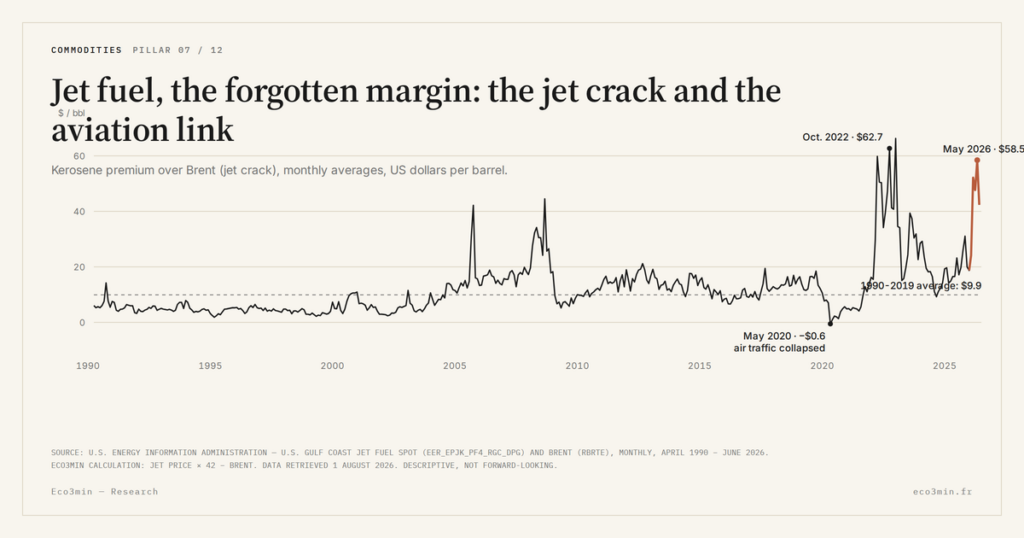
The omission matters. According to IATA, the premium of jet fuel over crude, the jet crack, sat below USD 20 a barrel for years, then topped USD 60 at times in 2022 and early 2023, before settling at a projected record average of USD 57 a barrel in 2026 (IATA, 7 June 2026). A margin that size never shows up in the 3-2-1. It lives beside it, invisible to the gauge everyone watches. We have set out elsewhere how refining margins drive oil profits more than the barrel; the jet crack is the link that framework leaves in shadow.
Why the 3-2-1 leaves kerosene out
The 3-2-1 was built on the two highest-volume products of a US refinery, gasoline and diesel (how the 3-2-1 crack spread is built is covered separately). Jet comes off in smaller quantity, and its market is more concentrated, resting on a handful of buyers: airlines and the military. Building a benchmark margin on the two big products and setting the third aside is convenient, not neutral.
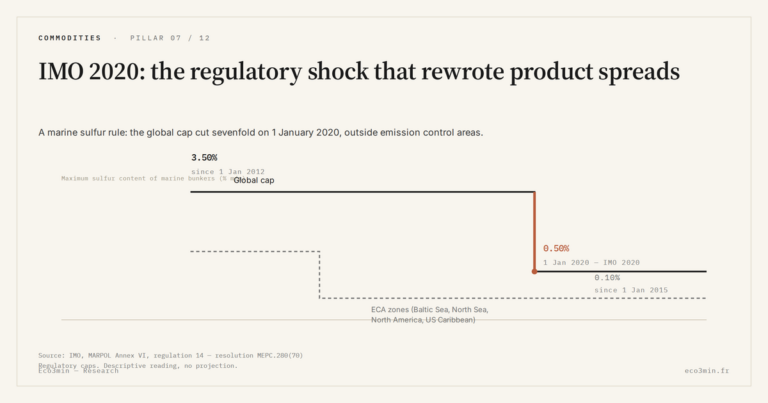
Technically, jet remains a middle distillate, a cousin of diesel. Both come off the same distillation cut, and refiners arbitrage between them constantly. IATA spells it out (Europe’s Jet Fuel Supply Outlook brief, November 2025): diesel and kerosene belong to the same range, and in tight markets refiners often favour diesel yields, which have wider outlets, squeezing jet supply further. That same middle-distillate range once bent under a regulatory shock, the IMO 2020 sulphur cap and product spreads, when a marine-fuel rule reshaped margins. The kinship is why the jet crack and the diesel crack often move together. It is not why they diverge.
The aviation overlay diesel does not have
The difference comes down to one word: demand. Diesel feeds road freight, farming, heating and industry; its outlets are spread across the whole economy. Jet has a single mass customer, the aircraft. That dependence on one end use makes the jet crack the one refining margin that carries an air-travel cycle.
When aviation stops, the margin collapses regardless of refining. 2020 proved it. In March, global passenger traffic fell 52.9% year on year, the steepest drop on record at the time (IATA). Jet prices sank to multi-year lows, not because refining had turned cheap, but because air travel demand had evaporated. Fuel’s share of airline costs dropped to 17.9% in 2020 (IATA), reflecting both crushed prices and record-low flying. Fuel usually runs at 25% to 30% of an airline’s operating costs (IATA); seeing it fall below 18% shows how far demand had retreated.
That single-customer link anchors kerosene in a specific macro cycle. Between 1990 and 2019, global air traffic tracked real PPP GDP closely (IATA): jet demand rises and falls with activity and income, more tightly than diesel’s, which is spread across a dozen uses. The jet crack therefore inherits a cyclical sensitivity the other cracks dilute.
2022 and 2026: when the forgotten margin sets the bill
The reverse move is just as sharp. In June 2022, jet kerosene reached USD 172 a barrel, a record, against the backdrop of Russia’s invasion of Ukraine (IATA). The jet crack pushed above USD 60 a barrel, far above its norm (IATA). Two forces stacked up: the post-pandemic recovery in traffic, and a general squeeze on middle distillates after Russian crude and products were pushed out of Western markets. Pinning the spike on the travel rebound alone would be wrong; scarce diesel counted just as much. As a marker of the turn, the average ticket price returned to pre-crisis levels in May 2022, just as the jet price ran 92% above its May 2019 mark (IATA).
What followed did not settle back to the old normal: the jet crack held near USD 26 a barrel late in 2025 (IATA, December 2025), above its long-run average, a sign of persistent distillate refining constraints. Then early 2026 replayed the pattern with a different trigger. IATA (7 June 2026) expects jet to average USD 152 a barrel over the year against Brent near USD 95, a crack of USD 57 a barrel it calls a historic high, as Middle East disruptions curb distillate supply. The margin the 3-2-1 cannot see is again the airlines’ largest cost line, with the sector’s fuel bill rising from around USD 252 billion in 2025 to a projected USD 350 billion in 2026 (IATA). None of this is new: back in 2008, the jet price already jumped 40% year on year (IATA), proof that the forgotten margin can move back to centre stage.
One structural factor could eventually move this margin: sustainable fuel. But in 2026, sustainable aviation fuel (SAF) still accounts for only 0.8% of total consumption, some 2.4 million tonnes, at an expected extra cost of USD 4.3 billion (IATA, 7 June 2026), and the price gap between conventional jet and SAF narrowed as fossil fuel grew dearer. In other words, conventional kerosene still sets the margin, and the jet crack remains, for now, the right thermometer.
Reading the jet series for what it says
That is the value of tracking the US Gulf Coast jet fuel spot price, the reference series published by the EIA with daily data since 1990. Set against crude, it yields a jet crack that blends two pieces of information: the state of distillate refining, shared with diesel, and the state of aviation demand, unique to jet. A jet crack climbing while the diesel crack stays calm signals a strain coming from the sky, not the refinery.
Measured on that series (Gulf Coast jet × 42 minus Brent, monthly averages, Eco3min calculation on EIA data to 15 September 2026), the premium averaged USD 9.9 a barrel over 1990-2019, fell to −0.6 in May 2020, then reached 62.7 in October 2022 and a monthly high of 66.2 in January 2023. In 2026 it climbed from 18.7 in January to 58.4 in May and 65.3 in August, and ran at 71.9 over the first half of September, above the 2023 peak if the month holds.
This cross-reading has a concrete bearing on the sector, without turning into an instruction. Facing a durably elevated crack, airlines had hedged roughly one third of their expected 2026 fuel consumption (IATA): an observation, not a recommendation. What the series teaches above all is not to confuse the drivers behind a price move.
Reading the jet crack as just another distillate crack over-attributes its moves to refining. The kerosene premium also carries an aviation-demand signal that diesel lacks: in 2020 it collapsed with traffic, in 2022 it climbed with the recovery as much as with distillate scarcity. Conflating the two drivers misses what the forgotten margin uniquely reports.
The jet crack does not replace the 3-2-1; it completes it. Where the standard gauge measures refining health through its two flagship products, the kerosene margin adds a variable neither gasoline nor diesel carries: how full the planes are. Watching one without the other leaves a blind spot exactly where the aviation cycle prints itself into prices.
Last updated — 22 September 2026
Disclaimer – Financial Information: The analyses, commentary, and content published on eco3min.fr are provided for informational and educational purposes only. They do not constitute investment advice or a solicitation to buy or sell financial instruments. Past performance is not indicative of future results. All investment decisions involve risk and are the sole responsibility of the reader.
Read next
Full pillar →The 2022–2023 refining golden age: anatomy of an episode
In 2022, refined fuel prices climbed faster than crude. That gap, measured by the 3-2-1 crack spread, reached…
Diesel versus gasoline: why the two crack spreads diverge
The 3-2-1 crack blends gasoline and distillate into a single number, and that convenience hides something the market…
The 3-2-1 crack spread explained: refining margin in one formula
A refinery is, in the crudest terms, a spread trade: it buys crude oil, transforms it, and sells…