Compound Interest: Why Our Intuition Goes Wrong
Compound interest is mathematically simple yet routinely misread because human intuition treats time and growth as linear. The gap between perception and exponential reality explains why projections appear disappointing early on and excessive late, regardless of the simulation's accuracy.

Analysis of the cognitive biases that prevent a correct perception of compound interest effects, despite their apparent mathematical simplicity.
TL;DR
Compound interest is easy to compute and easy to misread, because the mind expects steady progression while the bulk of the effect concentrates in the final years, where intuition fails.
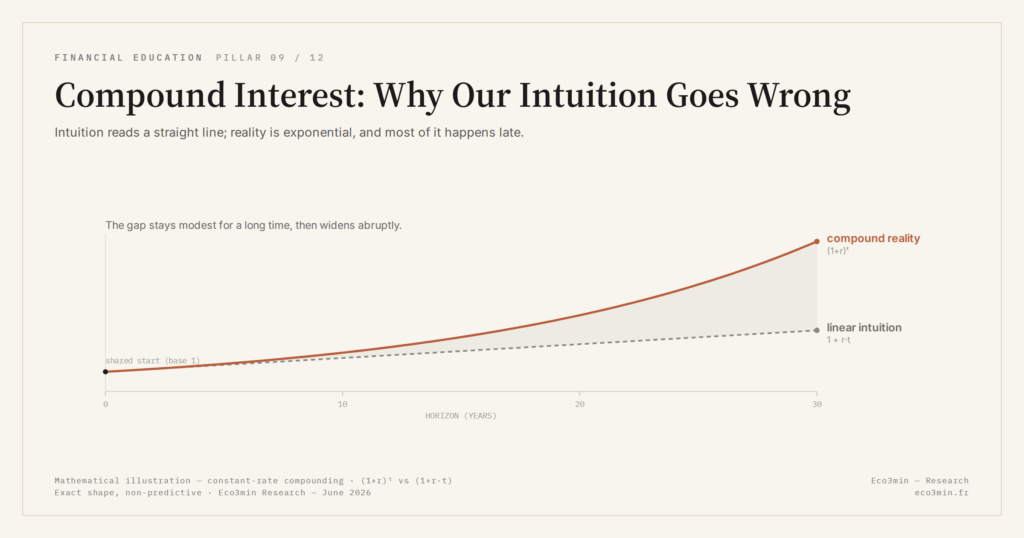
- Linear and compound paths stay close for a long stretch, then separate abruptly; that late phase is precisely where the curve is first underestimated, then dismissed as excessive or unrealistic.
- A simple check: once more than half of a projection's value comes from the final third of the horizon, the linearity bias turns critical, and a calculator displays the result without correcting that reading.
Compound interest is mathematically simple but economically deceptive. Not because it is hard to compute, but because it directly contradicts the way the human mind perceives time, growth and accumulation. This cognitive friction explains why, even when faced with clear simulations, projections remain poorly interpreted.
The linearity bias: an inadequate reading grid
Human intuition spontaneously treats developments as linear. A constant effort is expected to produce a proportional result. Compound interest, however, follows an exponential dynamic: each period builds on a base that gradually expands.
This difference is not abstract. Between linear and compound growth, the gap remains modest for a long time, then widens abruptly. It is precisely in this late phase that intuition breaks down. As long as the curve appears “well-behaved”, the effect is underestimated; once it becomes visible, it is perceived as excessive or unrealistic. Background: our breakdown of how households weigh financial decisions through the cycle.
This reading difficulty is not limited to compound interest. It belongs to a broader set of financial perception biases, where simple mechanisms produce mistaken interpretations for lack of an adequate framework. This panorama of biases connects with our study on the ordering of financial decisions over time, which shows how sequencing neutralises certain intuitive errors. This is precisely the objective of the pillar page
Financial education: identifying these recurring blind spots, not to oversimplify, but to rebuild a more robust reading grid for cumulative effects, lags and temporal asymmetries.
Why time is systematically misread
A second structural bias concerns time. Projections over 20 or 30 years are mentally compressed. The mind reasons in homogeneous blocks, where compound interest rests on temporal asymmetry: the final years weigh more heavily than the first ones. Written out, that asymmetry is simply the exponent n×t doing the counting, a detail that belongs to the three distinct formulas behind the phrase compound interest.
This gap explains why cumulative effects are often deemed “disappointing” at the start, then “spectacular” in hindsight. The dominant reasoning assumes a steady progression, while reality rests on a late acceleration.
This misreading distorts the interpretation of projection tools. A compound interest calculator does not create the effect; it makes it visible. But without prior cognitive correction, even a detailed simulation can be misinterpreted.
The tool as imperfect cognitive corrector
Part of the implicit consensus considers that access to calculation tools is enough to resolve the comprehension problem. This assumption is debatable. Numerical simulations correct the mathematical error, but not necessarily the reading error.
Faced with a projected curve, many seek to validate a prior intuition rather than challenge their mental framework. The reading remains linear: points are compared, visually extrapolated, without integrating the underlying cumulative logic.
In other words, the tool illuminates the result, but not always the mechanism. It is here that the illusion of simplicity persists, even though the error is conceptual.
Why this misunderstanding becomes more visible now
Since 2024–2025, the lasting rise in nominal rates and the end of near-zero yields have placed capitalisation mechanisms back at the centre of financial projections. The contrast between short scenarios and long trajectories has become more legible, accentuating the gap between immediate intuition and real dynamics.
What the reader actually seeks behind this question
Behind the question of compound interest lies less a calculation issue than a reading concern: understanding why projections seem unrealistic, or conversely disappointing, depending on the horizon chosen. The challenge is not the final figure but the coherence of the path leading to it.
Variables that can invalidate this reading
This analysis rests on the assumption of regular capitalisation. High volatility, flow interruptions or changes in macroeconomic regime can alter the observed trajectory. Likewise, persistently unstable inflation blurs the distinction between nominal and real growth, reinforcing perceptual confusion.
Interpreting a compound interest projection as a steady trajectory. This reading is misleading because the bulk of the effect concentrates at the end of the period, where intuition is least reliable.
Relevant reading indicators
To objectify the cumulative effect, a simple indicator consists in comparing the share of final capital generated over the last years to that produced over the first ones. When more than half of the projected value comes from the final third of the horizon, the linearity bias becomes critical.
Within a broader regime-reading framework, this type of cognitive distortion connects with other misleading signals. The logic is comparable to the one analysed in the misleading economic indicator tool, where accurate data produce mistaken interpretations for lack of an adequate framework.
Last updated — 13 August 2026
Disclaimer – Financial Information: The analyses, commentary, and content published on eco3min.fr are provided for informational and educational purposes only. They do not constitute investment advice or a solicitation to buy or sell financial instruments. Past performance is not indicative of future results. All investment decisions involve risk and are the sole responsibility of the reader.
Read next
Full pillar →Series I and EE Savings Bonds: Locked Formulas in a Moving Rate World
US savings bonds lock a rate formula at the moment you buy them, for the life of the…
Where the Livret A’s Money Goes: The Caisse des Dépôts Circuit and Social-Housing Finance
The savings held on Livret A accounts do not sit idle. A regulation-set share is centralised at the…
France’s LEP vs the Livret A: A Means-Tested Higher Rate, Explained
France’s Livret d’épargne populaire is often described as "the Livret A, only better". The description misleads: the LEP…