Real Rates and Property Valuation: Why Inflation Alone Does Not Protect Prices

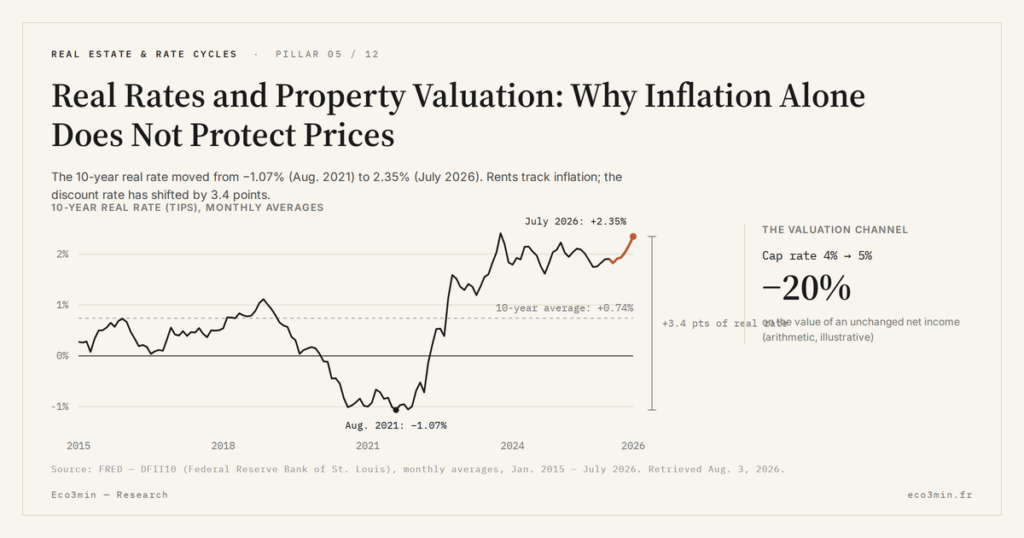
A property’s value is its net income capitalized at a rate the market sets, and that rate is anchored to the real interest rate. When real rates rise, the cap rate widens and value compresses, even as rents rise with inflation.
The claim that real estate hedges inflation overlooks the valuation channel. This piece isolates how real rates drive property value, separate from the rent channel.
Real estate passes inflation through rents, but its value tracks the real rate: when real rates rise, the cap rate widens and price falls for a given income.
- The 10-year real rate read off TIPS sits near 2.3% in mid-July 2026 (DFII10, FRED), well above its 10-year average.
- A cap rate moving from 4% to 5% cuts the value of a fixed net income by about 20%.
- Through 2022-2023, real rates repriced upward fast enough to compress property valuations despite high inflation.
1. Real rates, read off TIPS
A real rate is a nominal rate stripped of expected inflation. It is the return demanded beyond simple compensation for rising prices, the true cost of capital over time. This variable, more than the posted nominal rate, governs the price of long-duration assets, and rental property is one of them.
Treasury Inflation-Protected Securities give the cleanest market read. The 10-year real rate on TIPS sits near 2.3% in mid-July 2026 (DFII10, FRED), well above its average of the past decade, and a sharp reversal from the deeply negative real rates of 2021. The mechanism sits in the instrument: a TIPS principal adjusts with the consumer price index, so the quoted yield is a real yield, the return earned over and above whatever inflation turns out to be.
The gap between the nominal 10-year Treasury and its TIPS counterpart gives a second reading: the breakeven inflation rate, the market’s expected inflation over the horizon. That decomposition matters here, because a property competes with the real yield, not the nominal one. When the real leg rises while breakeven inflation holds, the hurdle a rental asset must clear moves up even if expected inflation has not.
That regime shift is the starting point. A property valued in 2021 under negative real rates does not rest on the same footing in 2026, with real rates clearly positive. No rent shock is needed for value to move between the two: the repricing of the real rate alone does the work. Inflation lifts rents; real rates deflate the value they support.
Seen this way, a rental property behaves like a long-duration bond with a growing coupon. Its price is a stream of future net rents discounted at a real rate, so a rise in that rate hits it the way a rate rise hits a long bond: hard, and up front. The growing coupon, the rent that drifts up with inflation, softens the blow over time but does not spare the initial repricing.
2. The valuation channel: cap-rate expansion
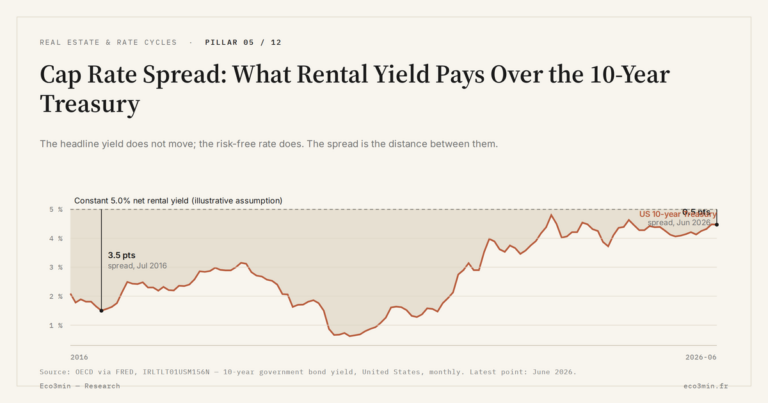
A rental asset is worth its net operating income divided by a cap rate. That cap rate carries the reference real rate, the yield on government debt, plus a premium for illiquidity, management and vacancy. Lift the real rate, and the required cap rate follows it up, so the same income stream commands a lower price.
The arithmetic is unforgiving. Take a net operating income of 20,000 a year. Capitalized at 4%, it is worth 500,000; at 5%, 400,000. A cap rate that moves from 4% to 5% therefore cuts the value of an unchanged net income by about 20% (illustrative). The income did not fall; the discount rose. The same discounting logic that reprices other long assets is set out in how real rates discount asset values.
The sensitivity is sharpest where the starting cap rate is lowest. A prime asset bought at a thin initial yield takes the hardest hit when real rates climb: moving from 3% to 4% erases a quarter of the value, while moving from 6% to 7% erases only a seventh. That is the mechanical cost of the scarcity investors chase in a low-rate regime, and it is visible across property when the rate cycle reprices property.
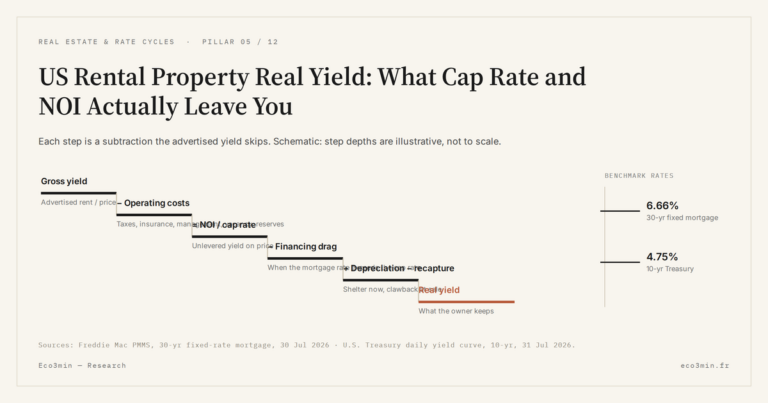
Leverage amplifies the hit to equity. A debt-financed purchase sees its financing cost rise with real rates at the same moment the asset’s value compresses. The loss lands on a base already thinned by the loan, so the investor’s net worth falls faster than the property price. With or without inflation, a rise in the real rate strikes a leveraged deal twice. Struck twice, the leveraged deal is also the link through which the mortgage credit cycle transmits monetary policy to housing prices.
A number makes the double hit concrete. Suppose an asset worth 500,000 is bought with 300,000 of debt and 200,000 of equity. A cap-rate move that trims the asset by 20%, to 400,000, leaves the equity at 100,000, a 50% fall, before any change in the loan itself. The wider the leverage, the sharper the equity swing for the same shift in real rates.
None of this depends on the property being a poor asset. A well-let building with rising rents can still lose value in a given year purely because the rate used to discount its income has moved. Quality protects the cash flow, not the multiple applied to it.
The blow is uneven across property types. Long-lease, bond-like assets, such as net-leased retail or core offices, carry the most duration and fall the most when real rates rise; shorter-lease assets, such as apartments or self-storage, reprice their rents faster and cushion part of the hit. Same rate move, different sensitivity, set by how quickly each type’s income resets.
3. Inflation versus real rates: when the latter wins
The dominant reading says inflation supports real estate: rents rise, so value follows. It forgets that inflation usually provokes a monetary tightening, and that tightening pushes real rates higher. The two channels then pull opposite ways, and nothing guarantees the first offsets the second.
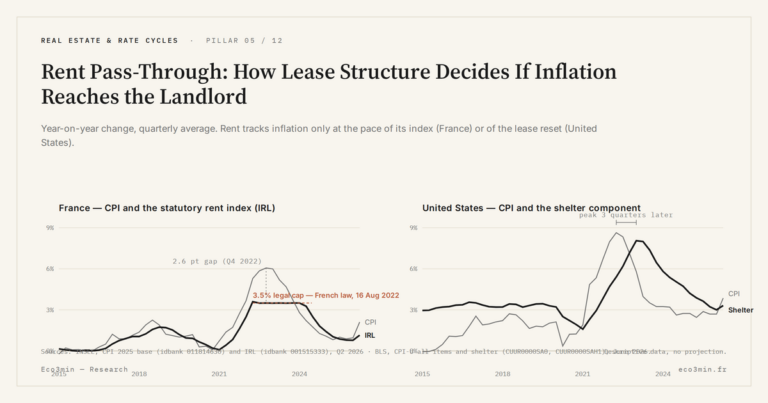
On one side, rents adjust with a lag and only at lease reset, as set out in how lease structure passes inflation through: a few points a year at best, often less. On the other, the real-rate repricing hits value at once, with no delay, and can run to several points in a handful of quarters. The slow channel meets the fast one, and over the short run the fast one usually wins.
The order of magnitude is telling. A two-point rise in the real rate, roughly the move from 2021 to 2023, is enough to justify a double-digit valuation cut on its own, before any weakening in rents or occupancy. The price moves because the denominator moved.
The timing asymmetry compounds the effect. The value loss is booked immediately, when the real rate reprices, while the rent catch-up spreads over years of renewals. By the time rents have rejoined inflation, the decline in value is already on the books. The two channels never meet at the same point in the cycle.
The 2022-2023 stretch illustrates it. Real rates rose quickly, after a decade near zero or below, and compressed property valuations even as inflation ran high. Nominal rent kept climbing; the real value of the asset fell. That configuration directly contradicts the automatic-hedge story: at the very moment inflation was most visible, property was losing value. The longer record shows the same tension between real rates and rich valuations in real rates against the CAPE ratio.
4. The protection condition
Real estate hedges inflation under one condition: that effective rent growth offsets the rise in the real rate. When inflation arrives with a real-rate shock, the condition fails, and value falls in real terms even as nominal rent climbs.
Protection is therefore neither assured nor ruled out; it depends on the regime. Inflation without a marked rise in real rates, as in years of financial repression when rates stay below inflation, lets the rent channel work without penalizing valuation. Inflation fought with higher real rates flips the result. The monetary regime, more than inflation alone, decides the outcome.
That regime dependence explains the contradictory verdicts of history. Over long stretches, property has often preserved purchasing power, because decades of low real rates dominate the sample. Across episodes of fast-rising real rates, the same asset has disappointed. The long-run average hides two opposite behaviors, separated only by the rate regime in force.
Empirically, it is the real rate rather than the inflation print that has moved with the valuation. A high inflation number alongside a stable or falling real rate has coincided with intact property values; a moderate inflation number alongside a rising real rate has not. The second figure, less discussed, is the one that has tracked the price.
The 2026 setup puts the reading to work. With the real rate back well above its decade average, the valuation channel leans against price even while rents stay indexed. The drag comes not from inflation but from the level of the real rate beside it, and while that rate holds high, the multiple does not drift back to where it began on its own.
Treating real estate as an automatic inflation hedge. The view conflates the rent channel, slow and lease-bound, with the valuation channel, immediate and anchored to the real rate. When real rates rise faster than rents adjust, value falls in real terms despite inflation.
A rental property therefore carries two signatures: the rents, which follow inflation on a lag, and the real rate, which sometimes contradicts it. Separating the two keeps a rise in rent from being mistaken for a rise in value. The full set of conditions is synthesized in the conditions for inflation protection, alongside the inflation and real-rate paradox hub.
Last updated — 18 September 2026
Disclaimer – Financial Information: The analyses, commentary, and content published on eco3min.fr are provided for informational and educational purposes only. They do not constitute investment advice or a solicitation to buy or sell financial instruments. Past performance is not indicative of future results. All investment decisions involve risk and are the sole responsibility of the reader.
Read next
Full pillar →Cap Rate Spread: What Rental Yield Pays Over the 10-Year Treasury
A 5% cap rate sounds attractive. But 5% against what? A risk-free 10-year Treasury yields near 4.5% in…
Vacancy and Turnover: The Cost That Erodes a Landlord’s Real Return
A listing shows full rent, twelve months a year. The owner knows the gaps between tenants, the make-ready…
US Rental NOI, Line by Line: What Net Operating Income Really Subtracts
A US rental yield is advertised gross: annual rent over price. Between that number and the income an…