Rent Pass-Through: How Lease Structure Decides If Inflation Reaches the Landlord

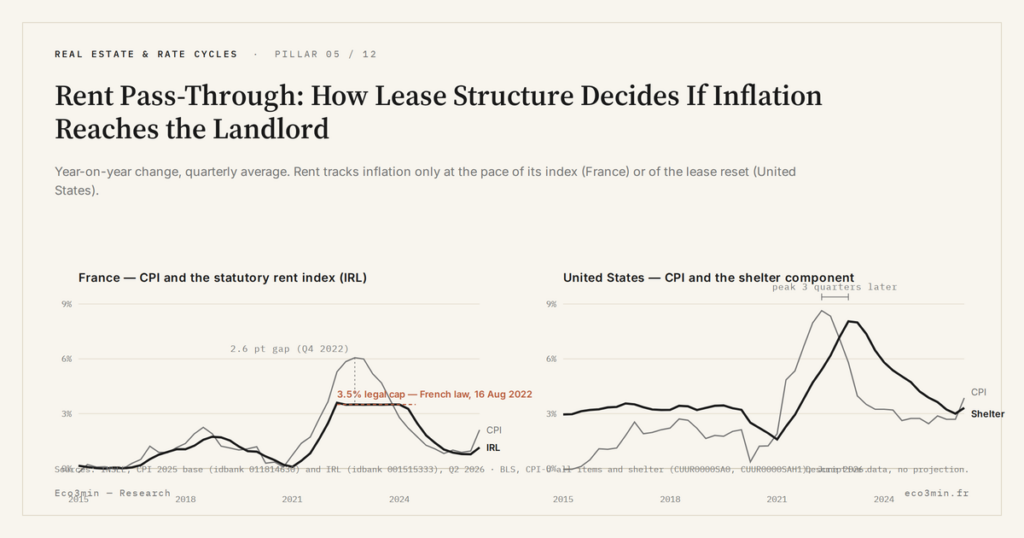
US rents adjust to inflation only when a lease resets, not continuously. Fixed terms, renewal smoothing and survey lags mean the share of inflation that reaches a landlord depends on lease structure, not on the headline inflation rate.
A common view treats real estate as an automatic inflation hedge. US lease mechanics show a slower, structure-dependent pass-through than that view assumes.
US rents reach the landlord only at lease reset: fixed terms, renewal smoothing and survey lags decide how much inflation passes through, and how late.
- Shelter is roughly one-third of the US CPI, with owners’ equivalent rent the single largest component (BLS).
- About 60% of US rental units sit under 12-month leases, so contract rents cannot move until renewal (NBER, 2025).
- The CPI shelter index lags market rents by roughly 8 to 14 months, and models put full pass-through of new-lease prices near two years (Minneapolis Fed).
1. Fixed-term leases and the reset lag
A US rent does not float with inflation. It is fixed for the term of a lease, and it moves only when that lease resets. The BLS draws a clean line between the two prices that matter here: the contract rent a tenant actually pays, and the market rent a unit would fetch if it were listed today (Minneapolis Fed). Inflation acts on the second; the landlord collects the first.
Roughly 60% of US rental dwellings are covered by 12-month leases (NBER, 2025). For those units, a jump in market rents cannot reach the landlord until renewal. The gap shows up directly in the aggregate data: the CPI shelter index, which measures contract rents, lags market-rent gauges by about 8 to 14 months. Shelter is no side item in that index; it is close to one-third of the CPI, and owners’ equivalent rent carries the heaviest single weight (BLS), which means the sluggishness of contract rent shapes the entire inflation reading.
The two shelter subcomponents measure different things. Rent of primary residence tracks what tenants actually pay; owners’ equivalent rent estimates what an owner-occupied home would rent for, imputed from the same survey rather than from house prices. Both inherit the stickiness of leases, so the largest single piece of US inflation is, by construction, one of its slowest-moving.
That structure sets the tempo of every inflation episode. A lease decides whether inflation reaches the landlord, or stops at the tenant. Until the reset, the tenant holds a below-market rate and the owner carries the gap, a gap that widens the faster market rents move away from the level locked in at signing. The mirror image holds on the way down: when market rents fall, contract rents stay elevated until leases roll, so measured shelter inflation keeps rising long after new-lease prices have cooled.
The lag has a macro footprint. Because shelter is so heavily weighted and so slow, it can keep headline inflation elevated for months after other prices have turned, and pull it lower long after market rents have rebounded. Much of the debate over how quickly inflation would fall in the mid-2020s turned on this single, sticky component.
2. Renewal smoothing and escalation clauses
Even at renewal, the adjustment is partial. Landlords smooth: they pass through only a fraction of the market-rent change accumulated since the last reset (NBER, 2025). The rent catches up, rarely in one step, and the catch-up itself spreads across several renewals. Retaining a paying tenant often weighs more than closing the full gap to market in a single year.
The share of tenants on flexible terms tempers this further. Around a third of renters are on month-to-month arrangements (NBER, 2025), which can reset faster but also churn faster, while the majority on annual leases move only at fixed dates. The blend of lease types, more than the headline inflation print, governs how quickly a given rental pool reprices. A landlord with high turnover reprices toward the market sooner; one with long-tenured tenants stays far below it.
The direction of the miss is consistent. Because each reset only ever catches part of the gap, contract rent trails market rent through a full inflation cycle and closes the distance only once prices have stopped moving. The catch-up arrives, but rarely at the moment the owner would most want it.
Market-rent gauges make the lag visible in real time. Series such as the Zillow Observed Rent Index and the Cleveland Fed and BLS New Tenant Rent Index track prices on newly signed leases, and they lead the CPI shelter index by close to a year (Brookings, Minneapolis Fed). When these gauges turn, the official shelter reading follows only after enough leases have reset to move the average.
Commercial leases handle the problem differently. Many carry explicit escalation clauses, fixed annual bumps or CPI-linked adjustments, that write inflation into the contract itself. A CPI-linked lease transmits price changes almost mechanically, within the year rather than at a distant renewal. Residential leases rarely include such clauses; they rely on the reset, and on a landlord’s decision to raise at that point, which local rules and tenant retention frequently soften.
Vacancy and concessions blunt the effective rate further. A headline rent can rise while free months, waived fees or upgrade credits quietly lower what the landlord actually collects. Effective rent, net of these giveaways, often lags the advertised figure, so even the market-rent gauges overstate what reaches the owner in a softening market.
3. Residential versus commercial pass-through
The pass-through therefore splits by segment. A CPI-linked commercial lease transmits inflation within the year, close to mechanically. A fixed-term residential lease transmits it in discrete steps, at renewal, with the smoothing described above. Same inflation, two very different transmission speeds, and two very different real-income paths for the owner.
Measurement adds its own lag. The BLS resamples each unit about every six months across rotating panels, so even realized rent changes enter the index with delay. The design mirrors the underlying economics: because rents move slowly and in steps, they are surveyed less often than other prices. A collection gap during the late-2025 government shutdown, later corrected in 2026, showed how sensitive the series is to that sampling rhythm.
Tenant protections widen the dispersion across the country. Some cities cap annual increases or lengthen notice periods, which slows pass-through further; others leave rents to reset freely at renewal. The same national inflation rate therefore reaches landlords at very different speeds depending on local rules, on lease length and on how tight the local market is.
Portfolio composition smooths or sharpens the path. A landlord whose leases all renew in the same month faces a single large reset; one whose leases are staggered through the year sees a steady trickle of small adjustments. The aggregate index behaves like the second case, which is part of why shelter inflation moves in a slow, continuous drift rather than in jumps.
For the owner, the practical implication is a timing mismatch. Costs, from financing to maintenance and insurance, respond to inflation quickly; contract rent responds slowly and partially. During an inflation burst, the expense side moves first and the revenue side lags, compressing the real margin until leases roll. The wider real-rate backdrop that governs those financing costs is traced in the history of real interest rates.
4. The net effect on real rent
Put together, these features describe a real rent, that is rent deflated by inflation, that dips during an inflation burst and recovers only as leases reset. The depth of the dip depends on lease length and on how much of the market-rent change a landlord passes through at renewal. The recovery depends on the pace of turnover in the portfolio, which is why a building full of long-tenured tenants adjusts more slowly than one with high mobility. A slow recovery in real rent is one more wedge between the yield a listing advertises and the real yield of a US rental property once cap rate and NOI are counted.
The order of an inflation shock therefore matters as much as its size. A sharp, brief spike can pass almost entirely to the tenant, because most leases never reach a reset before it fades. A slow, persistent rise gives more leases the chance to roll, so more of it eventually reaches the landlord. The same annual inflation figure produces different real outcomes depending on how it is spread over time.
The vehicle changes when the effect shows. A listed landlord is marked to market daily through its share price, so any repricing appears at once; a direct owner sees only the slow rent adjustment until a sale or refinancing forces a mark. The underlying rent cash flow is the same; the moment the change becomes visible is not, which is why direct property can look calmer than a REIT holding identical buildings.
None of this says real estate fails to track inflation. It says the tracking is partial, lagged and structure-dependent, and that the rent channel alone does not settle the question of real return, because the value of the asset also moves with the real-rate regime. That valuation channel is isolated in how real rates reprice property value, and the full set of conditions is synthesized in when real estate protects against inflation. See also the real estate and inflation hub.
- Contract rents move at lease reset, not continuously; the CPI shelter index lags market rents by about 8 to 14 months (Minneapolis Fed).
- Around 60% of US units are on 12-month leases, and renewals pass through only part of the accumulated market-rent change (NBER, 2025).
- Commercial CPI-linked or escalation leases transmit inflation faster than fixed-term residential leases, which adjust only in steps.
Rent pass-through is less an index than a set of valves that open at intervals and never fully. What the rent does, however, is only half the story; the other half is what happens to the price of the asset itself.
Last updated — 18 September 2026
Disclaimer – Financial Information: The analyses, commentary, and content published on eco3min.fr are provided for informational and educational purposes only. They do not constitute investment advice or a solicitation to buy or sell financial instruments. Past performance is not indicative of future results. All investment decisions involve risk and are the sole responsibility of the reader.
Read next
Full pillar →Vacancy and Turnover: The Cost That Erodes a Landlord’s Real Return
A listing shows full rent, twelve months a year. The owner knows the gaps between tenants, the make-ready…
US Rental NOI, Line by Line: What Net Operating Income Really Subtracts
A US rental yield is advertised gross: annual rent over price. Between that number and the income an…
Loan Term Mechanics: How 15-Year vs 30-Year Reshapes the Monthly Payment
Stretching a mortgage’s term lowers the monthly payment, so a given income can carry a larger loan. The…