Cap Rate Spread: What Rental Yield Pays Over the 10-Year Treasury

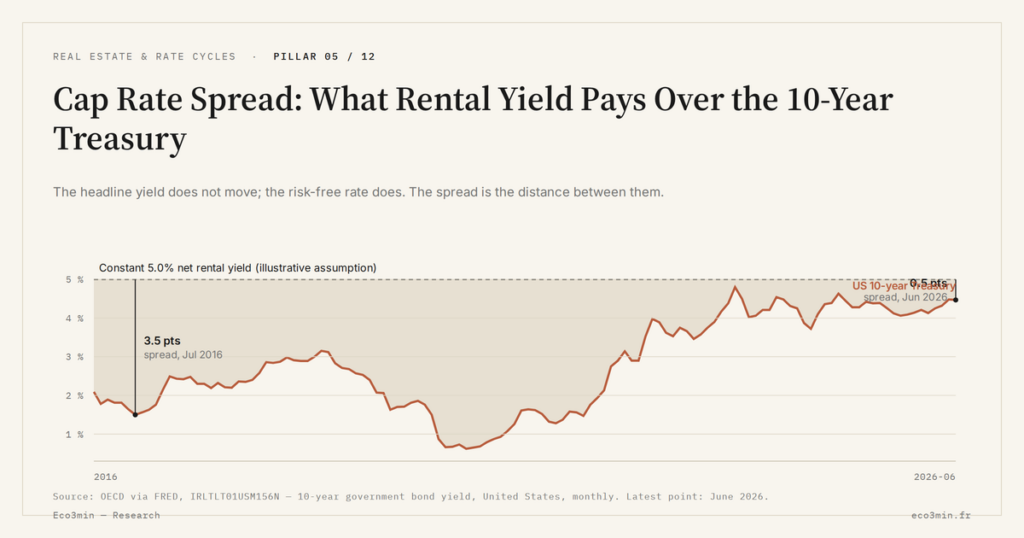
A 5% cap rate sounds attractive. But 5% against what? A risk-free 10-year Treasury yields near 4.5% in mid-2026. A rental yield only means something above that benchmark, as the premium an investor earns for taking on everything a Treasury does not.
Read alone, a cap rate says nothing. Read as a spread over the risk-free rate, it reveals what real estate actually pays for its risk and its work.
A cap rate is not judged in absolute terms but as a spread over the risk-free rate; when Treasury yields rise, that spread compresses and real estate’s relative appeal narrows.
- The multifamily cap rate near 5.6% over a 10-year Treasury near 4.5% left a spread around 110 basis points in early 2026.
- That spread sits well below the long-run average near 215 basis points and the post-2008 average near 315.
- The premium compensates illiquidity, management and vacancy risk, not just the wait for income.
Every yield breaks into two parts: the risk-free rate, what a government bond pays with no risk, and a premium, what an investor demands on top for taking one. A 5.6% cap rate when the Treasury yields 0.5% offers a premium above five points; the same 5.6% when the Treasury yields 4.5% offers barely one. The headline has not moved, but what it pays above the risk-free rate has collapsed. A cap rate means nothing alone; it lives above the Treasury.
This reframes an easy assumption, that a 5% cap rate is simply good. It is neither good nor bad in isolation; it depends entirely on the spread to the risk-free rate. In 2020, a 5% cap was a generous premium; in 2026, over a Treasury near 4.5%, the same figure barely pays for the risk taken. Judging a cap rate without the benchmark is like judging a wage without the cost of living. That premium is the real measure of appeal, the one the yield behind the cap rate makes it possible to compute.
The anchoring error is stubborn because a 5% figure was a sensible benchmark for years. It was, in a low-rate world where it dwarfed the risk-free rate; it no longer is, mechanically, in a world where the government pays nearly as much with no risk at all. The same threshold, judged good yesterday, can be mediocre today, not because real estate changed but because its benchmark moved. Reasoning in absolute levels is like keeping a ruler whose zero has shifted without anyone noticing. The mark reads the same; the measurement no longer means what it did.
The 10-year Treasury benchmark
The risk-free rate is not an abstraction: in the US it is the yield on the 10-year Treasury note, the obligation of the federal government. It represents what an investor can earn with no default risk and no work, simply by lending to the Treasury for ten years. That yield anchors the whole structure of long-term rates, from mortgages to corporate bonds, so it is the natural benchmark against which any risky yield is measured.
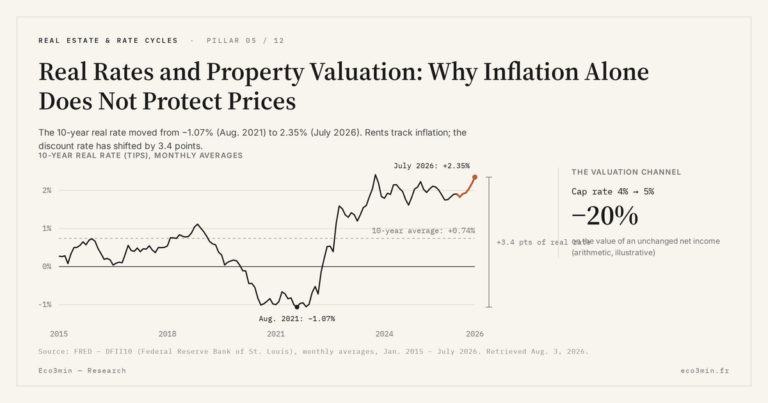
And that anchor has moved sharply. Held near 0.5% during the pandemic by Federal Reserve purchases, the 10-year yield climbed with inflation and monetary tightening to around 4.5% by mid-2026. That shift changes everything for real estate: the bar above which a yield becomes interesting has risen by several points in a few years. The operating costs that produce the net yield being compared are set out in the NOI cost breakdown.
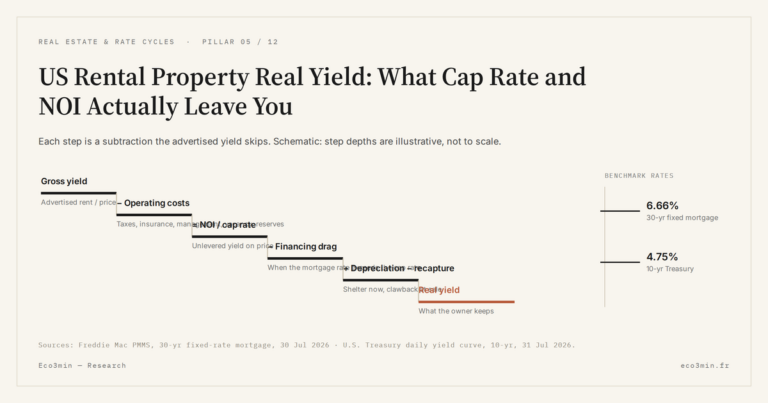
A method point matters here: the yield compared to the Treasury is the net cap rate, not the gross yield. Comparing a 6% gross to a 4.5% Treasury suggests a wide premium; but if the net cap rate falls to 3.5% once costs are stripped out, the real premium is negative, the property earning less than the risk-free bond. The comparison only holds between like quantities: a net yield, after everything ownership removes, against a Treasury that costs no effort at all. Comparing gross to the risk-free rate flatters the premium and corrupts the judgment from the start. The whole exercise stands or falls on comparing net to net.
Spread compression in a high-rate regime
When the risk-free rate rises, cap rates do not follow at once, because property prices adjust slowly. The result is spread compression: the gap between the cap rate and the Treasury narrows, sometimes toward zero. With multifamily cap rates near 5.6% and the 10-year near 4.5%, the spread sat around 110 basis points in early 2026, well under the long-run average near 215 and the post-2008 average near 315. Investors were accepting a thin premium for owning and operating real estate over simply holding a government bond.
That compression has a direct consequence: at an unchanged cap rate, real estate becomes relatively less attractive as rates rise, because a risk-free asset now offers nearly as much. It is a market mechanism, not a value judgment, and it explains why high-rate periods cool investment demand. The link to the monetary policy that sets the risk-free rate runs through the credit cycle behind housing, against the longer backdrop of the real interest-rate record.
Compression does not last forever: it resolves either through falling rates, which restore the premium, or through falling property prices, which lift the cap rate. The second path explains why prolonged high rates eventually press prices down: the market needs a higher yield to rebuild an adequate premium over a Treasury that has become a genuine competitor. A compressed spread is therefore less a stable state than a tension, one that unwinds through rates or through prices, and the timing of that unwind is where much of the cycle’s drama sits.
History offers a rough guide to the mechanism. A spread near 110 basis points, against a long-run average closer to 215, implies either that investors expect rates to fall, restoring the premium without a price adjustment, or that prices carry more downside than the headline cap rate suggests. Which of the two prevails is not knowable in advance, but the narrowness of the spread is itself the signal that the market is priced for one of them to happen. Either way, the spread, not the cap rate, is the variable doing the talking.
A premium is never free: it pays for real risks and constraints. Rental real estate is illiquid, a building sells in months, not a click, unlike a Treasury. It demands management, time and skill, where the bond demands nothing. It exposes the owner to vacancy, non-payment and unplanned repairs, the recurring cost detailed in how vacancy cuts the effective yield. The premium over the Treasury is the compensation for all of it.
Which raises the question that decides real appeal: is the premium large enough to pay for those risks? A spread of three or four points covers them comfortably; a spread of one point, or none, means accepting illiquidity, management and tenant risk for no extra reward over a government bond. Read this way, a cap rate stops being an isolated number and becomes a measure of what the market pays, or refuses to pay, for real-estate risk, a reading extended across the cost-of-capital sub-pillar.
There is no universal threshold: the premium judged sufficient depends on risk tolerance, horizon and the capacity to manage. A well-equipped investor active in their local market can accept a thinner premium than a distant, occasional owner. But whatever the profile, a zero or negative premium over the Treasury signals that the market is paying poorly for real-estate risk at that moment, information the advertised yield alone never delivers. It is that information, more than the headline number, that informs an investment decision. A cap rate quoted without its spread is half a sentence, and the missing half is the one that carries the meaning.
Calling a 5% cap rate good on its own. It is neither good nor bad in isolation: over a 0.5% Treasury it is a wide premium, over a 4.5% one it barely pays for the risk. The number that matters is the spread, not the cap rate, and the spread moves with the benchmark as much as with the property. Cropland is read the same way, against the same benchmark, which is the yield a hectare pays above a government bond.
The number that only means something in relative terms
A cap rate on its own is a figure with no scale. Set against the risk-free rate it becomes a spread, the one quantity that says whether real estate pays enough for its risks at a given moment. In a low-rate regime, almost any yield offered a comfortable premium; in a high-rate regime, the same measure turns demanding. Reading the yield in relative terms, not absolute ones, is what separates an investment decision from a reaction to a flattering number. It also reframes what “a good deal” means: not a high cap rate, but a wide enough spread over the risk-free rate to pay for the illiquidity, work and risk the bond avoids. The full framing sits within the real-estate and credit cycles pillar.
Last updated — 3 August 2026
Disclaimer – Financial Information: The analyses, commentary, and content published on eco3min.fr are provided for informational and educational purposes only. They do not constitute investment advice or a solicitation to buy or sell financial instruments. Past performance is not indicative of future results. All investment decisions involve risk and are the sole responsibility of the reader.
Read next
Full pillar →Vacancy and Turnover: The Cost That Erodes a Landlord’s Real Return
A listing shows full rent, twelve months a year. The owner knows the gaps between tenants, the make-ready…
US Rental NOI, Line by Line: What Net Operating Income Really Subtracts
A US rental yield is advertised gross: annual rent over price. Between that number and the income an…
Loan Term Mechanics: How 15-Year vs 30-Year Reshapes the Monthly Payment
Stretching a mortgage’s term lowers the monthly payment, so a given income can carry a larger loan. The…