Dollar Stablecoins: The Backbone of Crypto Liquidity
Why dollar stablecoins have become the backbone of crypto liquidity and a discreet barometer of market regimes, capital flows and systemic risk.

Why dollar stablecoins have become the backbone of crypto liquidity and a key indicator of market regimes.
TL;DR
Dollar stablecoins grew from under $30 billion in early 2021 to roughly $150-170 billion by late 2025, becoming both the plumbing and a barometer of crypto liquidity. This pattern is contextualised in our analysis of bitcoin and liquidity cycles.
- The deepest fragility sits in the dependency chains built on the $1 peg: stablecoins reused repeatedly as DeFi collateral, a form of crypto rehypothecation, create apparent liquidity above the genuinely available base.
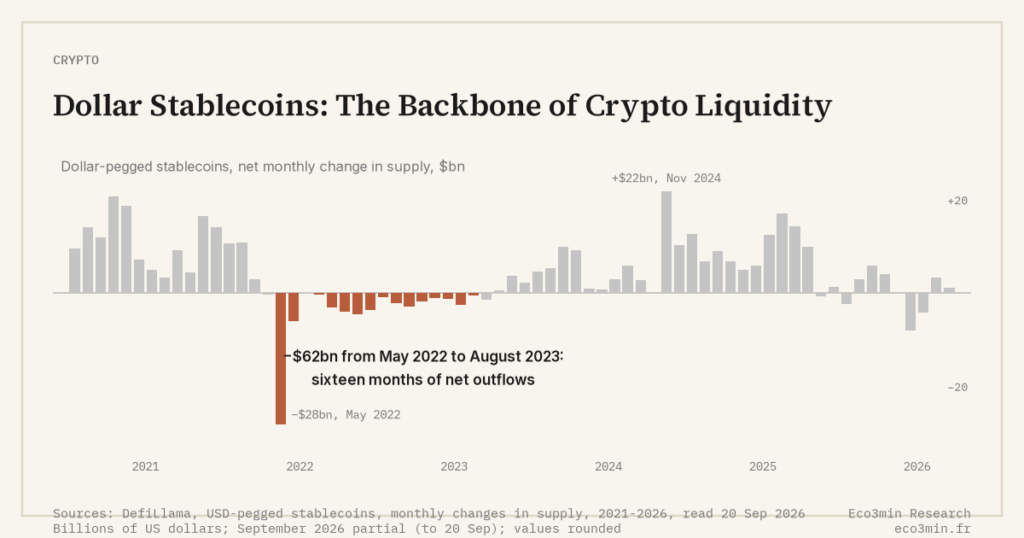
- Stablecoin balances track the crypto cycle: between late 2022 and mid-2023, secondary-issuer failures and rising fiat yields cut total balances from about $180 billion to $130 billion before a 2024-2025 rebound.
- Classical monetary policy reaches crypto through stablecoin demand: as US rates climbed to the 5.25-5.50% zone in 2022-2024, part of speculative capital rotated into yield-bearing on-chain dollar products rather than volatile tokens.
- Dollar-pegged tokens hold around 95% of the stablecoin market and 70-80% of crypto trading volume runs through stablecoin pairs, concentration that turns a few issuers into single points of failure.
In this analysis, stablecoins are treated strictly as instruments of liquidity and monetary transmission within the crypto system, rather than as financial innovations in the technological sense.
Dollar stablecoins have, in just a few years, become the main fuel of crypto markets. In December 2025, the combined market cap of the major USD stablecoins runs around ≈$150‑170 billion, against under $30 billion in early 2021 according to market aggregates. A market that size is precisely what has pulled the emerging US stablecoin oversight framework into being. The historical record is pieced together in this analysis of stablecoins systemic importance. This expansion has turned a niche tool into a systemic infrastructure.
What matters more than it appears is not just the size of this market, but the way these dollar-pegged tokens reshape liquidity, the transmission of monetary policy and the architecture of risk in the crypto ecosystem.
This reading sits within a broader approach to crypto assets as a macro-financial asset class, whose value and cycles depend above all on liquidity regimes, the cost of capital and the degree of institutional integration, far more than on their proper technical features.
Part of the consensus treats these assets as simple “parking tokens”, economically neutral. The analysis below starts from the opposite hypothesis: dollar stablecoin dynamics send structuring signals on risk appetite, market depth and the potential fragility of the entire crypto system.
Conjunctural starting point: what prices imperfectly capture
Since autumn 2025, several discreet signals have layered on top of one another:
- the dominance of dollar-pegged stablecoins remains very high (≈95 % of the stablecoin market), despite the return of yield-bearing fiat products;
- the share of crypto volumes denominated in stablecoins regularly exceeds 70‑80 % on the major spot and derivatives platforms;
- net stablecoin creation/destruction flows have accelerated again since bitcoin’s rebound above major technical thresholds.
This combination suggests that the dominant reading—“stablecoins are stable, and therefore uninteresting”—underestimates their role as a liquidity regime indicator. A more macro reading, close to the one offered in the general framework on monetary policy, shows on the contrary that stablecoins extend, into the crypto universe, the rate and currency choices made in the real world.
How a dollar stablecoin creates crypto liquidity
A dollar stablecoin generally follows a mechanism that is simple on paper:
- a participant deposits dollars (or equivalents) with an issuer or via an intermediary;
- the issuer mints a digital token meant to be worth $1;
- this token then circulates freely on exchanges and DeFi protocols.
At the aggregate level, every newly issued stablecoin increases the immediate purchasing power available in the crypto ecosystem. Conversely, every destruction (“burn”) corresponds, in principle, to a withdrawal of liquidity.
Two leverage effects follow:
1. Order-book depth effect
The more stablecoins in circulation, the more the order books on crypto/USDT, crypto/USDC or equivalent pairs can absorb large volumes without producing extreme price moves. Market depth becomes a partial function:
Depth ≈ stablecoin market cap × concentration of market makers.
During rallies, a large stablecoin stockpile allows capital to be deployed quickly into risk assets. During stress, it conversely facilitates the rapid conversion of volatile crypto into digital quasi-cash, which can accelerate certain selling moves.
2. DeFi collateral effect
In decentralised finance protocols, dollar stablecoins act as a key collateral for:
- borrowing other assets;
- providing liquidity to swap pools;
- amplifying positions through leverage.
This multiple reuse of the same stablecoin stock—what could be called a form of “crypto rehypothecation”—creates an apparent liquidity often higher than the genuinely available collateral base. The risk then becomes less the $1 peg itself than the chains of dependency built on this foundation.
Macro perspective: strong dollar, real rates and stablecoin usage
From a macroeconomic angle, dollar stablecoins extend the dollar’s dominance into a theoretically alternative universe and fit within the global liquidity dynamics that structure markets. Between 2022 and 2024, the rise in US policy rates (up to the 5.25‑5.50 % zone) and the increase in real rates raised the cost of dollar capital. This context had two concurrent effects:
- part of the most speculative capital rotated towards yield-bearing dollar assets “on-chain” (stablecoins deposited in yield-generating protocols) rather than into volatile crypto;
- crypto-to-crypto trading anchored even more on stablecoin pairs, turning these tokens into a daily operating currency.
Put differently, classical monetary policy is reflected indirectly in the crypto ecosystem through stablecoin demand: a global monetary tightening raises the dollar’s use value—and therefore the stablecoin’s—as unit of account and short-duration store.
This interconnection justifies the link to broader frameworks, such as those detailed in the macroeconomic bulletin, which place rate and currency moves in context.
What readers really want to understand
The real question is not so much whether dollar stablecoins will keep growing, but whether that growth strengthens or weakens the resilience of crypto markets. What many readers want clarified is the risk that a peg break or a regulatory shock on one of these issuers would represent, at a time when most flows and order books already rest on them. Which jurisdiction supervises those issuers is not a detail either, and it is one of the forces behind the clustering of the crypto industry into a few hubs.
Dollar stablecoins: a leading indicator of the crypto cycle
Dominant scenarios often associate crypto market health with the bitcoin price alone or with the size of ETF flows. Another reading uses the stablecoin market cap as a deeper barometer of the cycle:
- Accumulation phase: steady increase in stablecoin balances without an explosion in volatile crypto prices. Investors convert capital into digital quasi-cash, awaiting opportunities;
- Euphoria phase: stablecoin balances high but stable, with rapid rotation into risk assets. Volumes explode without stablecoin market cap necessarily growing at the same pace;
- Deflation phase: successive contractions of balances, reflecting net outflows to the banking system or losses of confidence following market incidents.
Between late 2022 and mid-2023, the failure of several secondary issuers and the rise in fiat yields drove a noticeable drop in stablecoin balances (from ≈$180 billion to ≈$130 billion according to market aggregates). The partial rebound seen in 2024‑2025, aligned with returning ETF flows and derivatives products, suggests that stablecoins accompany—rather than precede—the new cycle.
What is less integrated in consensus is that the internal composition of this stockpile (share of different issuers, underlying collateral, exposure to US Treasuries, etc.) modifies the crypto system’s sensitivity to rate, sovereign-spread or regulatory shocks.
Common misreadings of stablecoins
- Treating them as fully risk-neutral: a dollar stablecoin carries the risks of its issuer, its reserves and its jurisdiction. Ignoring them amounts to underestimating the potential transmission of “off-chain” shocks into the crypto sphere.
- Confusing price stability with absence of systemic volatility: a token staying close to $1 does not mean the surrounding system is stable. Volatility can manifest elsewhere—in market depth, or in redemption capacity during stress.
- Over-interpreting a single indicator (total market cap): tracking only the global stablecoin amount can hide significant shifts between issuers, blockchains or uses (payment vs. collateral) that change the risk structure.
Two structuring scenarios for dollar stablecoins
Scenario 1: orderly consolidation, deeper but more centralised liquidity
This scenario rests on a gradual rise in regulatory requirements (reserve standards, transparency, supervision) without a brutal shock. A few dominant issuers, already integrated into the classical financial system, consolidate market share. The total stock of dollar stablecoins keeps growing or stabilises at a high level, market depth stays solid and spreads stay tight, even during volatile periods.
In this framework, the risk shifts towards concentration: a handful of players sit at the heart of global crypto liquidity, with balance sheets very sensitive to the US yield curve and to money markets. A change in the real-rate regime or targeted regulatory tightening could then have broader repercussions than anticipated.
Scenario 2: peg break or confidence shock
A second scenario, less central in dominant projections but regularly mentioned in the background, is that of a confidence incident: reserve issues, major legal dispute, asset freeze, or coordinated flight to another stablecoin. Market history shows that “1-for-1” regimes can break rapidly when redemption demands exceed operational capacity or the real value of collateral.
If this dynamic emerged at a time when dollar stablecoins represent the bulk of trading volumes and a significant share of DeFi collateral, the impact could be twofold:
- immediate liquidity shock (price gaps, temporary depegs from the dollar, slide towards other on-chain havens);
- durable reduction in order-book depth, with persistent effects on implied volatility and the risk premium required on crypto assets.
This scenario is not a base case, but it remains a fragility zone that markets sometimes seem to underestimate, focused mostly on bitcoin or altcoin prices.
Variables that could shift the current reading
Several factors could invalidate an overly linear reading of dollar stablecoins’ role:
- Evolutions in central bank digital currency (CBDC) payment infrastructures: if some CBDCs became technically interoperable with public blockchains, part of current stablecoin demand could shift;
- Emergence of multi-currency or basket-backed stablecoins: this would mechanically reduce the dollar’s dominance in the ecosystem, even if the dollar would likely remain central;
- Changes in the cost of capital: a prolonged cycle of high real rates, or conversely a return to durably low rates, would shift the competitiveness of “on-chain” yields offered on stablecoins relative to traditional placements.
These elements show that the current trajectory—dominant dollar, massive stablecoins, few winners—is not the only possible one, even if it remains the framework favoured by many participants today.
Indicators to watch around dollar stablecoins
To track the place of dollar stablecoins in crypto liquidity, a few concrete indicators serve as benchmarks:
- Total USD stablecoin balance (in billions): steady growth or prolonged contraction over 3‑6 months gives a signal on net capital flows;
- Share of crypto volumes denominated in stablecoins: a ratio durably above 70‑80 % underscores the market’s dependence on these tokens as a unit of account;
- Distribution by issuer and by blockchain: excessive concentration on a single issuer or single network strengthens the single-point-of-failure risk;
- Composition and duration of reserves (when published): the higher the share of short-term Treasuries, the more sensitive the system is to yield-curve moves;
- Intraday price gaps: recurring deviations from $1 can signal liquidity strain or technical constraints.
These indicators sit within a broader framework for tracking financial cycles, developed for instance on the page dedicated to economic and monetary issues around crypto assets.
Concrete implications for investors, companies and households
For investors, dollar stablecoins act as a thermostat of crypto liquidity: their balances, flows and spreads reflect risk appetite, market depth and the system’s sensitivity to real rates. Decisions then rest less on a token’s nominal price than on its ability to remain pegged to $1 during a shock.
For crypto-exposed companies (exchanges, market makers, fintechs), concentration on a few issuers and a few jurisdictions creates operational and regulatory dependencies worth mapping: access to payment systems, KYC/AML rules, collateral management, the impact of economic sanctions.
For households, dollar stablecoins embody both a simplification (understanding dollar value is intuitive) and a complication (understanding underlying risks is more technical). The question is not just whether 1 token will be worth $1 tomorrow, but how the chains of dependency built around that token would react in a broader system stress.
Ultimately, dollar stablecoins appear less as a simple utility tool than as a discreet pillar of crypto liquidity. This is not always the central scenario in market analyses, but it is a territory where risk is less visible than elsewhere—and therefore easier to ignore.
Frequently asked questions from readers
Do dollar stablecoins really transmit US monetary policy?
Indirectly, yes. When US short rates rise, the opportunity cost of holding a non-yielding stablecoin also rises. Issuers investing reserves in Treasuries are then more sensitive to rate moves, linking the crypto ecosystem to the classical monetary cycle.
How can a dollar stablecoin more exposed to rate risk be identified?
A key indicator is the average duration of its reserve assets: the longer it is, the more sensitive the asset value to rate hikes. When this information is available, short duration (1‑3 month bills) limits this risk, without fully eliminating it.
Why do some stablecoins trade at a slight discount to the dollar on certain platforms?
These gaps can stem from technical frictions (transfer fees, network congestion), liquidity differences across exchanges, or temporary distrust signals. They do not tell the whole story about an issuer’s solidity, but recurring discounts deserve to be read as tension signals.
Can a bitcoin crash directly destabilise dollar stablecoins?
The link is not automatic. A violent bitcoin shock can on the contrary trigger increased stablecoin demand as an intra-crypto refuge. Potential fragility lies more in DeFi protocols where stablecoins serve as collateral to fund highly levered positions. The chain of effects is traced in our review of common mistakes about Bitcoin and crypto.
- Key points
- The mass of dollar stablecoins has become a discreet barometer of the depth and fragility of the crypto market.
- These tokens transmit, into the crypto ecosystem, the monetary policy and currency choices made in the “off-chain” world.
- The major risk is not limited to the 1:1 peg, but extends to the chains of dependency built on these assets.
Last updated — 20 September 2026
Disclaimer – Financial Information: The analyses, commentary, and content published on eco3min.fr are provided for informational and educational purposes only. They do not constitute investment advice or a solicitation to buy or sell financial instruments. Past performance is not indicative of future results. All investment decisions involve risk and are the sole responsibility of the reader.
Read next
Full pillar →Crypto Seasonality: Why the Signal Is Weaker Than It Looks
Crypto’s cyclical regularities, monthly seasonality or the four-year cycle, rest on a very small number of observations. That…
Bitcoin Halving: How the Programmed Supply Cut Works
The halving writes bitcoin’s scarcity into an immutable rule, applied without exception since 2012. It shapes the pace…
Crypto Cycles: Why Their Amplitude Dwarfs Equity Swings
Crypto cycles post drawdowns two to four times deeper than equity markets. The asymmetry stems from market microstructure,…