How ETFs Are Reshaping Equity Market Dynamics
ETFs increasingly shape the structure of equity markets. Mechanical flows reinforce large-cap concentration and amplify procyclical price dynamics, well beyond the framing of passive management as a neutral vehicle.

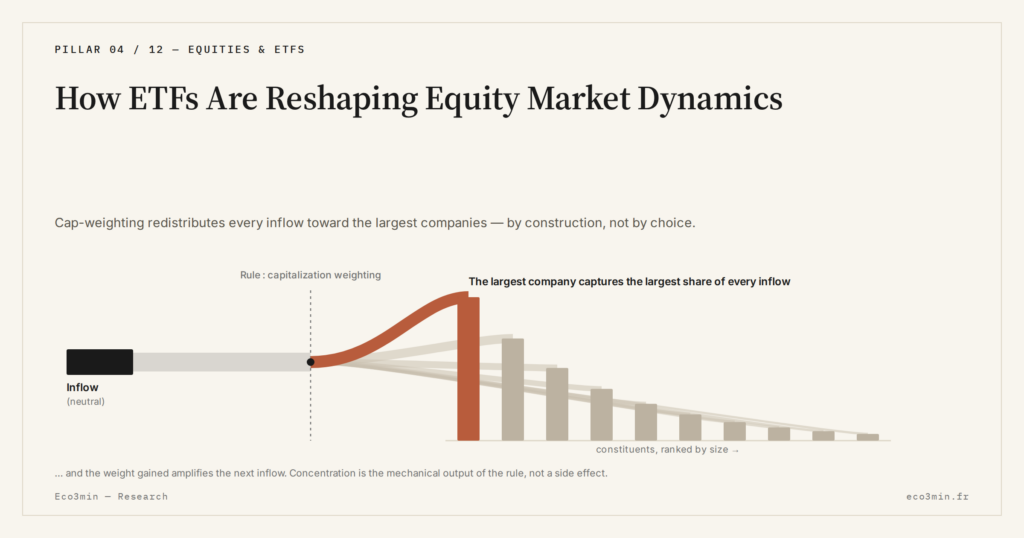
ETFs are reshaping equity market dynamics. Analysis of their effects on flows and index concentration.
TL;DR
Equity ETF flows redistribute by index weighting, mechanically funneling most new capital to the largest caps and deepening index concentration as global equity ETF assets topped $11 trillion by end-2025. The broader logic is traced in the Eco3min mapping of how index stability can mask growing risk.
- Cap-weighted redistribution: reallocating into a broad ETF spreads the flow by index weight, so megacaps capture the bulk of new capital regardless of any change in fundamentals.
- Flow procyclicality operates daily, not only in stress episodes: inflows reinforce already-outperforming segments and widen valuation gaps.
- By December 2025 the top ten capitalizations were close to 30% of the S&P 500, versus around 20% in the mid-2010s, concentrating index risk on a few earnings trajectories.
ETFs are often described as simple passive replication vehicles. This reading minimizes their actual impact on equity market functioning. As their assets grow, their role goes well beyond that of a neutral tool. The flows they channel reshape price formation, sectoral hierarchy and index concentration. Observed performance no longer results solely from economic fundamentals or earnings, but also from automatic flow mechanisms. Understanding this transformation has become essential to read market phases correctly. Further detail: physical ETFs versus synthetic ETFs, by the data.
Mechanical flows that reshape the equity hierarchy
The first mechanism stems from the very nature of equity ETFs. When an investor reallocates into a broad ETF, the flow is redistributed in proportion to index weightings. The largest-cap companies therefore mechanically capture the bulk of new capital. Related work: the assumptions that mislead investors on ETFs and passive investing.
By the end of 2025, global assets invested in equity ETFs exceeded ≈$11 trillion, against less than $3 trillion ten years earlier. This rapid expansion has reinforced the cumulative effect of capitalization weighting. Large caps benefit from structural support, regardless of any marginal improvement in their economic prospects. Related material: the Eco3min mapping of the gap between equity markets and the real economy.
An often underestimated procyclicality
Part of the consensus holds that ETFs mainly amplify volatility during episodes of extreme stress. This reading focuses on rapid corrections. It overlooks a more diffuse phenomenon: the daily procyclicality of flows.
In a rising phase, net inflows reinforce already-outperforming segments, accentuating valuation gaps. Conversely, during moderate outflows, selling pressure concentrates on the same dominant names. This logic does not create the trend, but it accentuates its trajectory. Price increasingly becomes the result of a mass effect rather than of a granular aggregation of individual analyses.
This procyclicality is even more pronounced when financing conditions remain favorable, as detailed in the analysis of the role of liquidity and capital flows in equity markets.
Index concentration and the illusion of diversification
The growing concentration of indices is a less commented-upon side effect. In December 2025, the top ten capitalizations represented close to 30% of the S&P 500, against around 20% in the mid-2010s. This evolution alters the nature of the risk borne by broad ETFs.
Apparent diversification masks an increased dependence on a small number of earnings trajectories. This transformation fits into a broader dynamic of decoupling between equity markets and the real economy, where index structure weighs more heavily than macroeconomic dispersion.
This evolution also reinforces the limits of reading indices themselves, whose economic representativeness has progressively been distorted by sectoral and capitalistic concentration.
Why this question is becoming central now
Since late 2025, the combination of elevated real rates and more heterogeneous growth across regions has reinforced the rotation toward the most liquid markets. In this context, ETFs play the role of a silent accelerator: they channel flows toward already-dominant segments, without explicit fundamental arbitrage.
Underlying human reading
This kind of question often comes up when index performance appears concentrated on a few names while the rest of the market looks more fragile. The point is not to judge the relevance of those performances, but to understand why collective dynamics can diverge from observable economic dispersion. A related perspective: Our active management-versus-passive management comparison.
What could limit the ETF effect
This reading does not imply permanent dominance of passive flows. Several factors could reduce its impact: a durable rotation back toward active management, a change in weighting rules, or increased index fragmentation. A liquidity shock or regulatory tightening targeting certain index products would also alter the observed trajectory.
Key indicators to read this dynamic
- Weekly net flows into global and regional equity ETFs.
- Evolution of the top ten capitalizations’ concentration in major indices.
- Performance gaps between cap-weighted and equal-weighted indices.
Equating passive management with full neutrality leads to ignoring the impact of mechanical flows. ETFs do not analyze fundamentals, but their collective movements directly influence price formation.
This transformation fits within the broader framework of equity markets and ETFs, where product structure becomes an explanatory factor in its own right of aggregate performance.
Conclusion: a change in mechanics rather than in value
ETFs do not redefine the economic value of companies, but they transform how that value is translated into market prices. As long as passive flows continue to grow, their structural influence will remain a key reading element. This is neither a unique scenario nor irreversible, but a dynamic that warrants integration into current analytical frameworks.
- ETFs redistribute flows according to index weightings, mechanically reinforcing large caps.
- The procyclicality of flows operates daily, well beyond visible stress phases.
- Increased concentration alters the nature of the risk borne by broad indices.
Last updated — 12 July 2026
Disclaimer – Financial Information: The analyses, commentary, and content published on eco3min.fr are provided for informational and educational purposes only. They do not constitute investment advice or a solicitation to buy or sell financial instruments. Past performance is not indicative of future results. All investment decisions involve risk and are the sole responsibility of the reader.
Read next
Full pillar →Reading Earnings Surprises: Cash Flow, Margins, Guidance
How to analyze an earnings surprise beyond the simple beat or miss: cash flow, margins, guidance, and weak…
Equal-Weight ETFs: The Quiet Signal Behind Rising Indices
Equal-weight ETFs reveal the true health of the equity market behind mega-cap-driven indices. Their gap with cap-weighted ETFs…
Smart Beta ETFs: The Hidden Risk Behind Factor Performance
Smart beta ETFs now hold ~15-20% of global equity ETF assets. Stacking factor exposures often rebuilds hidden concentration…