Ethereum Staking: How the Threshold Reshapes Crypto Risk
Ethereum staking is becoming an internal rate market shaping liquidity, capital flows and systemic risk across the crypto ecosystem.

Ethereum staking is no longer a purely technical mechanism. As the share of immobilized ETH rises, it functions as an internal rate that structures liquidity, capital allocation trade-offs and risk formation across the crypto ecosystem.
TL;DR
By late 2025, over 26% of ETH supply is staked, up from 15% in mid-2023, and the roughly 3 to 4% yield now behaves as Ethereum's internal base rate.
- The real staking yield has fallen from roughly 5–6% at the 2022–2023 post-Merge peak to about 3–4%, now overlapping the 3–4% nominal yields on US and euro cash and bond products in late 2025.
- The yield is paid in ETH, whose price swung more than 80% between its 2024 lows and highs, leaving the bond-like carry marginal against price risk.
- Through liquid staking tokens and restaking, a single unit of staked ETH can back several leverage layers, so a sharp ETH drop can cascade into DeFi margin calls rather than act as a yield cushion.
This regime shift gradually pulls the staking yield closer to traditional rate markets while introducing new systemic vulnerabilities. Understanding the transition is essential to assess the risk-return profile of crypto assets. For the broader picture: macro regimes and bitcoin behaviour.
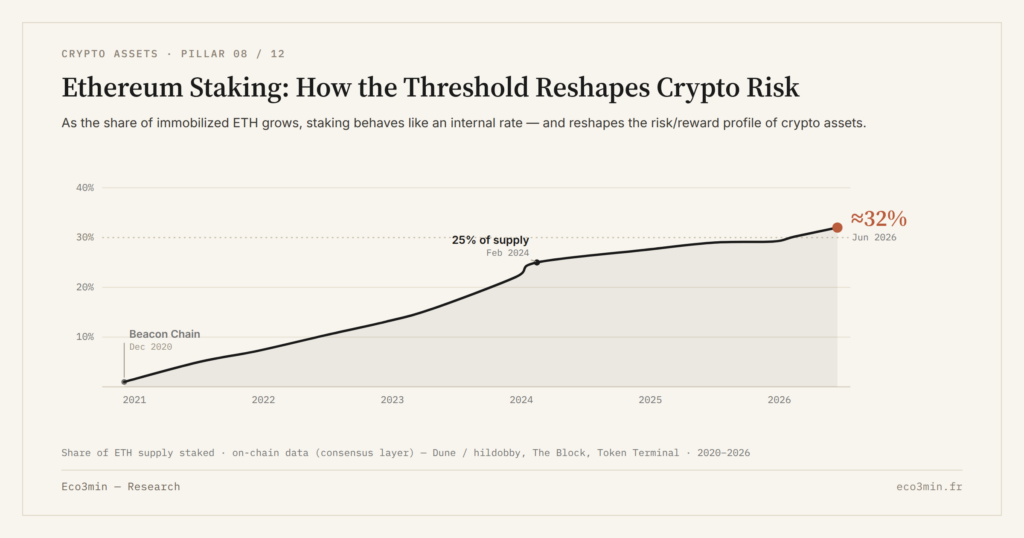
Ethereum staking refers to the mechanism by which ETH holders immobilize their assets to secure the network and earn compensation. As the share of staked ETH expands, the arrangement moves beyond its operational function and becomes a genuine internal reference rate within the ecosystem.
The staking yield thus tends to align with levels observed in other asset classes, reshaping capital-allocation trade-offs. A frequent confusion is treating this yield as a quasi-risk-free income or as a simple bonus attached to a speculative position.
This analysis examines the conditions under which Ethereum staking transforms the nature of crypto risk and how this threshold shapes investor and institutional behavior. Companion analysis: the myths surrounding Bitcoin and crypto.
Ethereum staking is studied here as an internal rate mechanism and a channel of risk transmission within the crypto ecosystem, not as a mere technical yield tool. Comparing bitcoin and ethereum across regimes traces what separates the two in practice.
Ethereum staking: why the mechanism is becoming central
In this analysis, Ethereum staking is approached as an internal mechanism of yield and risk transmission within the crypto-asset system, not as a financial innovation in the institutional or technological sense.
Since Ethereum’s transition to Proof of Stake and especially since deposits became freely withdrawable after the Shapella upgrade, Ethereum staking has moved from a technical topic to a pillar of the crypto ecosystem. By late 2025, ≈32–33 million ETH are staked, slightly above 26% of circulating supply, versus ≈15% in mid-2023.
Behind this number lies a quiet but structuring shift: staking gradually turns ETH into a yield-bearing asset with an implicit “yield curve,” while most analyses still treat it as a simple speculative token.
To grasp the economic role of staking, it helps to place it within the broader frame of the economic and monetary stakes of crypto-assets: it is a validation mechanism, but also a form of native interest rate within the Ethereum ecosystem.
The trigger: a new yield regime
Since mid-2024, the real ETH staking yield (excluding additional DeFi incentives) has stabilized around ≈3–4% annualized, against ≈5–6% at the peak of the post-Merge phase in 2022–2023. This decline is more than a detail: it reflects three key mechanisms:
- More validators: the more ETH staked, the lower the per-validator reward mechanically becomes.
- Lower gross transaction fees in periods of more moderate volatility on DeFi and NFTs, hence fewer “tips” shared with stakers.
- The rise in traditional real rates since 2022: cash and bond products at 3–4% in the United States and Europe alter the relative trade-off.
Part of the consensus considers that ETH staking will remain confined to a technical role, with yields simply “average” relative to other rate products. The analysis here diverges: the convergence between staking yield and traditional risk-free rates is gradually creating a genuine crypto rate market, with its own spreads, risk premia and cycles. Related coverage: Crypto Airdrops: Mechanisms, Dilution and Selection Risk.
The convergence between ETH staking yield and traditional risk-free rates can only be understood through a rate-cycle lens, integrating the duration of the high-rate plateau, the lag in expectations adjustment and the non-immediate nature of monetary easing, as illustrated in this reading of the rate cycle.
This shift can only be understood when placed within the broader dynamic of liquidity, rate and institutional-integration cycles that structure crypto-assets, which explains why internal mechanisms such as staking become central as the market matures.
- Treating the ETH staking yield as a risk-free rate.
- Reading 3–4% as stable income independent of the ETH price.
- Ignoring the role of liquidity cycles and global real rates.
How does the Ethereum staking yield really work?
Staking can be read as a combination of three components:
- The base reward: compensation for participating in block validation (network security), calculated based on the total amount of ETH staked.
- Transaction fees: a portion of gas fees is redistributed to validators, especially during activity peaks (DeFi, NFTs, airdrops).
- The MEV component (Maximal Extractable Value): additional revenue tied to transaction ordering within blocks.
Concretely, an investor staking directly or through a liquid protocol (LST type) currently receives ≈3–4% in ETH per year. In fiat terms, this yield is extremely volatile: in 2024, ETH price varied by more than 80% between lows and highs, making this “bond-like” yield marginal relative to price risk.
Yet with major central bank policy rates currently around 3–4% nominal (late 2025) and inflation easing toward 2–3% across developed economies, ETH staking now sits in the same nominal yield zone as many traditional rate products. This is what the market is still imperfectly pricing in.
Macro effects: when central bank rates meet crypto rates
ETH staking does not exist in isolation. It is increasingly anchored to three macro forces:
- Prolonged restrictive monetary policy: after the 2022–2024 hiking cycle, rates have stayed elevated longer than expected. For a fund or corporate treasury, a 3.5% staking yield must be compared to a near-risk-free T-bill or euro money-market product at 3–4%.
- Currency volatility: a European investor staking in ETH bears a double risk — ETH price and EUR/USD — even though the asset is primarily priced in dollars.
- Capital flows: when equity and credit markets become more attractive (spread compression, tech rally), some flows leave DeFi, reducing on-chain activity and therefore part of MEV/fee revenue.
This macro/micro intersection is often misread. Many still reason as if staking were a “free bonus” on a directional ETH bet. In reality, it gradually approaches a policy rate internal to Ethereum that must remain competitive against global real rates to keep attracting long-duration capital.
- Compare the staking yield to real rates, not to past yields.
- Read staking as a policy rate internal to Ethereum.
- Analyze spreads rather than absolute levels.
Liquid staking, LSTs and restaking: a new layer of systemic risk
The massive shift toward liquid staking (LSTs: liquid staking tokens) is the other major inflection. Estimates suggest that a majority of staked ETH now flows through liquid derivatives (LSTs and restaking), which can be reused as collateral in DeFi.
This creates a complex value chain:
- ETH is deposited with a validator or a staking protocol,
- a liquid token representing this staked ETH is issued,
- this token is then deposited as collateral to borrow, farm, or restaked to secure other protocols.
The seldom-discussed consequence: a single unit of staked ETH can support several leverage layers. In case of a sharp drop in ETH price or regulatory stress on a major staking protocol, cascading margin calls in DeFi can turn into a mini liquidity crisis.
Part of the consensus considers these risks “contained” thanks to on-chain transparency and overcollateralization. The underlying assumption here is more cautious: as long as dominant LSTs remain concentrated in a handful of actors and inter-protocol correlation is high, staking becomes a possible channel of shock transmission, not merely a yield safety net.
The risk of staking does not come from the Ethereum protocol itself, but from the stacking of financial layers around an immobilized asset whose liquidity remains conditional.
What investors are really seeking with Ethereum staking
The real question is not only whether the ETH staking yield exceeds or falls short of a money-market fund. What many primarily seek to understand is: can staking be used as a recurring yield pillar in a portfolio, or does it remain a simple speculative “extra”?
Behind this question lie three concerns:
- Is it too risky to represent more than a small share of total wealth?
- Is it already too late to capture a structural excess return?
- Is it preferable to act now or wait for a volatility point to enter?
The answer depends less on the current yield level than on each investor’s ability to absorb a 50–70% price shock on ETH while remaining staked for two to three years.
Common errors in reading Ethereum staking
- Treating the staking yield as a risk-free rate. The yield is paid in ETH and remains exposed to high underlying volatility.
- Interpreting a rising staking ratio as an automatic bullish signal. A significant share of staked ETH can be mobilized through LSTs in stress conditions.
- Underestimating counterparty risk. Reliance on liquid-staking protocols and restaking introduces operational and regulatory risks distinct from Ethereum itself.
- Confusing staking yield with risk-free rate. The 3–4% paid in ETH bears no relation to a guaranteed deposit. It comes with extreme underlying risk. Treating it as “safe passive income” is misleading.
- Over-interpreting the share of staked ETH. A rising staking ratio does not automatically imply upward price pressure. A significant portion of staked ETH may simultaneously be used as collateral, hence mobilizable in stress conditions.
- Ignoring protocol counterparty risk. Routing through an LST or a centralized exchange introduces operational risk (bug, hack, regulatory sanction) distinct from Ethereum itself.
Three plausible scenarios for ETH staking
1. Normalization as a “crypto base rate”
The first scenario, close to dominant projections, sees the staking yield oscillating durably between 2.5% and 4% nominal, with staked ETH near 30–35% of supply. Staking becomes a crypto base rate: DeFi protocols price loans and deposits with a spread above this rate, much like banks do above policy rates.
In this framework, ETH establishes itself as a semi-bond-like asset for a minority of long-term investors prepared to bear the volatility. Systemic risk remains contained as long as concentration on a few LSTs does not increase too much.
2. Over-financialization and “crypto carry trade” risk
A second, less discussed scenario would see the ecosystem create an aggressive carry trade: borrowing at low rates in fiat or stablecoins to buy ETH, stake it, and recycle the LSTs in leveraged strategies. If traditional rates fall faster than expected while the staking yield holds, this differential could become attractive.
The result: a build-up of hidden leverage and heightened vulnerability to a sharp ETH reversal. This is not the central scenario today, but the market likely does not fully price this possibility.
3. Targeted regulatory stress on staking protocols
The final scenario: a major regulatory shock on staking intermediaries (centralized exchanges, dominant pools) in a large jurisdiction. Even if the Ethereum protocol remains functional, the perception of counterparty risk could trigger a temporary mass disengagement from LSTs and a wave of withdrawal orders.
This stress would then transmit to DeFi via LST collateral, causing a wave of liquidations and an amplified ETH drawdown. It is a diffuse but rising risk, hard to model, but unwise to ignore.
Key indicators to track risk and opportunity
To avoid flying blind, a few simple indicators can serve as a dashboard:
- Staked ETH / total supply ratio: above 35–40%, the network becomes heavily “immobilized,” which can reduce exchange-available liquidity and amplify price moves.
- Spread between ETH staking yield and risk-free dollar rates: if the spread durably falls below one percentage point, the incentive for institutional capital to stake declines markedly.
- Concentration of leading LSTs: the more a single protocol dominates, the higher the single-point-of-failure risk.
- Volume of LSTs used as collateral in DeFi: an excessive share signals rising systemic leverage. This KPI can be monitored via aggregated on-chain dashboards.
Practical approach: how to calibrate staking in a portfolio?
For a diversified investor, a sensible approach treats ETH staking as a yield supplement on an already-decided crypto exposure rather than a new standalone asset class.
A simple grid, to be adapted to each profile:
- Conservative profile: a minimal crypto exposure has historically been observed, with only a fraction of it allocated to staked ETH. The objective is more pedagogical than financial.
- Balanced profile: a low-single-digit crypto exposure has been observed, with allocations typically split across BTC, ETH (a majority of which staked), and other assets. Staking adds a yield premium but does not condition overall performance.
- Aggressive profile: higher crypto exposure has been observed in some mandates, with most ETH staked, while limiting leverage layers (DeFi, restaking) to avoid double exposure.
For those who wish to deepen the place of crypto-assets in a global portfolio, the article on the 60-30-10 split in a high-rate environment offers a useful allocation framework.
Watchpoints and counter-arguments
Several elements could invalidate the scenario of staking structuring itself as a stable crypto rate market:
- A durable return to low policy rates (below 1–2%) without an inflation surge: in this case, a 3–4% staking yield would once again become markedly attractive, potentially boosting flows and recreating an euphoric regime.
- Protocol evolution that would raise the share of redistributed fees or MEV efficiency, lifting yields without weighing on risks.
- Rise of alternatives (other PoS L1s or L2s with native tokens) offering a perceived better risk-return mix, redirecting some capital currently concentrated on Ethereum.
Conversely, a tighter-than-expected regulatory stance or a confidence shock on a major staking protocol could push the ecosystem toward a forced-deleveraging scenario, with rising yields but on a smaller capital base.
Practical implications for three profiles
Retail investors
For retail, the issue is not “chasing” one extra point of yield through complex setups, but limiting risk layers. Three concrete reference points:
- Favoring a simple exposure: ETH staked through a reputable actor or a leading LST, without multiplying secondary protocols.
- Limiting the share of the ETH bucket that is used as DeFi collateral via LSTs to avoid stacking risks.
- Tracking monthly the staking yield vs risk-free rate ratio to assess whether increasing the staked share remains rational.
Companies and corporate treasuries
For a company exposed to crypto (payments, partial ETH treasury), staking can serve as a yield tool on part of reserves. But it must remain marginal given liquidity and compliance constraints.
A reasonable approach: limiting staking to a fraction of excess treasury (e.g. a small slice of ETH exposure) and tracking as an internal KPI the maximum exit window if cash is needed (factoring in LST market depth).
Professional investors
For funds, ETH staking is already an allocation building block. The question becomes: how much DeFi systemic risk is acceptable to gain 2–3 additional points of annualized yield through LST leverage?
A prudent framework consists of setting a global engagement limit on the “staking complex” (staked ETH + LST as collateral + restaking) within the crypto bucket, and managing this cap based on the indicators discussed above (LST concentration, collateral volume, spread vs risk-free rate).
Frequently asked questions on Ethereum staking
Does Ethereum staking really protect against ETH price volatility?
No. The 3–4% yearly yield does not offset a ±50% price move. Staking marginally improves the carry of a long-term position but does not turn ETH into a defensive asset.
Is direct staking preferable to LSTs?
Direct staking reduces counterparty risk but immobilizes capital and requires technical implementation. LSTs add liquidity and DeFi opportunities at the cost of additional risk (protocol, market, regulatory). The choice depends on sophistication and investment horizon.
What happens if a major liquid-staking protocol is sanctioned or attacked?
The LST token can de-peg sharply versus ETH, triggering cascading liquidations in DeFi. As long as Ethereum remains functional, funds are not necessarily lost, but market value can be heavily affected.
Can the staking yield rise sharply?
Yes, if on-chain activity rebounds (DeFi, NFTs, rollups), if fees rise, or if some staked ETH withdraws, easing competition between validators. But a higher yield often comes with a more volatile context. The wider context: how proof of work and proof of stake compare.
- ETH staking creates an internal rate, not safe income.
- LSTs turn a security mechanism into a leverage vector.
- The main risk is systemic and behavioral, not technical.
Last updated — 12 July 2026
Disclaimer – Financial Information: The analyses, commentary, and content published on eco3min.fr are provided for informational and educational purposes only. They do not constitute investment advice or a solicitation to buy or sell financial instruments. Past performance is not indicative of future results. All investment decisions involve risk and are the sole responsibility of the reader.
Read next
Full pillar →Crypto Seasonality: Why the Signal Is Weaker Than It Looks
Crypto’s cyclical regularities, monthly seasonality or the four-year cycle, rest on a very small number of observations. That…
Bitcoin Halving: How the Programmed Supply Cut Works
The halving writes bitcoin’s scarcity into an immutable rule, applied without exception since 2012. It shapes the pace…
Crypto Cycles: Why Their Amplitude Dwarfs Equity Swings
Crypto cycles post drawdowns two to four times deeper than equity markets. The asymmetry stems from market microstructure,…