Why a Good Investment Idea Doesn’t Replace a Strategy
Isolated investment ideas can produce contradictory decisions over time when they are not embedded in a coherent framework. This analysis examines why insight quality alone does not build trajectory.

Analysis of the limits of isolated investment ideas faced with the need for a coherent strategic framework over time.
TL;DR
Across 2015–2024, uncoordinated rotation between isolated investment ideas cost an estimated 0.5 to 1.5 points yearly in frictions, as sound intuitions overlapped and cancelled for lack of a hierarchy. Related analysis: our study of reading the economic cycle for portfolio positioning.
- Two relevant ideas can be incompatible when their horizons, risks or macro dependencies differ; without a hierarchy, each new idea competes with the previous one instead of compounding.
- The framework deficit surfaces over time: more uncoordinated decisions mean more adjustments, producing a result below the sum of each idea's individual quality.
Markets abound with ideas judged relevant or attractive. Many assume that a succession of good intuitions is enough to build a solid trajectory. What is missing, however, is not the idea itself but the absence of a framework to embed it over time. Without a strategy, even sound decisions can neutralise or contradict one another. The most widespread confusion consists of equating point-in-time accuracy with overall robustness. It is this asymmetry between intuition and cumulative coherence that clarifies the role of strategy.
This gap has become more visible recently. In an environment where the cost of capital remains durably higher than before 2020 and where performance dispersion across assets remains pronounced, isolated ideas can produce opposite results depending on their moment of application, without their intrinsic quality being in question.
When a Sound Idea Becomes Ineffective Without a Framework
An investment idea often rests on a real observation: a valuation gap, an identified competitive advantage, a temporary imbalance. Taken in isolation, it can be relevant. The problem appears when it is not connected to a horizon, to explicit constraints, or to an arbitrage logic.
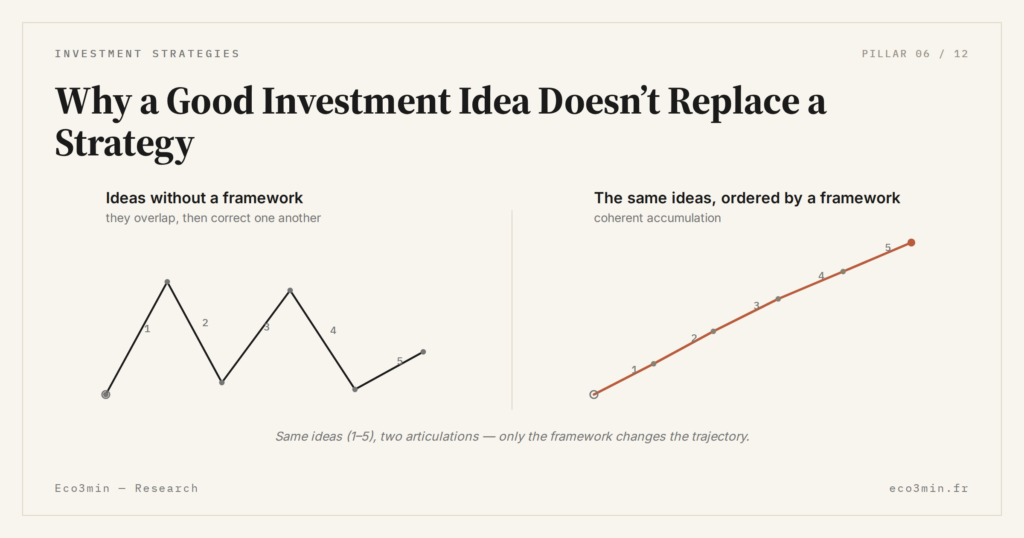
Without a strategy, each new idea competes with the previous one. Decisions do not add up: they overlap, then correct one another. This mechanism explains why portfolios composed of “good ideas” sometimes display high volatility without a readable trajectory. This tension between idea and trajectory is clarified in our framework on investment discipline through cycles. The absence of a hierarchy among ideas prevents any coherent accumulation.
The Implicit Consensus: The Quality of an Idea Is Enough
Part of the operational consensus assumes that a sound analysis mechanically leads to a sound decision. Mainstream projections often retain the hypothesis that correctly identifying a theme or an asset is sufficient to create value over time.
The analysis diverges on a key point: an idea says nothing about its compatibility with past or future decisions. Two relevant ideas can be incompatible if their horizons, risks, or macro dependencies differ. It is not the idea that builds the trajectory, but the way it fits into an existing framework.
An Often Underestimated Cumulative Mechanism
The effects of an absent strategy emerge over time. A succession of uncoordinated ideas tends to increase the frequency of adjustments. Aggregate market data show that, over the 2015–2024 period, excessive rotation of decisions translated into cumulative frictions of around 0.5 to 1.5 points per year, between direct costs and timing errors, depending on the segments observed.
These orders of magnitude illustrate a structural mechanism: even when ideas are relevant, their sequencing without a framework produces a result inferior to the sum of their individual qualities.
This framework deficit translates not only into reduced efficiency. It generates diffuse costs, hard to identify in isolation, but cumulative over time. These invisible risks appear when decisions are sequenced without a clear hierarchy, making the trajectory more fragile than it appears.
What Many Are Really Trying to Understand
Behind this question lies a simple inquiry: how can a decision be sound without improving the overall trajectory? The real question is not whether an idea is good, but whether it strengthens or weakens overall coherence. It is this distinction that allows results to be reread without overinterpreting point-in-time successes.
Counterarguments and Limits of the Reading
This analysis would be less relevant in an environment of homogeneous returns and low volatility, where successive ideas produce similar effects. Likewise, a strong exogenous constraint — regulatory or fiscal — can impose decisions independently of any pre-existing strategy. Conversely, in phases of prolonged macro transition, the absence of a framework makes cumulative effects more visible.
Why This Bias Is Frequent Today
In a context where some aggregate indicators appear reassuring while underlying trajectories remain fragile, the temptation to multiply corrective ideas is strong. This reading recalls the situations analysed through the notion of a misleading economic indicator, where a partial signal masks a more complex dynamic.
The general framework in which this reasoning fits is developed more broadly in the strategic framework set before performance, which shows why ex ante coherence conditions the reading of ex post results.
Equating a sequence of good ideas with a strategy. This reading is misleading because it confuses the point-in-time quality of an intuition with its capacity to fit durably within a coherent trajectory.
Observable Economic Implications
For markets, this logic favours erratic flows and increased dispersion of performance. For companies, it translates into shifting strategic orientations justified by isolated opportunities. For households, it makes the reading of past decisions more confused and complicates the assessment of cumulative risks.
The distinction between idea and strategy does not eliminate uncertainty, but it clarifies why relevant decisions can produce incoherent trajectories.
- A relevant idea does not guarantee a coherent trajectory without an explicit framework.
- The absence of a hierarchy among ideas favours contradictory decisions over time.
- Strategy organises the compatibility of decisions, independently of their point-in-time success.
Within the architecture of investment strategies, this reading highlights a central point: it is not the scarcity of good ideas that limits trajectories, but the absence of a framework to articulate them durably.
Last updated — 12 July 2026
Disclaimer – Financial Information: The analyses, commentary, and content published on eco3min.fr are provided for informational and educational purposes only. They do not constitute investment advice or a solicitation to buy or sell financial instruments. Past performance is not indicative of future results. All investment decisions involve risk and are the sole responsibility of the reader.
Read next
Full pillar →Beneficiary Designations, the Step-Up in Basis, and the 10-Year Rule: How US Accounts Transfer at Death
At death, most US financial accounts pass outside the will, straight to a named beneficiary, under tax rules…
The Fee Stack in Variable Annuities: M&E Charges, Riders, and Subaccount Costs
A variable annuity does not carry one fee, but a stack of them. Mortality and expense charges, subaccount…
The Conventional 401(k)-Match-First Funding Order: Where It Comes From, How It Works
The question of what order to fund accounts in usually draws a fixed list, presented as a rule…