Investing Without a Strategy: The Hidden Risks of an Unframed Approach
Without an explicit framework, decisions accumulate on different criteria. This fragmentation creates cumulative exposures that only become visible after the fact, when past choices are reread as a whole.


Analysis of the implicit risks linked to investing without a strategic framework structuring decisions over time.
TL;DR
Without an explicit framework, each investment decision rests on a different criterion, and the uncoordinated exposures accumulate into a trajectory whose risk goes untracked. This point is illuminated in our study of investment discipline and long-term performance.
- The danger lies not in any single decision but in the trajectory they collectively form, as exposures add up without ever being thought of together.
- Annualized equity-market volatility ran near 18-25% over 2022-2024 versus roughly 10-12% across 2013-2019, a less directional regime in which opportunistic choices alternate gains and losses.
- Exposure drifts silently: an allocation can grow more sensitive to rates or liquidity cycles with no conscious decision, surfacing later as outsized reactions to expected shocks.
- Since 2023, policy rates held above pre-2020 levels have widened performance gaps without a clear trend, so reactive decisions amplify perceived volatility even when risk has not risen.
The absence of a framework often gives the illusion of broad decisional freedom. In the short term, each choice may appear rational in isolation. Over time, the accumulation of uncoordinated decisions creates imbalances that are difficult to identify. These risks are not immediately visible because they do not take the form of a single error. Many still confuse flexibility with the absence of structure. It is this gradual drift that exposes the hidden risks of investing without a strategy. Directly related: reading the economic cycle for portfolio positioning.
When the addition of decisions becomes the problem
Part of the operational consensus holds that a sequence of sound point-in-time decisions is enough to build a satisfactory trajectory. The dominant projections assume that the ability to react quickly takes precedence over the prior definition of a framework. This reading values immediate adaptability and minimizes the role of intertemporal coherence.
This interpretation is incomplete. Without an explicit strategy, each decision is taken on a different criterion: perceived opportunity, market signal, recent performance or intuition. This fragmentation creates a cumulative risk: exposures add up without being thought of together. The danger lies not in any single decision, but in the trajectory they collectively form.
This mechanism appears clearly when market regimes become less directional. Between 2022 and 2024, annualized volatility on major equity markets remained between ≈18% and ≈25%, against ≈10–12% over the 2013–2019 period. In this context, opportunistic choices can alternate gains and losses without their overall coherence ever being questioned.
An explicit strategy imposes rules: horizon, tolerance for deviations, liquidity constraints, diversification logic. Without these benchmarks, risk is not measured, it is absorbed. Real exposure shifts with each decision, often without being perceived as a change of stance.
This drift is discreet. An allocation can, for example, gradually become more sensitive to rates or to liquidity cycles without that having been consciously decided. The risk then appears as surprises: an excessive reaction to an otherwise expected shock, or a loss of readability of the results. The framework presented in the analysis of strategy before performance shows that these drifts are only visible after the fact, when past decisions are reread as a whole.
In this context, the absence of a framework makes the interpretation of results particularly fragile. Point-in-time gains can mask growing inconsistency, while temporary losses can be over-interpreted in the absence of explicit rules to place them within an overall trajectory.
Why this topic is becoming more sensitive now
Since 2023, the persistence of high policy rates has reshaped the hierarchy of risks. With the cost of capital remaining above pre-2020 levels, performance gaps have widened without offering a clear trend. In 2025, several segments alternated rapid rebounds and equally sharp corrections within a few months.
In this context, the absence of a strategy makes trajectories more erratic. Reactive decisions amplify perceived volatility, not because risk has actually risen, but because it is no longer framed by stable rules.
What many readers really want to understand
The real question is not whether a recent decision was good or bad, but whether it fits a logic compatible with previous ones. The broader framing is laid out in our breakdown of portfolio risk management and survival before performance. Behind the search for flexibility often lies a simpler concern: that of being locked into a rigid framework. Yet the absence of a framework does not eliminate risk, it merely makes it less readable.
Without a strategy, every new piece of information becomes a potential reason for adjustment. This permanent reactivity creates a bias: the short term mechanically takes precedence over overall coherence.
Alternative reading and limits
This analysis does not imply that a strategic framework is immutable. A lasting change of macroeconomic regime, a new regulatory constraint or a technological disruption can render a framework obsolete. In that case, persisting without adaptation itself becomes a source of risk.
The point is therefore to distinguish an absence of strategy from a strategy that has become unsuited. A regime lens, such as the one offered by the macro cycle diagnostic, helps identify whether observed imbalances reflect an external transition or an internal inconsistency.
Observable economic implications
For markets, investing without a strategy fuels unstable flows: rapid rotations, accidental risk concentration, amplified reactions to macroeconomic news. For corporates, this logic translates into investment decisions revised frequently without reassessing the initial assumptions. For households, it complicates the reading of past choices and increases the sense of uncertainty when performance fluctuates.
Within the architecture of investment strategies, the absence of a framework is not neutrality: it is implicit exposure to risks that have not been chosen.
Confusing flexibility with the absence of a strategy. This view is misleading because it equates ad hoc adaptation with controlled risk management, while the absence of a framework makes cumulative exposures hard to track.
What these risks concretely imply
This is not the central scenario today, but the most discreet risk remains that of a trajectory that has become incoherent without any explicit decision. The market does not fully price this drift, because it does not manifest as a single shock. It settles in gradually, as decisions add up without a guiding thread.
Last updated — 12 July 2026
Disclaimer – Financial Information: The analyses, commentary, and content published on eco3min.fr are provided for informational and educational purposes only. They do not constitute investment advice or a solicitation to buy or sell financial instruments. Past performance is not indicative of future results. All investment decisions involve risk and are the sole responsibility of the reader.
Read next
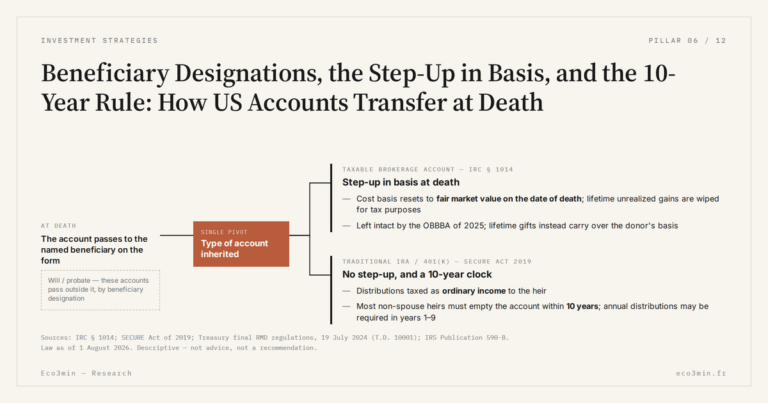
Full pillar →Beneficiary Designations, the Step-Up in Basis, and the 10-Year Rule: How US Accounts Transfer at Death
At death, most US financial accounts pass outside the will, straight to a named beneficiary, under tax rules…
The Fee Stack in Variable Annuities: M&E Charges, Riders, and Subaccount Costs
A variable annuity does not carry one fee, but a stack of them. Mortality and expense charges, subaccount…
The Conventional 401(k)-Match-First Funding Order: Where It Comes From, How It Works
The question of what order to fund accounts in usually draws a fixed list, presented as a rule…