
HY OAS during the 2008-2009 crisis: anatomy of a 2,000-basis-point widening

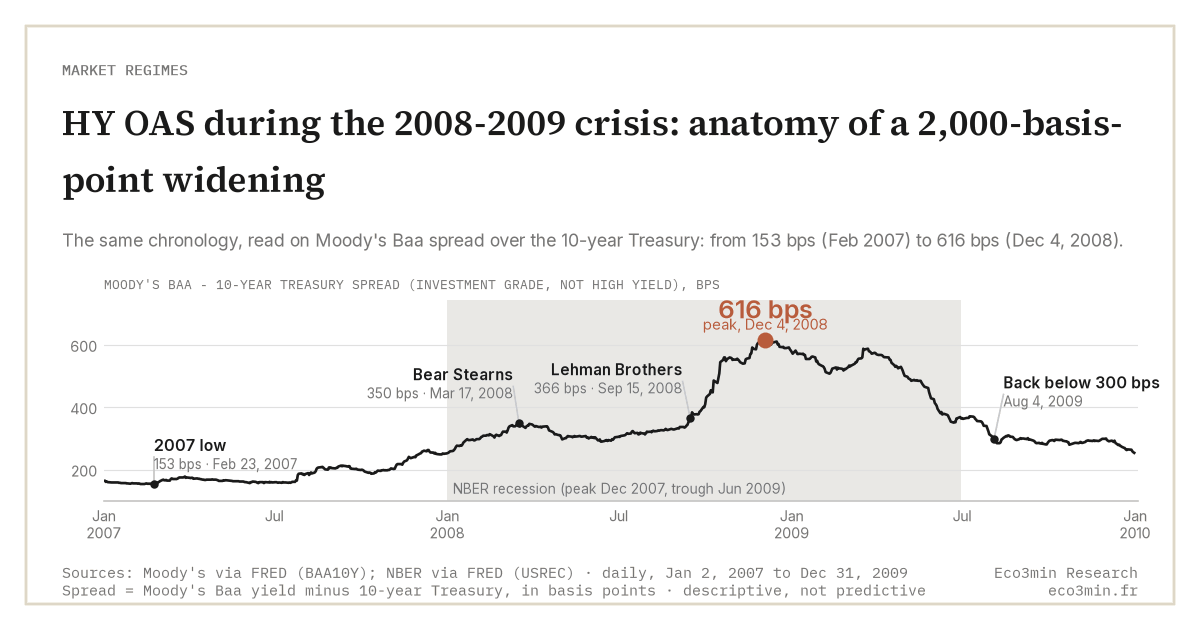
Between July 2007 and December 2008, the HY OAS moved from 280 to nearly 2,200 basis points — the sharpest widening on record since the series began in 1997. This chronology aggregates four rarely simultaneous dynamics: bank-liquidity stress, realized defaults, global risk aversion, market-infrastructure failure.
TL;DR
HY OAS widened from 280 to 2,182 basis points between July 2007 and December 2008, the sharpest move since the series began in 1997, in four distinguishable phases.
- The widening ran in four phases: an initial decoupling (280→600 bps, July-December 2007), a Bear Stearns pause (peak near 860 bps, March 2008), the Lehman shock (900→1,680 bps in six weeks), and an absolute peak of 2,182 bps on 15 December 2008 (FRED series BAMLH0A0HYM2).
- HY OAS turned about three months before the S&P 500's October 2007 peak, with IG OAS still contained at 100-205 bps, the cleanest illustration of high-yield credit leading equities into a reversal.
- The peak near 2,180 bps, roughly four times the ~515-bp historical mean and double the 2020 COVID high near 1,090 bps, overlapped four dynamics (bank liquidity, realized defaults, global risk aversion, infrastructure failure) that no later episode has combined.
- Normalization took about nine months against thirteen weeks from Lehman to the peak (six to the first late-October high), a temporal asymmetry visible across all 1997-2025 episodes as default expectations revise up faster than down.
Breaking the episode into phases lets us distinguish a “normal” default-cycle widening from a systemic-stress widening. Eco3min maintains the full record in the HY OAS series. That distinction is precisely what makes reading HY OAS in the contemporary regime more delicate than it first appears.
July-December 2007: The Initial Decoupling
In the first half of 2007, HY OAS traded around 280 basis points, at the bottom of its historical range, in a regime of broad complacency comparable to 2006. The US subprime mortgage market began showing stress as early as February 2007 (New Century Financial’s first bankruptcy filing), but that deterioration was perceived as an isolated sectoral event. HY OAS reacted only marginally. A parallel read: the anatomy of the 2008 shock.
The turning point came in July 2007. On 31 July, Bear Stearns announced that two of its hedge funds focused on subprime CDOs were essentially worthless. The announcement triggered a brutal reassessment of tail risk across the financial system. HY OAS moved from 280 to roughly 450 basis points in six weeks, reaching 600 bps by November 2007. IG OAS, by contrast, remained relatively contained during this first phase, between 100 and 205 bps, exactly matching the HY-lead-over-IG pattern documented across other episodes.
This first phase is analytically critical because it proves the transmission mechanism operated in its canonical configuration: the HY segment reacted before IG decoupled, and well before the S&P 500 made its October 2007 peak. A reader following HY OAS daily between July and October 2007 would have observed in real time the first signs of a major reversal in formation — about three months before the S&P 500 peak.
March 2008: The Bear Stearns Episode
Between January and mid-March 2008, HY OAS gradually widened to roughly 840 basis points. The next phase was triggered by Bear Stearns’ collapse on 14 March 2008, rescued in extremis by JPMorgan with a Federal Reserve guarantee over the 16-17 March weekend. HY OAS spiked to 862 bps on 17 March, a level not seen since early 2003.
This episode is pedagogically instructive because it delivered a first visible activation of channel 3 (equity-credit arbitrage). Single-name CDS spreads on major investment banks had begun widening as early as February 2008, signaling the Bear Stearns failure ahead of time. Equity-credit hedge funds tracking those spreads adjusted their bank-stock positions, which appears ex post in the short-interest reports the SEC published for that period. The three-channel mechanism was functioning, but with an amplification driven by the infrastructure dimension: counterparties were beginning to fear counterparty risk on CDS and repo.
A partial easing followed the Bear Stearns rescue. HY OAS returned below 700 bps in April-May 2008, in an emerging consensus that the Fed had prevented systemic escalation. That easing would prove to be a false normalization. IG OAS, however, never returned below 220 bps during the pause, signaling that the deterioration had diffused to investment grade — a sign of broader macro stress than a simple HY-segment correction.
September 2008: The Lehman Shock
On 15 September 2008, Lehman Brothers filed for bankruptcy. This is the most violent phase of the episode and probably the most instructive on the mechanics of a systemic stress. The mechanism is unpacked in how market stress shows up in the indicators.
Simultaneous Activation of All Three Channels
In the days following Lehman’s collapse, the three transmission channels identified in the three transmission channels in action activated simultaneously. Channel 1 (refinancing) exploded: the primary HY market was essentially closed for several weeks, meaning issuers with short-term refinancing needs lost market access. Channel 2 (covenants) triggered massively: simultaneous equity collapse and falling coverage ratios activated the maintenance covenants still present in pre-2010 bonds. Channel 3 (arbitrage) operated at full strength: hedge funds unwound long-credit / long-equity positions in the general panic, producing simultaneous selling across both segments.
Market-Infrastructure Freeze
Beyond the three fundamental channels, the Lehman episode added an infrastructure dimension absent from other events: the CDS market partially froze, margins became uncomputable on certain counterparties, and the interbank market (LIBOR-OIS spread) showed unprecedented stress levels. HY OAS moved from ~900 bps in mid-September to over 1,650 bps by late October (1,681 on 27 October), an acceleration of nearly 800 bp in six weeks, unparalleled in the series.
On 14 October 2008, the US government announced the TARP (Troubled Asset Relief Program) at $700 billion. The HY OAS reaction was revealing: easing was minimal and short-lived. The market signaled that intervention, however massive, was insufficient relative to the balance-sheet shock underway. AIG entered rescue on 16 September with successive extensions. On 23 November, the Treasury and Fed announced a Citigroup rescue. Each intervention brought brief easing followed by renewed widening.
November-December 2008: The Absolute Peak
HY OAS reached its absolute peak on 15 December 2008: 2,182 basis points per FRED series BAMLH0A0HYM2, after a first plateau at 1,992 bps on 21 November. IG OAS peaked in the same window at 656 bps (5 December, series BAMLC0A0CM), the highest ever recorded, and BBB at 804 bps (16 December, BAMLC0A4CBBB). The Moody’s trailing 12-month HY default rate then stood at 4.3%, heading toward its cycle peak of 14.7% in November 2009 — the ex-post amplitude of the default cycle.
The 2,180-bp level deserves to be put in perspective. It represents roughly 4 times the historical HY OAS mean (~515 bps) and nearly 2 times the 2001-2002 cycle peak (1,120 bps in October 2002). No subsequent episode came close: the 2020 COVID peak near 1,090 bps is exactly half that level. The GFC remains to date the maximum credit stress observed on the modern series, making it the benchmark reference for peak regimes.
December 2008 – June 2009: Normalization
Easing began in December 2008 under the combined effect of massive policy announcements (Fed ZIRP on 16 December, TARP bank recapitalizations, expansion of TAF and TSLF). HY OAS returned below 1,800 bps by year-end 2008, below 1,500 bps in late April 2009, then below 1,000 bps in late July, well after the S&P 500 bottom of March. Normalization was gradual and asymmetric: the return to the “average” 500-800-bp range took about nine months (18 September 2009), contrasting with the speed of the widening (six weeks from Lehman to the first late-October high, thirteen to the peak).
This temporal asymmetry between widening and normalization is itself a signature of peak regimes. It is observed across all 1997-2025 historical episodes and reflects the fact that default expectations revise upward faster than they revise downward, in the absence of a clear signal of fundamental normalization.
What the Episode Reveals About Systemic-Stress Mechanics
Four dynamics overlapped during the GFC, making it the textbook case of systemic stress, as opposed to an “ordinary” default cycle. The first is bank-liquidity stress, which paralyzed the interbank market and therefore the traditional financing channel of the corporate sector. The second is the activation of realized defaults, with the Moody’s rate tripling in twelve months to reach 14.7% at peak — a level that empirically justified a meaningful share of the spread widening. The third is global risk aversion, which simultaneously hit all risky asset classes (equities, IG credit, HY credit, listed real estate). The fourth is the market-infrastructure failure (partial CDS freeze, uncomputable margins, repo dysfunction) which added a dimension absent from other historical episodes. Read alongside: The mechanics of a strong dollar that does not trigger a crisis.
The overlap of these four dynamics explains why HY OAS reached 2,180 bps in 2008 while no subsequent episode came close, even when individual dynamics were present. Understanding this decomposition helps evaluate the risk that any given contemporary episode becomes “systemic”: all four dynamics would need to activate simultaneously, which is a strict condition and historically rare. The reading framework for HY OAS outside extreme episodes is precisely calibrated for configurations where these conditions are not all met.
The GFC episode thus provides a reference by contrast with more recent configurations. The contrast with the 2024-2026 HY-VIX divergence is particularly instructive: during the GFC, HY OAS and VIX were synchronized (90-day rolling correlation of 0.97 in late October 2008, still 0.89 at the December peak); in the current regime, their correlation has collapsed. This contrast signals a structural regime change, the full analysis of which is treated in the dedicated satellite. For the comparative chronology of the five other 1997-2025 episodes as a whole, the complete table of HY OAS widening episodes 1997-2025 provides the overview that complements the present zoom. This episode belongs to the canonical family of systemic-stress signals identified by Eco3min.
- The HY OAS 2007-2008 episode unfolded in four phases: initial decoupling (July-December 2007, 280→600 bps), Bear Stearns pause (January-August 2008, temporary peak 862 bps), Lehman shock (September-October 2008, 900→1,680 bps), absolute peak (15 December 2008, 2,182 bps).
- HY OAS anticipated the October 2007 S&P 500 peak by about three months — the cleanest illustration of the canonical HY-segment lead time over equities.
- The 2,180-bp peak reflects the rare overlap of four dynamics: bank liquidity, realized defaults, global risk aversion, infrastructure failure. No subsequent episode has combined all four simultaneously.
- The temporal asymmetry between widening (thirteen weeks from Lehman to peak, six to the first high) and normalization (~nine months to the average range) is a behavioral signature of peak regimes, observable across all historical episodes.
Last updated — 6 October 2026
Disclaimer – Financial and Legal Information: The analyses, commentary, and content published on eco3min.fr are provided for informational and educational purposes only. They do not constitute investment advice or a solicitation to buy or sell financial instruments. Past performance is not indicative of future results. All investment decisions involve risk and are the sole responsibility of the reader. Data, charts and calculated series are provided as is and may contain errors or lag behind their source: check any figure against the primary source cited before relying on it. Content describing laws, regulations or contracts reflects the law as of its publication date and does not constitute legal or tax advice; applying it to a specific situation requires a qualified legal or tax professional.
Read next
Full pillar →HY OAS: why this credit spread is a leading signal of recession and equity reversal
The HY OAS, published by FRED under code BAMLH0A0HYM2, bundles three risk premia (perceived default, liquidity, aggregate risk…
Weak or Strong Euro: Imported Inflation and Competitiveness
The euro's level acts on the area's economy through two opposing channels: it changes the price of imports,…
How to Read EUR/USD: What Moves a Currency Pair
EUR/USD is the price of one euro expressed in dollars: when it reads 1.14, one euro trades for…