
HY OAS vs VIX: credit still tracks volatility, from a much lower level
The high-yield spread still tracks the VIX (250-session correlation of 0.74 on 6 October 2026). Yet when the VIX tops 20 its median has been 319 basis points since 2024, against 654 in 2003-2022.

The high-yield spread and the VIX respond to the same shocks, because a corporate default and an equity sell-off are two faces of one risk. Since 2024 they still move together, but the spread now trades far lower for any given level of volatility.
The real question is the price of credit risk, which the market now sets much lower for the same amount of stress. Whether the link between the two gauges has broken is the easier one to answer.
TL;DR
Since January 2024 the high-yield spread has tracked the VIX as closely as ever, yet on days when the VIX tops 20 it sits at half its 2003-2022 level.
- The 250-session correlation between the ICE BofA high-yield spread and the VIX stood at 0.74 on 6 October 2026, above its 2003-2022 median of 0.70.
- Sessions with the VIX above 20 show a median spread of 319 basis points since 2024, against 654 in 2003-2022 (Eco3min calculation on the ICE BofA index).
- With the VIX above 20, Moody’s Baa spread tells the same story: 1.76 points against 2.92, a level seen in under 1% of the stress sessions of 2003-2022.
Two gauges of one risk
The high-yield spread is the extra yield that speculative-grade corporate bonds pay over US Treasuries once their call options are stripped out. The VIX, computed by Cboe, is the 30-day volatility implied by S&P 500 options. One is quoted in basis points, the other in index points. What ties them is the balance sheet: equity is an option on the firm’s assets, risky debt is its mirror image, and higher asset volatility makes protection on both more expensive at once.
On 6 October 2026 the ICE BofA US High Yield index spread stood at 303 basis points and the VIX closed at 15.01 (Cboe’s VIXCLS series). The gap between Moody’s Baa corporate yield and the 10-year Treasury was 1.46 points (BAA10Y series). None of the three is unusual on its own.
A story nonetheless gained ground from 2024, including in an earlier version of this article: credit and volatility had parted ways and their correlation had collapsed. The data do not bear it out. Credit still answers to the VIX; it simply starts from a lower floor.
The co-movement held
Over rolling 250-session windows, roughly one trading year, the correlation between the levels of the high-yield spread and the VIX was 0.74 on 6 October 2026. Its median was 0.70 over 2003-2022 and 0.73 since January 2024 (Eco3min calculation on the ICE BofA index and Cboe data). A correlation of levels blends two things: the common response to shocks and any slow drift the two series happen to share over a year. The tougher test uses daily changes, which strip out that drift. Their 250-session correlation comes to 0.50, against a median of 0.40 before 2023.
Sensitivity has not moved either. A regression of daily changes gives 2.3 basis points of spread per VIX point over 2003-2022, and 2.1 since 2024. Credit reacts at the same pace.
The three recent shocks confirm it. On 5 August 2024 the VIX closed at 38.57, up from 12.37 on 8 July, and the high-yield spread reached 393 basis points that same day, according to ICE BofA. In the tariff shock, the VIX peaked at 52.33 on 8 April 2025 and the spread at 461 points on 7 April, after rising about 150 points in two weeks. In late March 2026 the VIX hit 31.05 on 27 March and the spread rose with it. Each time the two gauges moved the same way, with their peaks at most one session apart. The anatomy of equity-volatility and credit stress episodes covers the sequence and the return to calm.
What broke is the level. Across the 127 sessions since January 2024 with the VIX above 20, the median high-yield spread was 319 basis points. On comparable sessions in 2003-2022 it was 654 (Eco3min calculation on the ICE BofA index). A VIX of 25 used to come with a spread near 670 points; it now sits alongside one near 320.
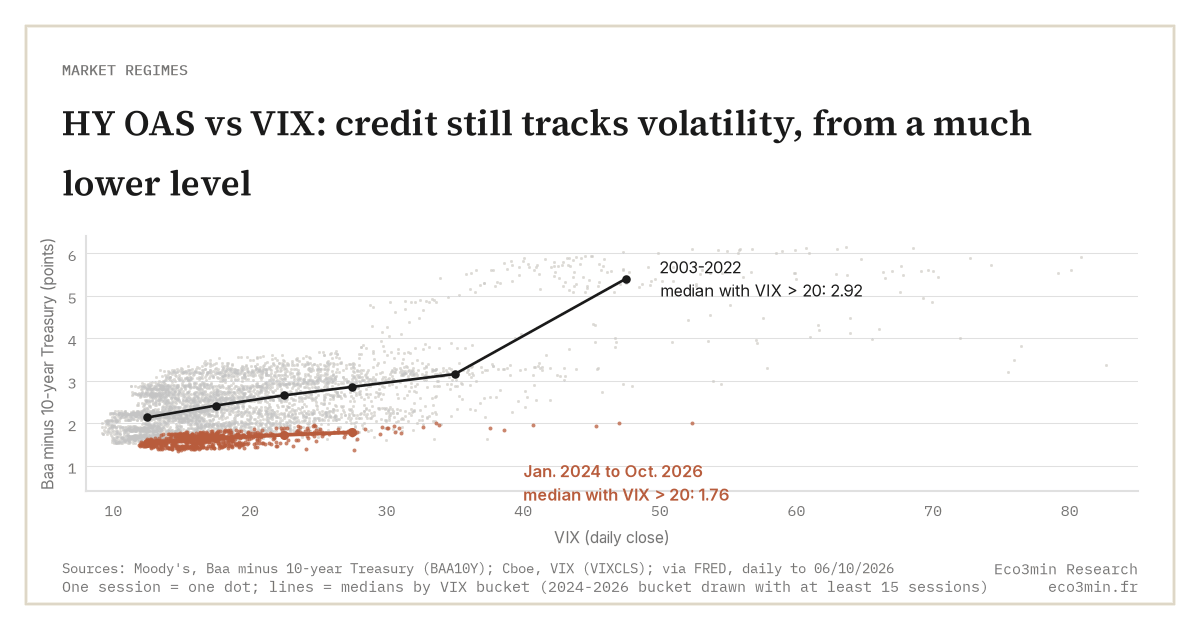
Moody’s series, which can be charted, makes the same point. With the VIX above 20, the median Baa spread has been 1.76 points since 2024, against 2.92 in 2003-2022. Fewer than 1% of that period’s stress sessions showed a Baa spread below 1.76. The shift holds in calm markets too: with the VIX between 10 and 15 the median is 1.55 points against 2.14, and with the VIX between 25 and 30, 1.79 against 2.86.
Two objections come to mind, and the data answer both. First, the pre-2023 median might be inflated by 2008 and 2020. Excluding September 2008 to June 2009 and March to June 2020, the median Baa spread with the VIX above 20 is still 2.74 points. Second, spreads were already very tight in 2004-2007. True in calm markets, but the stress sessions of those years still produced a median Baa spread of 2.10 points, above today’s level. The year 2023 sits in between, at 1.98.
The scatter at the top of this article shows the shift. The 2024-2026 points form a lower band than the 2003-2022 cloud across the whole observed range of the VIX.
Declaring a break between credit and volatility on the strength of a 90-session rolling correlation of levels. On 6 October 2026 it reads 0.11, but it already fell below 0.5 on one day in three between 2003 and 2022, because in calm markets both series barely move and the measure turns into noise. Daily changes over a long window, and the response to shocks, say more about the link between the two markets.
Two explanations, neither proven
The first is demand for credit. In its May 2026 Financial Stability Report, the Federal Reserve notes that corporate bond spreads remain at the low end of their historical range. The Fed’s asset valuations chapter puts leveraged loans at $1,549 billion at end-2025, up 9.2% on the year, against $1,772 billion and 4.7% for high-yield and unrated bonds. Those loans are the collateral of CLOs, securitisation vehicles the Fed describes as predominantly backed by them, whose post-2008 evolution widened the buyer base. The hypothesis rests on substitution: loans and bonds compete for the same issuers, so cheap loan funding tends to drag bond spreads down with it. If steady, price-insensitive demand absorbs risky paper, then the spread required for a given volatility falls. One fact cuts the other way: the Fed puts mutual funds focused on loans and high-yield bonds at about $362 billion in February 2026, 20% below their 2021 highs. Open-ended funds cannot carry the explanation alone.
The second points at the VIX. Same-day expiry options, or 0DTE, made up 59% of SPX options volume in 2025, 2.3 million contracts a day according to Cboe’s release of 6 January 2026. One reading holds that this activity distorts implied volatility. Yet the VIX methodology only uses options with more than 23 and fewer than 37 days to expiry. 0DTE contracts are outside the calculation, so any effect would be indirect. A Cboe study from September 2023 also found buy and sell flows in these options closely balanced. The role of 0DTE options in market swings is still debated.
What would undercut the demand reading: a lasting shock that sent the spread straight back to its pre-2023 levels for a given VIX. April 2025, with the VIX above 45 and the spread below 470 points, did not.
A marker for the next episode
The gauge can be built from two public series. The Baa spread is used rather than the high-yield index because Moody’s data can be reproduced with attribution, and because it tells the same story. Take the Baa spread on sessions when the VIX closes above 20 and compute its median over the past year. Around 1.8 points, credit remains in the regime seen since 2024. A move back towards 2.7 or 2.9 would mean the old relation between stress and credit premium had returned. In between, both explanations stay open. The high-yield spread as a recession signal keeps its value in changes, while the spread compression below 300 points describes its level. The open question lies elsewhere: whether a premium this low for the same stress still pays for default risk over a full credit cycle, recession included.
Last updated — 8 October 2026
Disclaimer – Financial and Legal Information: The analyses, commentary, and content published on eco3min.fr are provided for informational and educational purposes only. They do not constitute investment advice or a solicitation to buy or sell financial instruments. Past performance is not indicative of future results. All investment decisions involve risk and are the sole responsibility of the reader. Data, charts and calculated series are provided as is and may contain errors or lag behind their source: check any figure against the primary source cited before relying on it. Content describing laws, regulations or contracts reflects the law as of its publication date and does not constitute legal or tax advice; applying it to a specific situation requires a qualified legal or tax professional.
Read next
Full pillar →HY OAS: why this credit spread is a leading signal of recession and equity reversal
The HY OAS, published by FRED under code BAMLH0A0HYM2, bundles three risk premia (perceived default, liquidity, aggregate risk…
Weak or Strong Euro: Imported Inflation and Competitiveness
The euro's level acts on the area's economy through two opposing channels: it changes the price of imports,…
How to Read EUR/USD: What Moves a Currency Pair
EUR/USD is the price of one euro expressed in dollars: when it reads 1.14, one euro trades for…