
HY OAS as a leading indicator of the S&P 500: the credit-to-equities transmission mechanism

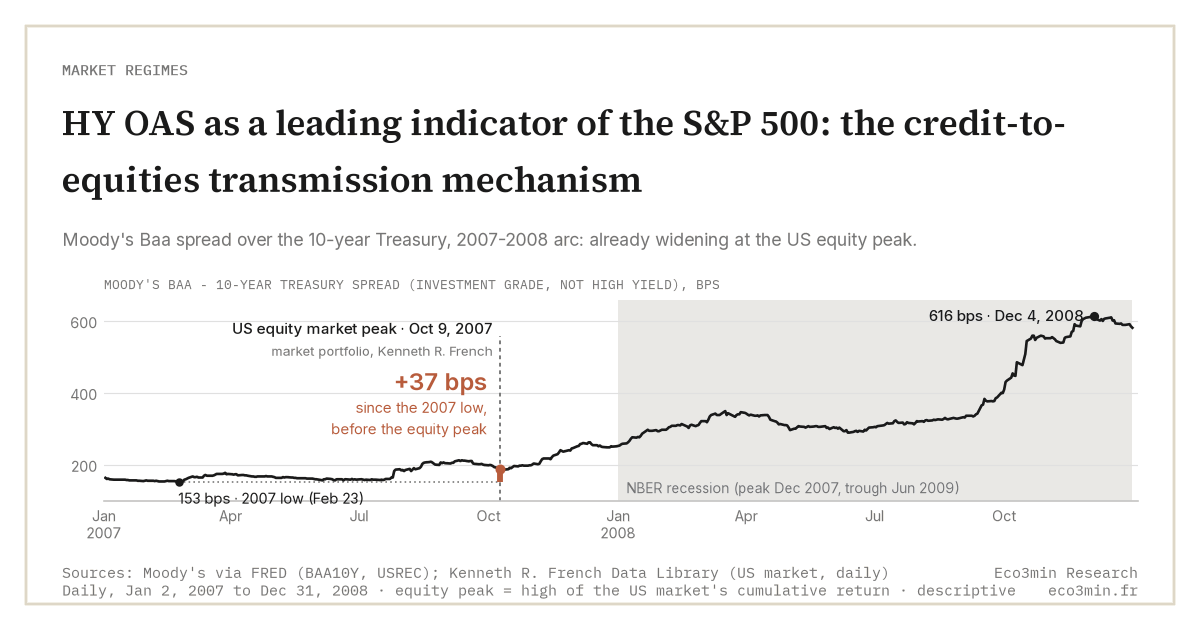
The observation that HY OAS widens before the S&P 500 is documented empirically across six episodes 1997-2025. Three concrete channels articulate this mechanism: refinancing cost, covenant triggers, equity-credit arbitrage. Their relative weights shift by regime.
TL;DR
Three channels carry HY OAS's lead over the S&P 500 (refinancing, covenants, equity-credit arbitrage); the covenant channel is the weakest of the three on bonds, because high-yield bonds carry incurrence covenants rather than maintenance covenants.
- Refinancing transmits slowly, because issuers actively push the maturity wall out when markets are open, so the interest-expense hit lags 2 to 4 quarters while equity analysts wait for quarterly prints.
- Equity-credit arbitrage transmits fast through hedge-fund flows and single-name CDS: across the 2007-2008 arc, HY OAS bottomed at 2.41% in June 2007 and the S&P 500 peaked on 9 October 2007 at 1,565.15, about four months of credit lead.
- Channel weights are regime-dependent: channel 1 leads in monetary tightening (2022), channel 3 in acute liquidity stress (March 2020 COVID), channels 1 and 3 but not 2 in concentrated sectoral stress (energy 2014-2015).
Observing a statistical regularity is not enough to understand it. This satellite isolates the three structural channels that cause HY-segment deterioration to precede equity deterioration, and discusses their respective contributions depending on shock type.
From Observed Fact to Articulated Mechanism
The empirical documentation of the six 1997-2025 episodes establishes the regularity: HY OAS widens several weeks ahead of the S&P 500 drawdown in nearly every case. But observation is not mechanism. For so regular a signal to emerge across six very different economic configurations (Asian external shock, dotcom valuation shock, GFC balance-sheet shock, commodity shock, health shock, monetary shock), structural channels must articulate the transmission, independent of the trigger.
Three distinct channels have been identified in market and academic literature: (1) transmission through refinancing cost, which pressures corporate margins before equity analysts have revised forecasts; (2) the triggering of bond covenants, which forces corrective actions that weigh on valuations; (3) equity-credit arbitrage run by certain hedge-fund structures, which adjust their books in mirror. No channel taken in isolation is sufficient to explain the empirical lead time, it is their combined action, in regime-dependent relative weights, that produces the observed regularity. Understanding why credit spreads widen in recessions at a fundamental level is the necessary backdrop to the three-channel decomposition that follows.
Channel 1: Refinancing Cost and Margin Impact
The first channel operates directly through issuer financing cost. When HY OAS widens, new issuance and refinancing of existing debt occur at higher spreads. Our HY OAS series tracks this measure across decades. The increase in marginal financing cost mechanically pressures total interest expense, and therefore the marginal EBIT of affected issuers.
Transmission Mechanics
For an HY issuer with a weighted-average debt maturity of around 5 years, a 200-basis-point spread move translates, per dollar of refinanced debt, into an interest-expense increase of roughly 200 bps annualized. Diffusion to total EBIT depends on the refinancing calendar. The share of HY debt maturing within twelve months is not stable: issuers refinance early whenever the market is open, which pushes the maturity wall out and spreads the diffusion. The impact on total interest expense lags by 2 to 4 quarters.
This temporal diffusion has an important consequence: at the moment the spread widens, corporate balance sheets do not yet reflect the future margin impact. Equity analysts, who rely on published accounts and corporate guidance, lack the elements to revise earnings forecasts downward. The bond market, by contrast, integrates that information immediately because spread repricing is forward-looking on default probability by construction.
Why Equity Analysts Revise Late
Lagged revision by equity analysts is not an individual flaw; it is a structural feature of the analytical function. Equity valuation models typically embed stable margin assumptions until proven otherwise, and proof arrives with quarterly publications. A spread deterioration is integrated into equity models only when the first corporate publication shows the interest-expense impact, typically 1 to 2 quarters after the actual spread widening. During that lag, the HY OAS decoupling is already visible and readable for anyone consulting the FRED series, while equity valuations continue to price a still-intact future.
The 2014-2015 energy episode provides a clean example: the energy HY OAS widening preceded by about 4 months the systematic downward revision of HY shale-major earnings forecasts by sell-side analysts, even though the EBITDA / interest-coverage ratio was already deteriorating in the Q4 2014 accounts published in February 2015.
Channel 2: Bond Covenants as Triggers
The second channel operates through contractual clauses in HY bonds. Some bonds contain covenants that trigger at specific spread levels or financial-ratio thresholds, forcing the issuer to take corrective actions: dividend cuts, buyback suspensions, asset sales, investment restrictions. Each of these actions has a direct impact on the issuer’s equity valuation, a suspended buyback removes equity support; an asset sale reduces the future EBIT base; a dividend cut deteriorates the yield premium for equity investors.
Structural Weakening of the Channel
This channel has always been the weakest of the three on the bond side, for a structural reason: a high-yield bond carries incurrence covenants, tested when the issuer acts, rather than maintenance covenants requiring the continuous preservation of financial ratios under penalty of technical default. But the composition of covenants in the HY segment has profoundly evolved since 2010, with the generalization of the “covenant-lite” segment. The covenant-lite statistic commonly cited, which moves from about a fifth of the market in 2007 to more than 90% today according to PitchBook LCD, describes the leveraged loan market rather than the bond market: it measures the disappearance of maintenance covenants from syndicated credits, that is, their convergence toward the bond standard. Transposing it to primary HY dates a weakening that, on bonds, never happened: it was there from the start.
This structural evolution has a visible effect: channel 2 transmits less stress today than it did before 2010, at equivalent spread deterioration. This does not mean the channel has disappeared, incurrence covenants (triggered not on maintenance but on issuer actions) remain largely present, and some bonds still carry strict maintenance covenants. But the relative weight of channel 2 in the aggregate transmission mechanism has declined over the past fifteen years. A broader view: the early-warning signals that precede stress.
An analyst leaning on pre-2010 empirical regularities without accounting for this covenant-lite dilution can overestimate the expected weight of channel 2 in a contemporary stress episode. This is one of the reasons why the overall mechanism may carry a different signature today than during the 1997-2009 episodes. Related framing: how LEI and PMI compare.
Channel 3: Equity-Credit Arbitrage as Accelerator
The third channel operates through active positions held by certain hedge funds that treat an issuer’s equity and debt as two derivatives of the same underlying asset (the firm). When an issuer’s credit spread deteriorates, these structures adjust their equity exposure in mirror, typically by reducing longs or initiating shorts, anticipating that credit deterioration will eventually transmit to equity valuations.
Why This Channel Accelerates
Unlike channels 1 and 2, which produce slow-transmission fundamental effects, channel 3 produces a direct and rapid market effect. Equity-credit hedge funds are not a majority share of HY or equity markets, but their activity concentrates on issuers where the credit signal is sharpest, precisely the issuers whose deterioration is most likely to diffuse. Their action in the first weeks of a spread widening can represent a disproportionate fraction of outflows on certain stocks, amplifying the price move before fundamentals are even published.
The 2008 Lehman episode provides the most striking illustration: Lehman’s CDS spread had widened massively several weeks before the equity’s intra-day peak (June-July 2008), and the short flows identified ex post show concentrated equity-credit activity in that window. The 2015 energy episode showed a similar pattern on shale majors: spread widening in late 2014, hedge-fund position adjustments in the following weeks, then marked equity declines.
The Role of CDS as Accelerator
Single-name Credit Default Swaps play a particular role in this channel. They allow arbitrageurs to express a bearish view on an issuer’s credit without having to short-sell the bond (which is technically difficult for corporate bonds). A CDS that widens before the cash bond signals credit-arbitrage activity; a CDS that widens jointly with short activity on the stock precisely signals channel 3 in action. The CDS / cash bond / equity triangulation on a given issuer is the reference instrument for identifying channel 3 activation.
Relative Channel Weights by Regime
No channel dominates in all circumstances. Their relative weight depends on the macro regime and the nature of the shock.
In monetary-tightening regimes (such as 2022), channel 1 dominates: rising nominal rates diffuse mechanically into refinancing costs, and that diffusion carries the bulk of the credit-to-equity transmission. In acute liquidity-stress regimes (March 2020 COVID), channel 3 temporarily dominates: the near-instantaneous HY/equity synchronization observed during the shock reflects the immediate activity of arbitrage structures rebalancing their books simultaneously across both markets. In sector-concentrated default regimes (energy 2014-2015), channels 1 and 3 operate jointly while channel 2 remains relatively muted: the energy HY segment has been largely covenant-lite since 2012, limiting propagation through that channel.
For pre-2010 historical episodes, such as the extreme illustration in 2008-2009, all three channels operated at full strength, in a combination that probably will not be reproduced identically because channel 2 has structurally weakened.
By contrast, the current regime challenging the mechanism, one of durable spread compression below 300 basis points, has not yet activated the transmission. The three channels are on standby, awaiting a widening signal that may or may not reproduce historical regularities. The HY OAS as a leading reversal signal in the cycle belongs to this family of cross-market leading indicators, whose common function is to capture tensions before they diffuse across asset classes.
- The HY OAS lead time over the S&P 500 documented across 1997-2025 rests on three structural channels: refinancing cost, covenant triggers, equity-credit arbitrage.
- Channel 1 (refinancing) operates with slow diffusion (2 to 4 quarters); channel 2 (covenants) operates through discrete actions; channel 3 (arbitrage) operates with rapid diffusion via hedge-fund flows and CDS.
- Channel 2 is the weakest of the three on the bond side: the covenant-lite dilution usually invoked describes leveraged loans, whereas high-yield bonds have carried incurrence covenants from the start.
- The three channels carry regime-dependent weights: channel 1 dominant in monetary cycles, channel 3 dominant in acute liquidity stress, channels 1+3 but not 2 in concentrated sectoral stress.
Last updated — 6 October 2026
Disclaimer – Financial and Legal Information: The analyses, commentary, and content published on eco3min.fr are provided for informational and educational purposes only. They do not constitute investment advice or a solicitation to buy or sell financial instruments. Past performance is not indicative of future results. All investment decisions involve risk and are the sole responsibility of the reader. Data, charts and calculated series are provided as is and may contain errors or lag behind their source: check any figure against the primary source cited before relying on it. Content describing laws, regulations or contracts reflects the law as of its publication date and does not constitute legal or tax advice; applying it to a specific situation requires a qualified legal or tax professional.
Read next
Full pillar →HY OAS: why this credit spread is a leading signal of recession and equity reversal
The HY OAS, published by FRED under code BAMLH0A0HYM2, bundles three risk premia (perceived default, liquidity, aggregate risk…
Weak or Strong Euro: Imported Inflation and Competitiveness
The euro's level acts on the area's economy through two opposing channels: it changes the price of imports,…
How to Read EUR/USD: What Moves a Currency Pair
EUR/USD is the price of one euro expressed in dollars: when it reads 1.14, one euro trades for…