Why Index Performance Depends Less and Less on Companies
Index performance increasingly reflects flow concentration and weighting mechanics rather than the average health of listed companies. A structural reading of signal neutralisation and late-cycle dispersion in equity markets.

The near-uninterrupted rise of major equity indices sustains a stubborn conviction: if the CAC 40 or the S&P 500 advance, it must be because the companies that compose them are doing well. This equation, long verified during synchronised expansion phases, no longer holds in today’s world.
TL;DR
Major indices now track flow concentration more than corporate health, as cap-weighting and passive ETF flows funnel capital into a handful of mega caps regardless of fundamentals.
- Passive management amplifies the distortion: ETF and index flows funnel capital toward the same heavily weighted names for their index weight, not better fundamentals, loosening the link between equity and economic performance.
- Late in the cycle, real rates filter future cash flows and liquidity turns selective, so performance narrows from broad market exposure to a handful of locomotives while a growing share of the listed universe stalls.
When Markets Tell a Story Companies No Longer Live
More and more often, the trajectory of indices no longer reflects the operating reality of listed companies. The signal sent by these benchmark barometers weakens, blurs and ends up detaching itself from what is actually happening on company books. This gap is neither a passing anomaly nor a statistical illusion: it reveals a deep mutation in the very mechanics of markets.
To grasp why equity performance depends less and less on the health of companies, one must abandon the superficial reading of charts and examine the drivers of this disconnection: signal neutralisation, informational saturation, extreme concentration of performance. The point is not to predict a collapse, but to understand a regime shift in how markets digest and redistribute information.
This approach extends the analyses developed on the Equities and ETFs pillar page, which aims precisely at distinguishing the apparent performance of indices from the economic and financial reality of the companies that compose them, as well as from the allocation and concentration mechanisms specific to index vehicles.
This analysis builds on institutional work devoted to market concentration, performance dispersion and end-of-cycle dynamics, as analysed by the Bank for International Settlements, the IMF and the ECB in their studies on financial stability and market structure.
The Mirage of Index Synthesis
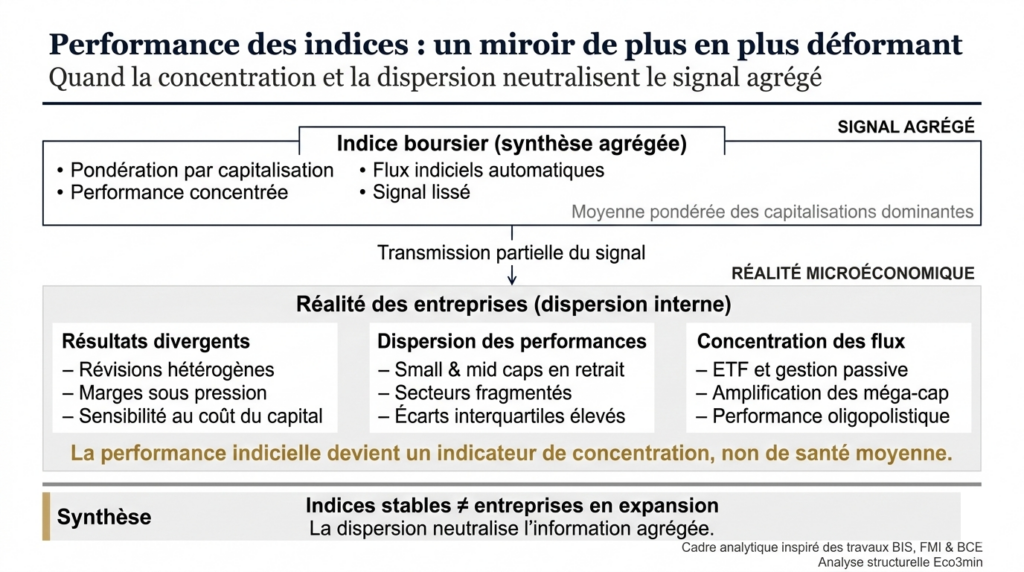
Equity indices were invented to offer a snapshot of the state of the market. Cap-weighted, adjusted for distributions, recalculated in real time, they compress into a single number a mosaic of information on hundreds of companies. As long as the latter move in a common direction, the synthesis retains all its relevance.
But when trajectories diverge, the index gradually loses its capacity to reflect reality. The average crushes the gaps, and weighting compounds this distortion. The mega caps, by sheer size, dictate the general direction without the rest of the market necessarily following. Index performance then becomes a distorting mirror.
Passive management amplifies this phenomenon. The massive rise of ETFs and index strategies funnels flows of capital towards the same names, not because they show better fundamentals, but simply because they carry heavy weight in the indices. The umbilical cord between equity performance and economic performance mechanically loosens.
This progressive distortion of the equity signal fits within the passive and index management revolution, where index performance increasingly reflects the mechanics of flows and weights rather than the aggregate value creation of companies.
When Information Cancels Itself Out
This disconnection does not mean microeconomic information has disappeared from the radar. It means this information cancels out at the aggregate level. The signals still exist, but they no longer point in the same direction. Good and bad news cohabit without producing a clear trend.
One must distinguish here between noise and saturation. Noise is erratic, often short-lived, volatility. Informational saturation, by contrast, sets in over time. It arises when the market simultaneously absorbs contradictory data without managing to rank them. The index keeps fluctuating, but its moves no longer faithfully summarise the situation of companies.
The Blind Spots of Indices
Indices still measure performance, but they no longer capture the dispersion of risks, the fragility of the most vulnerable business models or the growing divergence of earnings trajectories. They project a smoothed image of a market whose foundations are cracking.
The Signature of Late Cycles
This dissociation between indices and companies typically appears late in the economic cycle. At this stage, growth slows without collapsing, margins cease to expand uniformly, and the cost of capital becomes a ruthless selection factor again. The market is no longer carried by a homogeneous macroeconomic dynamic, but pulled by antagonistic forces.
Real rates occupy a central place in this shift. Their level directly conditions the valuation of future cash flows and operates as a filter between companies able to absorb this cost and those whose profitability wavers.
Liquidity, still apparently abundant, becomes more selective. It concentrates on the segments deemed most solid, mechanically fuelling the concentration of index performance.
From Broad Exposure to Oligopolistic Performance
In early cycle, mere market exposure is generally enough to capture most of the upside. In late cycle, this logic exhausts itself. Performance becomes the preserve of a handful of locomotives, while a growing fraction of the listed universe stalls or slips.
Corporate Earnings: The Great Divergence
Earnings releases starkly illustrate this fracture. Profit trajectories are no longer synchronous. Some companies keep delivering legible and predictable growth, while others sink into a silent erosion. At the index level, these moves partly offset.
This dynamic is dissected in the article on earnings surprises, which shows how the dispersion of beats and misses can amplify without prompting a clear directional reaction from indices. The market integrates the information but no longer converts it into a univocal signal.
Sectors themselves become heterogeneous from the inside. Even compartments reputed to be defensive now harbour radically opposed trajectories, rendering any global sectoral reading obsolete.
The Amplification Effect of Weighting
Cap weighting exacerbates this phenomenon. A handful of giants is enough to orient the performance of the index, regardless of the health of the rest of the listed universe. The apparent stability of the index can thus coexist with diffuse deterioration.
Decoding the Regime Rather Than Guessing the Direction
The dissociation between indices and companies is neither a leading indicator of a crash nor a market-timing tool. It constitutes above all a reading grid for the market regime. It signals that risk no longer resides in aggregate averages but in the internal architecture of the market.
In such an environment, strategies anchored solely on indices become less informative. They capture concentrated performance but obscure the growing fragmentation of risks and opportunities.
This regime can persist. As long as macroeconomic forces neutralise each other without resolving, as long as the cost of capital continues to discriminate without triggering a systemic break, index performance can remain durably disconnected from the average reality of companies.
When microeconomic dispersion neutralises aggregate information on value creation, index performance ceases to measure the health of companies and becomes an indicator of flow concentration.
Conclusion — What Indices No Longer Say
Index performance depends less and less on companies, not because the latter have lost their importance, but because their signals neutralise each other in a market saturated with contradictory information. Indices keep functioning, but the nature of their message has changed.
This reading grid rests on the observation of concentration and dispersion regimes documented by the institutional literature on financial market structure.
In this context, the relevant reading is no longer directional but structural. Understanding what indices now leave unsaid becomes as crucial as analysing what they keep displaying. It is in this capacity to decode the internal fragmentation of markets that the intelligence of financial cycles plays out today.
Last updated — 20 September 2026
Disclaimer – Financial Information: The analyses, commentary, and content published on eco3min.fr are provided for informational and educational purposes only. They do not constitute investment advice or a solicitation to buy or sell financial instruments. Past performance is not indicative of future results. All investment decisions involve risk and are the sole responsibility of the reader.
Read next
Full pillar →Equal-Weight ETFs: The Quiet Signal Behind Rising Indices
Equal-weight ETFs reveal the true health of the equity market behind mega-cap-driven indices. Their gap with cap-weighted ETFs…
Smart Beta ETFs: The Hidden Risk Behind Factor Performance
Smart beta ETFs now hold ~15-20% of global equity ETF assets. Stacking factor exposures often rebuilds hidden concentration…
Equity Profit Warnings: Risk and Opportunity After the Alert
Profit warnings have become accelerated stress tests in a higher-cost-of-capital regime. How equity risk reconfigures and where structural…