Why Every Investment Strategy Has Structural Limits
Every investment strategy carries structural limits tied to economic regimes and uncertainty. Frameworks remain operational within a given range, but their bounds surface as regimes gradually shift the conditions under which they hold.

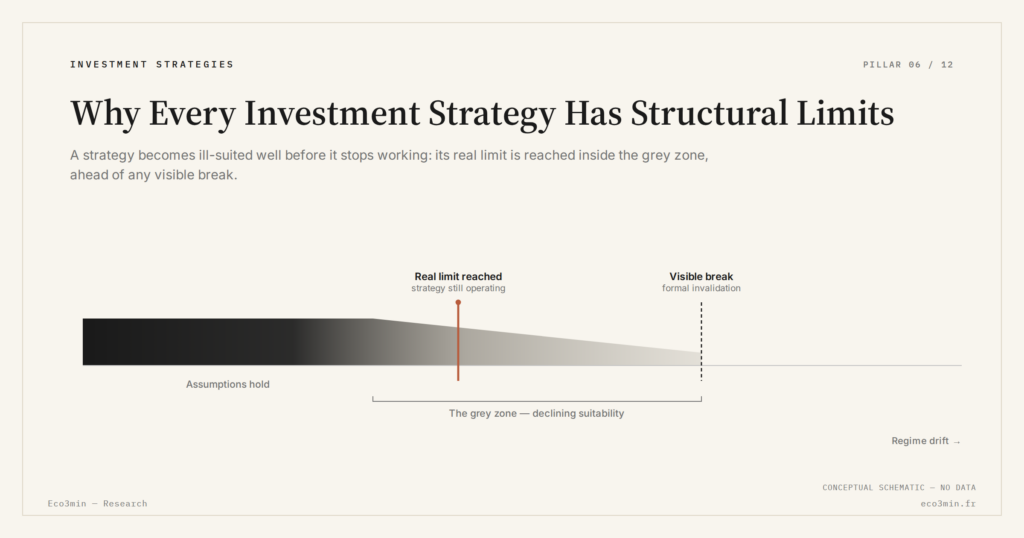
Why every investment strategy carries structural limits tied to economic regimes and uncertainty.
TL;DR
Every investment strategy rests on conditional assumptions whose validity shrinks as regimes drift, losing effectiveness through accumulating friction long before any visible macro break. On this point: our analysis of reading the economic cycle for portfolio positioning.
- Every framework assumes relative regime stability, consistent correlations and a long-enough horizon to absorb deviations, premises that hold only conditionally.
- Limits surface as accumulating friction (volatility harder to interpret, wider outcome dispersion) before any macro assumption is invalidated; 2022–2024 equity volatility ran ≈18–25%, against ≈10–12% over 2013–2019.
- When cycles shorten or turn erratic, the window over which a strategy can be assessed contracts, narrowing its domain of validity without making the framework wrong.
No strategy operates continuously and without friction. Economic regimes evolve and shift the reference points on which existing frameworks rest. That drift renders certain strategies temporarily ill-suited. Searching for a universal approach often slides into a dogmatic reading. Many still confuse structural limits with strategic failure. Recognising these limits clarifies what a strategy can actually do in the face of uncertainty.
The quiet mechanism that bounds every strategy
Every strategy rests on a set of implicit assumptions: relative regime stability, consistent correlations, a horizon long enough to absorb deviations. These assumptions are not wrong in themselves, but they are conditional. When the context shifts, the strategy does not stop working at once — it gradually becomes less suited.
This drift is rarely abrupt. It manifests through rising friction: volatility that becomes harder to interpret, wider dispersion of outcomes, weaker readability between decisions and outcomes. The limit is not a clean break but a grey zone where the strategy still operates without being fully effective.
At this stage, the difficulty is no longer simply whether the strategy still works, but what the observed results actually say about the underlying framework. When regimes become unstable, the central question becomes one of trajectory readability, often blurred by isolated performance points that no longer reflect the consistency of the process.
Why the consensus tends to underestimate these limits
Part of the consensus holds that a well-designed strategy remains valid as long as its core macroeconomic assumptions are not invalidated. Dominant projections assume that necessary adjustments are marginal and can be integrated without overhauling the broader framework.
The analysis diverges on one key point: limits often appear before any explicit macro invalidation. Between 2022 and 2024, annualised volatility on major equity markets stayed around ≈18–25 %, against ≈10–12 % over the 2013–2019 window. In that environment, a strategy can remain coherent on paper while becoming difficult to maintain operationally — simply because its tolerance margins are reached more frequently.
Limits tied to time, not only to markets
Most strategies assume a minimum application period for their mechanisms to play out. That temporal dimension is often overlooked. When cycles shorten or become more erratic, the effective window over which a strategy can be assessed contracts.
This does not mean the strategy is « bad », but that its domain of validity has shrunk. Eco3min lays this out in the analysis of strategy before performance, which shows that observed performance is always a delayed consequence, and that this latency itself becomes a constraint when regimes shift faster.
Why the question has become more acute
Since 2023, the persistence of elevated policy rates has reshuffled the hierarchy of constraints. With the cost of capital remaining above pre-2020 levels, arbitrages have shifted without producing long, readable trends. In 2025, several asset classes alternated rebound phases and rapid corrections within a few months.
In this environment, the structural limits of strategies surface earlier — not because the frameworks are invalid, but because regimes demand greater tolerance for deviation and more temporal patience.
What many are really trying to understand
The real question is not whether a strategy is still « good », but whether its current limits stem from regime noise or from a deeper change. Behind that question often sits a simpler concern: applying a framework that has quietly become unsuited without realising it.
Identifying the limits helps separate what belongs to a transitional phase from what signals a lasting shift in the conditions of application.
Counter-reading and break variables
This analysis assumes regimes evolve gradually. A major exogenous shock, a sharper-than-expected monetary tightening or a regulatory break can invalidate certain frameworks more quickly. Conversely, a faster normalisation of financial conditions would temporarily widen the validity range of strategies currently constrained.
Observable economic implications
For markets, these limits translate into faster style rotation and wider performance dispersion. This rotation inflation is also examined in our study on the discipline–performance pairing. For companies, they explain why some financial policies remain coherent yet produce more uneven results. For households, they shed light on the difficulty of interpreting trajectories that alternate favourable phases and stagnation periods without a clear signal.
Within the architecture of investment strategies, recognising the limits is not an admission of weakness — it is a precondition for a realistic reading of trajectories over time.
- Every strategy rests on conditional assumptions with a bounded domain of validity.
- Limits often emerge through an accumulation of frictions before any visible macro break.
- Recognising these bounds sharpens the reading of trajectories without dismantling the broader framework.
Last updated — 12 July 2026
Disclaimer – Financial Information: The analyses, commentary, and content published on eco3min.fr are provided for informational and educational purposes only. They do not constitute investment advice or a solicitation to buy or sell financial instruments. Past performance is not indicative of future results. All investment decisions involve risk and are the sole responsibility of the reader.
Read next
Full pillar →Beneficiary Designations, the Step-Up in Basis, and the 10-Year Rule: How US Accounts Transfer at Death
At death, most US financial accounts pass outside the will, straight to a named beneficiary, under tax rules…
The Fee Stack in Variable Annuities: M&E Charges, Riders, and Subaccount Costs
A variable annuity does not carry one fee, but a stack of them. Mortality and expense charges, subaccount…
The Conventional 401(k)-Match-First Funding Order: Where It Comes From, How It Works
The question of what order to fund accounts in usually draws a fixed list, presented as a rule…