Borrowing for 20 Years: When Time Turns Risk Into Leverage
A 20-year fixed-rate mortgage locks a nominal cost while inflation erodes real debt. Time progressively reshapes the structure of patrimonial risk.

A 20-year fixed-rate mortgage locks a nominal cost while inflation erodes real debt. Time reshapes the structure of patrimonial risk.
TL;DR
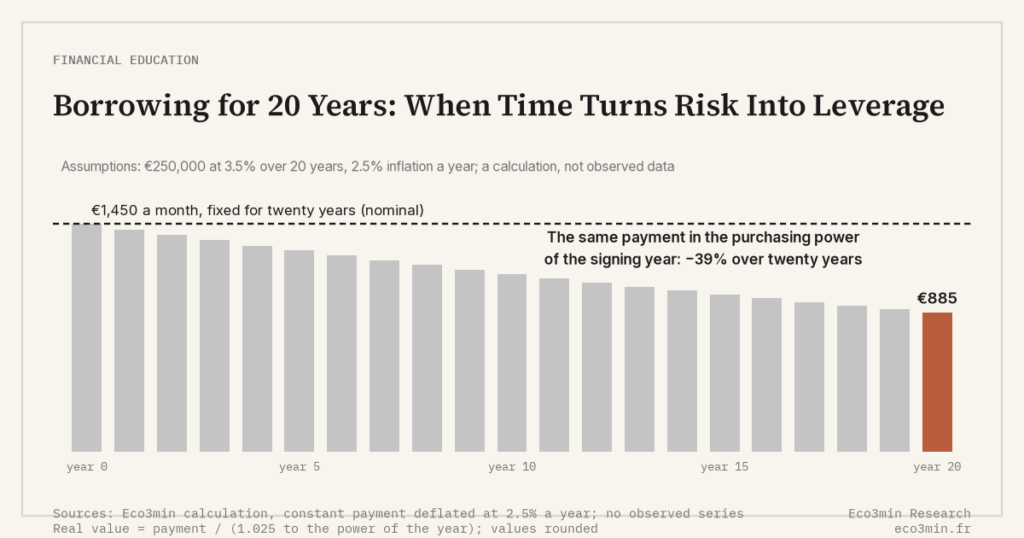
A €250,000 fixed-rate loan at 3.5% keeps a €1,449 monthly payment for 20 years, but 2.5% inflation cuts its real weight to about €870 by year 20.
- In France over 98% of retail mortgages are fixed-rate (Observatoire Crédit Logement, Q3 2025), locking the borrower's cost while prices, incomes and inflation keep moving.
- At 2.5% annual inflation, cumulative 63% over 20 years shrinks the €250,000 borrowed to roughly €153,000 in the purchasing power of the subscription year.
- The effect activates only after seven to eight years of holding (entry costs run 7-8% on existing property) and assumes stable income and a steady local market — French prices fell 5-15% in some metros between 2022 and 2024 (Notaires-INSEE, Q4 2024).
A 20-year fixed-rate mortgage locks a nominal cost in an environment where prices, incomes, and inflation continue to evolve. Over time, the real monthly payment — inflation-adjusted — declines, while the value of the property may follow a trajectory different from that of the residual debt. This mechanism progressively transforms borrowing into patrimonial leverage, provided the holding period is sufficient. Risk lies not in the debt itself but in any mismatch between the duration of the commitment and the capacity to carry it. Long-term debt is therefore closer to a structural position than to a bet.
The fixed rate: an asymmetric position over time
In France, almost all retail mortgages are fixed-rate — above 98% according to data from the Observatoire Crédit Logement (Q3 2025). This choice, atypical in the European landscape where variable rates dominate in many countries (Spain, the United Kingdom, Nordic countries), creates a fundamental asymmetry: the borrower locks in their financing cost while the surrounding economy keeps moving.
Concretely, a 20-year mortgage taken out at 3.5% in 2025 produces a fixed nominal monthly payment of €1,449 on a principal of €250,000. If inflation runs at 2.5% per year — an order of magnitude consistent with ECB medium-term projections (December 2025) — the real monthly payment drops from €1,449 in year 1 to roughly €1,120 in year 10, then to €870 in year 20, in constant euros. The weight of the debt in the household budget declines mechanically, with no renegotiation or intervention.
It is in this context that rate-cycle transitions take their full meaning: the rate regime in force at the moment of subscription conditions the magnitude of this effect over the entire duration.
Real-debt erosion: the central mechanism
Borrowed capital is nominal. Inflation reduces its real value over time. Over twenty years, with cumulative inflation of 63% (assuming 2.5% per year), the €250,000 borrowed represent only around €153,000 in the purchasing power of the year of subscription. The borrower repays in eroded euros a principal fixed in earlier euros.
In parallel, the value of the property tends — over long periods — to track inflation at least partially. According to the Notaires-INSEE indices (Q3 2024), French residential real estate prices rose on average 3.2% per year in nominal terms between 2000 and 2024. This trajectory is neither guaranteed nor linear — the corrections of 2008-2009 and 2023-2024 are reminders — but over a full 20-year cycle, the historical pattern shows nominal appreciation above inflation.
The combined effect is structural: real debt declines, the value of the collateral rises in the central scenario, and net wealth — the difference between property value and outstanding debt — increases progressively. This dynamic is precisely what transforms initial borrowing into patrimonial leverage, and it explains why debt in the reading of the patrimonial balance sheet does not carry the same meaning at the start and at the end of the loan.
- Reasoning about mortgage debt in nominal terms without integrating inflation erosion — the real burden falls, even when the displayed monthly payment stays constant.
- Treating long-term borrowing as a static risk, when its profile evolves structurally with time, inflation, and progressive principal repayment.
The conditions for leverage to activate
The mechanism is not automatic. It rests on several conditions which, if not met, can reverse the dynamic.
The first is holding period. The leverage effect only fully manifests after an initial phase during which entry costs — 7 to 8% on existing property — and the high interest share of early monthly payments weigh on the balance sheet. A borrower who sells before seven to eight years often ends in a neutral or even negative position once costs and the composition of repayments are integrated.
The second condition is income stability. A fixed-rate loan protects against rate increases — but not against income decline. The debt-service ratio remains indexed to current income. An employment shock early in repayment, when outstanding principal is still high, can turn leverage into a liquidity trap.
The third is local market evolution. Real estate is not a uniform market. Between 2022 and 2024, prices fell 5 to 15% in some major French metropolitan areas (Notaires-INSEE data, Q4 2024), while holding steady in others. A borrower exposed to a correcting market suffers a deterioration in their loan-to-value ratio — leverage then operates in reverse.
Why long-term borrowing is neither risk nor advantage in itself
The binary reading — “debt is good” versus “debt is dangerous” — misses the essential. Fixed-rate mortgage debt is a structural position whose risk profile evolves over time. At the start of repayment, the borrower stands in a position of maximum vulnerability: high outstanding balance, low net wealth, recent unamortized fees. At the end, the situation has reversed: low residual balance, high net wealth, real monthly payment lightened by inflation.
This transformation is not a financial gain in the conventional sense. It results from the mechanical combination of time, inflation, and the fixity of nominal cost. The borrower does not earn money — they see the structure of their balance sheet shift progressively. This logic of transformation links long-term debt to long-horizon investment logic rather than to a simple financing operation. In the same vein: our breakdown of the assumption-stress tools.
Fixed-rate mortgage debt is a temporal position — its risk profile after ten years bears little resemblance to that on the day of signing. Judging debt without integrating this dynamic is photographing a process in motion.
Current conditions illustrate this ambivalence. With nominal rates around 3.3% in early 2026 (Observatoire Crédit Logement, January 2026) and inflation stabilizing below 3%, the margin for real erosion is narrow but positive. Today’s borrower benefits from less powerful leverage than the one who borrowed at 1.5% in 2021, yet from a more resilient position should rates rise again, since their cost is already locked at a level that integrates the recent restrictive cycle.
This type of patrimonial reasoning belongs to the broader framework of structural patrimonial arbitrages in which each decision simultaneously commits a horizon, a risk, and an opportunity cost.
- A fixed-rate loan locks a nominal cost; inflation erodes real debt and lightens the monthly payment in constant euros, progressively transforming the risk profile.
- Leverage only activates after a minimum of seven to eight years of holding and presupposes income stability and a local market that does not turn.
- Long-term borrowing is neither a risk nor an advantage in itself — it is a structural position whose balance sheet shifts with time.
Last updated — 20 September 2026
Disclaimer – Financial Information: The analyses, commentary, and content published on eco3min.fr are provided for informational and educational purposes only. They do not constitute investment advice or a solicitation to buy or sell financial instruments. Past performance is not indicative of future results. All investment decisions involve risk and are the sole responsibility of the reader.
Read next
Full pillar →Series I and EE Savings Bonds: Locked Formulas in a Moving Rate World
US savings bonds lock a rate formula at the moment you buy them, for the life of the…
Where the Livret A’s Money Goes: The Caisse des Dépôts Circuit and Social-Housing Finance
The savings held on Livret A accounts do not sit idle. A regulation-set share is centralised at the…
France’s LEP vs the Livret A: A Means-Tested Higher Rate, Explained
France’s Livret d’épargne populaire is often described as "the Livret A, only better". The description misleads: the LEP…